
Can You Tow an EV to a Charging Station? The Flatbed Rules by Brand

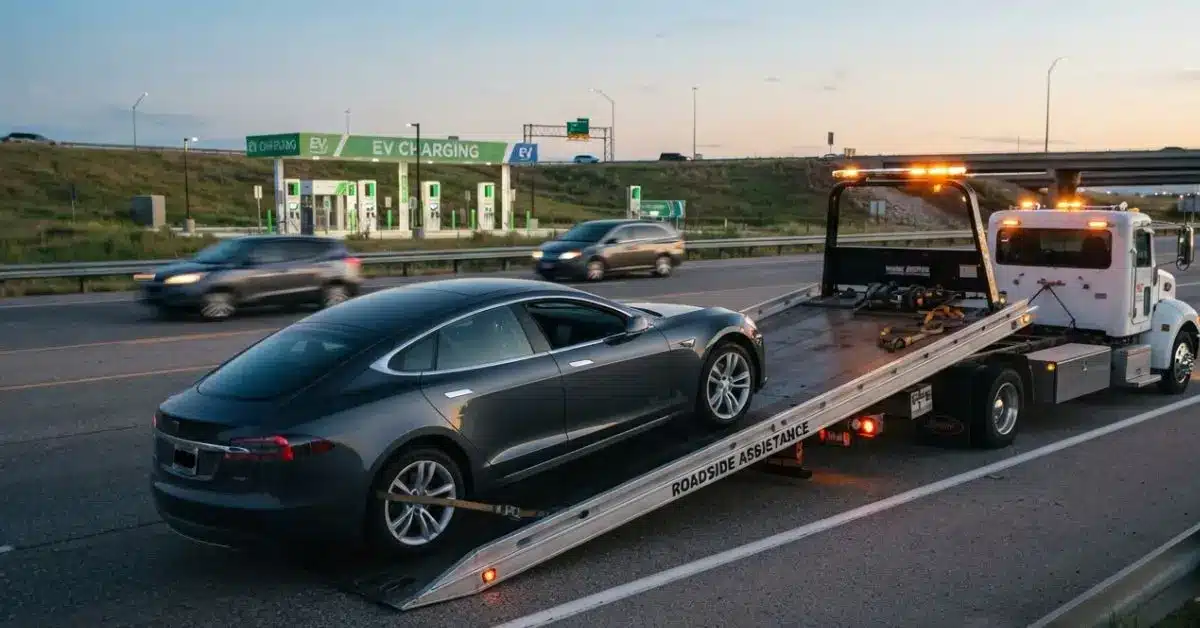
A dead EV on the roadside raises one urgent question — can a tow truck just take it to a charger? Yes, but only one way is safe. Here’s the short answer, then the rules by brand.
Yes — a dead EV can be towed to a charging station, and the manuals say the tow should end at the nearest one. The catch is how: the car must travel on a flatbed (or on dollies) with all four wheels off the ground. Never let it be dragged with its drive wheels rolling — that can damage the motor and, in the makers’ own words, start a fire.
- Flatbed: always right, for every EV
- The one real exception: Ford’s emergency rule (Mach-E, 35 mph / 50 miles, below)
Can you tow an EV to a charging station?
Yes — and that is exactly where the tow is supposed to go. Tesla’s own manual tells the tow provider to deliver a car that ran out of range to the nearest charging station and unload it within reach of the charging cable.
This is the part people get wrong in both directions. Some assume a dead EV must go to a dealer; others assume any tow truck will do. Neither is true. Roadside services treat “to a charger” as a normal destination — AAA’s roadside page puts it in one line: they will “deliver fuel or tow your EV to a charging station.” The destination is easy. The method is the whole ballgame, and it is the subject of the rest of this page.
Where should the truck take you? To a charger you can actually use — ideally a DC fast charger, so twenty minutes plugged in gets you home, and one your car can connect to without an adapter hunt. Our guide to how public EV charging works covers finding and using one if this is your first time.
Why can’t an EV be towed like a petrol car?
Because in an EV the wheels and the motor are never truly disconnected. Roll the drive wheels and you spin the motor — and a spinning EV motor generates electricity whether the car is switched on or not.
A petrol car in neutral freewheels; its gearbox separates the wheels from the engine. An EV’s single-speed reduction gear keeps motor and wheels mechanically linked. Kia’s manual states the consequence without softening it: tow with the drive wheels on the ground and “the vehicle motor may generate electricity and the motor components may be damaged or a fire may occur.” Rivian’s tow guide uses the words “Fire Hazard” and adds the financial sting: damage caused by improper towing is not covered under warranty. Tesla’s manual gives the same instruction from the other direction — the motors “generate power when the wheels spin,” so all four tyres stay off the ground, always.
Neutral does not save you. Selecting N on most EVs does not uncouple anything mechanical; it only changes what the electronics do. That is the single most expensive misunderstanding in this whole subject.
What do the manufacturers actually say?
Five makers, five versions of the same rule — with exactly one genuine wheels-down exception among them, and it belongs to Ford.
| Brand / model | The rule | The only exception |
|---|---|---|
| Tesla Model 3/Y | Flatbed; all four tyres off the ground | Wheel lifts + dollies (wheels still off the ground), max 35 miles |
| Ford Mustang Mach-E | Flatbed, or wheel lift + dollies; no wheels on the ground | Emergency flat-tow: all wheels down, in N, max 35 mph, max 50 miles |
| Hyundai Ioniq 5 | Flatbed or dollies recommended | 2WD cars: front wheels may roll with the rear lifted; AWD: none |
| Kia EV6 | Flatbed or dollies; never tow with rear wheels down | Repositioning only: 33 ft at 3 mph or less |
| Rivian R1T/R1S | Flatbed only | None |
Read the exceptions column carefully, because the internet routinely scrambles it. Tesla’s “35 miles” is a limit on dollies — the wheels are still off the ground. Hyundai’s small print is about rolling the car a few feet to load it, not travelling on it. Only Ford publishes a true emergency flat-tow allowance, for the Mach-E, and even Ford frames it as the last resort when no flatbed or wheel-lift exists.
What about the F-150 Lightning?
Honestly: unverified here. Ford’s own manual pages for the Lightning serve no manual at all, and we do not print towing rules we cannot read in the maker’s own document. The Mach-E rule above is Ford’s current published EV position; Lightning owners should follow the manual in the truck (and in FordPass) until Ford’s site serves the document again. If your Lightning needs a tow today, asking for a flatbed is the choice that cannot be wrong for any EV.
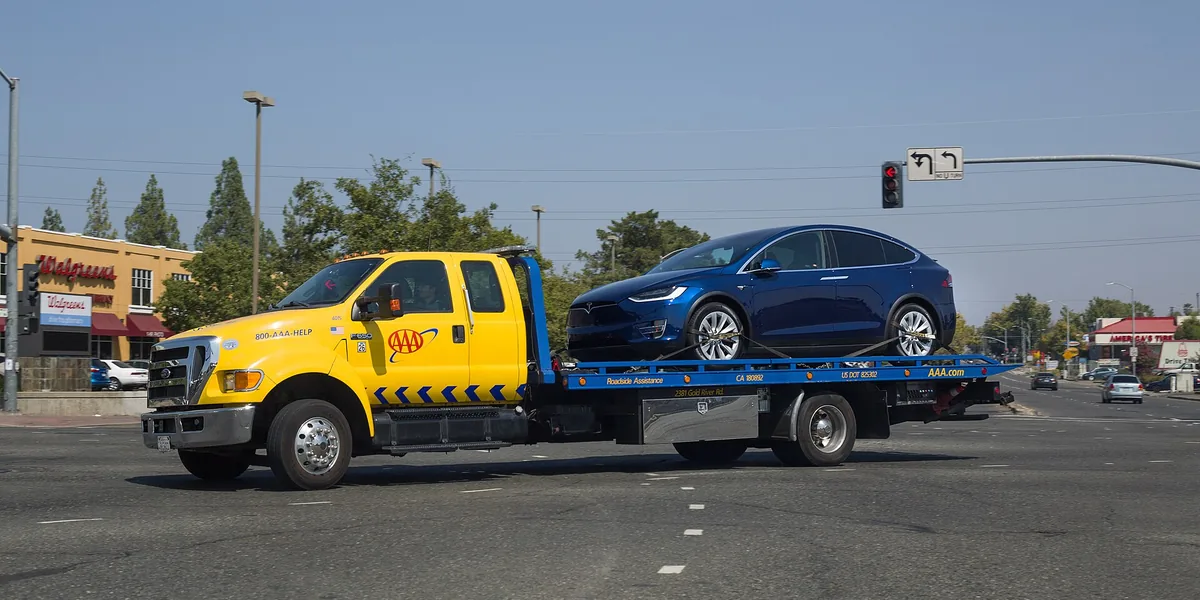
How the tow actually works, step by step
The five minutes you spend on the phone decide whether this ends as an inconvenience or a repair bill.
- Ask for a flatbed, by name. When you call roadside assistance, say “electric vehicle, flatbed required.” If a hook-and-chain or sling truck arrives, decline it — every manual above prohibits sling-type towing.
- Tell them it is an EV before they dispatch. Some operators carry dollies as the backup method; they can only bring them if they know.
- Put the car in its tow/transport mode if it still has power. This releases the parking brake and lets the wheels rotate slowly for winching. Tesla’s Tow Mode, for example, allows under 5 mph for less than 30 feet — it exists for loading, not travelling.
- Choose the destination: the nearest usable charger, and ask to be unloaded within cable reach of it, exactly as Tesla’s manual prescribes.
- If the car is completely dead — doors and screens dark — expect a 12-volt jump first. A flat 12V battery can stop an EV being loaded or charged even when the main pack is the real problem; our guide to EV 12-volt batteries explains why the little battery matters so much.
What will the tow cost?
Without a membership, AAA puts a short 5-mile tow at typically $75–$150; longer tows run to several hundred dollars. With cover, the same tow may cost you nothing beyond the membership itself.
AAA’s own numbers: Classic membership tows 5 miles (or 40 miles to a AAA Tire & Auto Center), Plus up to 100 miles, Premier up to 100 miles with one tow a year up to 200 miles. Carmaker roadside programmes vary in the detail that matters here — Tesla’s roadside assistance will arrange an out-of-range tow, but its own support page states plainly that running out of range is not a financially covered service: you pay. One related warning from Tesla’s manual: towing because you ran out of range is not covered by the vehicle warranty either. None of this is a reason to panic at the roadside; it is a reason to check what your plan covers on a quiet afternoon rather than a dark one. Planning habits that keep you out of this position entirely are covered in our EV charging problems and solutions guide.
Can you charge an EV by towing it behind another car?
No — and it is the one version of this idea that can actually hurt the car.
“Tow charging” sounds clever: drag the EV in gear, let regeneration refill the pack. But no manufacturer approves it or even mentions it as a procedure, and the manuals above prohibit exactly what it requires — sustained rolling of the drive wheels, which is the act Kia warns can damage the motor or cause a fire, and that voids Rivian’s coverage for towing damage. Videos of people doing it exist. So do videos of people doing many things their warranty does not cover. The flatbed is cheaper.
Frequently asked questions
Can an EV be towed with a tow dolly?
Sometimes — a dolly that lifts the drive wheels (with the other axle also lifted or free-rolling only where the maker allows it) is an approved backup method for Tesla, Ford, Hyundai and Kia. The car must never travel with its drive wheels on the road. For AWD EVs, all four wheels belong off the ground, which makes the flatbed the simple answer.
Will towing an EV in neutral damage it?
Yes, it can. Neutral does not disconnect the motor from the wheels on most EVs, so rolling in neutral still spins the motor and generates power. The makers’ manuals prohibit it outside tiny repositioning allowances (a few feet at walking pace for loading).
How much does it cost to tow an EV to a charger?
Typically $75–$150 for a short 5-mile tow without membership, per AAA; several hundred for longer distances. AAA members are covered for 5 to 100+ miles depending on tier. Carmaker roadside help may arrange the tow but charge you if you ran out of range.
Can AAA charge my EV at the roadside instead?
On its published roadside pages, AAA offers to tow your EV to a charging station — it does not list a mobile-charging service that brings the charge to you. Independent mobile-charging services exist in some cities, but they are not part of AAA’s stated offer.
What should I tell the tow company?
Three things: it is an electric vehicle, you need a flatbed (or dollies), and the destination is the nearest charging station — with the car unloaded within reach of the cable. Saying all three on the first call prevents the wrong truck being sent.
Conclusion
A dead EV is not a crisis; it is a logistics problem with one rule. The car rides — it never rolls — to the nearest charger, on a flatbed you asked for by name. Everything else on this page is the fine print of that sentence: Ford’s one genuine exception, the dollies limits, the costs, and the myths (neutral, tow-charging) that turn a $100 tow into a damaged motor. Keep your roadside cover’s number in the car, and the worst this ever becomes is a story.
Quick view: Yes, tow to the nearest charging station — on a flatbed with all four wheels off the ground. Drive wheels rolling can damage the motor or cause a fire (Kia’s words), and towing damage is not warranty-covered (Rivian’s words). Ford’s Mach-E alone has an emergency flat-tow allowance: 35 mph, 50 miles, in neutral.
