
How to Install EV Charging at Your Office or Business

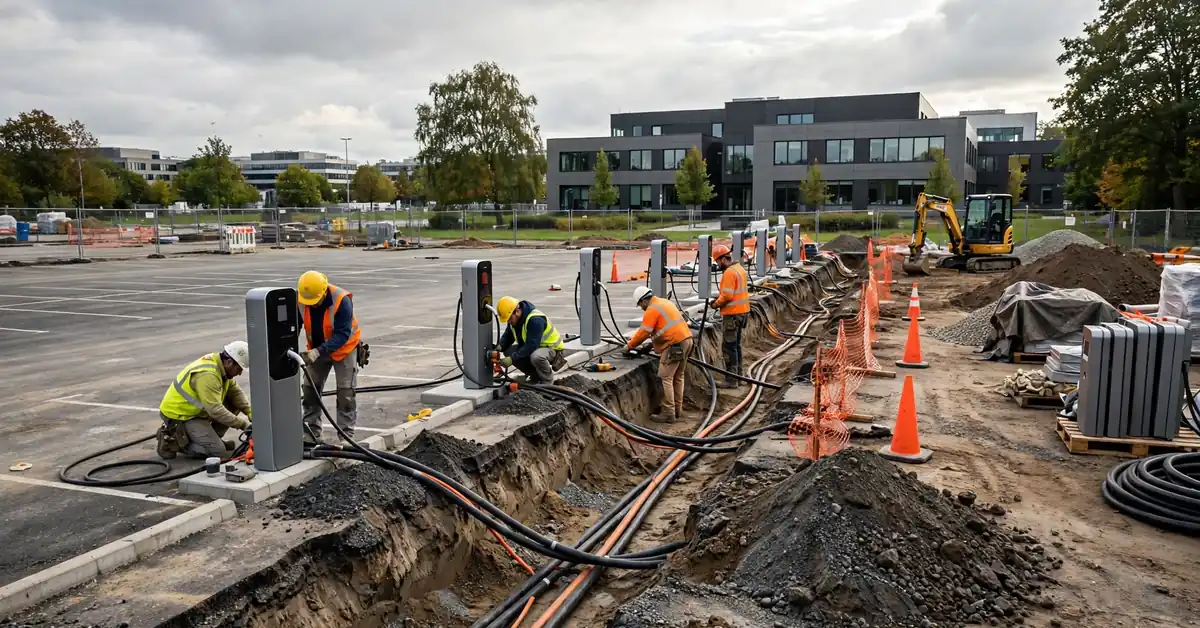
Installing EV charging at your office or business involves four steps: assess your electrical capacity, choose the right hardware, hire a certified installer, and select a management platform. Total installed cost typically ranges from $2,500–$8,000 per Level 2 station — reduced to $1,750–$5,600 after the 30% federal Alternative Fuel Vehicle Refueling Property Credit. Most businesses recoup costs through electricity revenue, employee retention value, and customer attraction within 2–4 years. Here is a complete guide to commercial EV charger installation.
Step 1: Assess Your Site and Electrical Capacity
Before selecting any hardware, have a licensed electrician assess your site. Key questions: What is your facility’s main electrical service amperage? Is there panel capacity for new 240V circuits? Where is the main panel relative to the parking area? Are permits required in your municipality? This assessment typically costs $150–$300 and determines the scope of the project. Many commercial sites on 3-phase power can easily support multiple high-power Level 2 stations; smaller buildings on single-phase 200A service may require an upgrade for more than 2–4 stations.
Step 2: Choose the Right Hardware
| Hardware Type | Power Output | Best For | Cost Per Unit |
|---|---|---|---|
| Commercial Level 2 (single-port) | 7.2–11.5 kW | Employee parking, small business | $500–$1,200 |
| Commercial Level 2 (dual-port) | 7.2–11.5 kW per port | High-volume employee or customer parking | $900–$2,000 |
| DC Fast Charger (50–150 kW) | 50–150 kW | Retail destinations, highway adjacent | $20,000–$80,000 |
| DC Fast Charger (150–350 kW) | 150–350 kW | Fuel retail, truck stops, large commercial | $80,000–$150,000 |
Step 3: Select a Network Management Platform
Networked chargers — connected to a management platform — enable access control, usage monitoring, billing, and software updates. For most businesses, a networked Level 2 station is worth the modest additional monthly network fee ($5–$25/station/month). The leading commercial platforms are ChargePoint for Business (most widely used in North America), Blink Commercial (strong hospitality and multi-family focus), IONNA (newer, high-power focus), and Greenlots (enterprise fleet focus). Each platform offers different pricing models and management features — compare at least three before committing.
Step 4: Hire a Certified Installer
Commercial EV charger installation requires a licensed electrician and typically a building permit. Use certified installers recommended by your chosen charger brand — ChargePoint, Blink, and most hardware suppliers have preferred installer networks. Qmerit is the largest third-party commercial EV installer in North America, recommended by multiple automakers and charger brands. Getting three competitive quotes from certified installers before committing is standard practice for commercial projects — installation quality and permit handling vary significantly between contractors.
Federal and State Incentives for Commercial EV Charging
- 30% Alternative Fuel Vehicle Refueling Property Credit (IRS Form 8911): Applies to both hardware and installation costs — up to $100,000 per location for commercial properties (vs $1,000 for residential). Available through 2032 under the Inflation Reduction Act
- NEVI Formula Program: Federal funding for DC fast chargers on designated Alternative Fuel Corridors — businesses on or near highway corridors may qualify for significant grant funding
- State and utility rebates: Most states and utilities offer additional commercial EV charging rebates — check DSIRE.org (Database of State Incentives for Renewables and Efficiency) for your state’s current programmes
- Accelerated depreciation: Commercial EV charging equipment qualifies for MACRS accelerated depreciation — reducing tax liability in the installation year
Conclusion
Installing EV charging at your office or business is a straightforward four-step process — site assessment, hardware selection, platform choice, and certified installation. Total costs of $2,500–$8,000 per Level 2 station drop to $1,750–$5,600 after the 30% federal tax credit. Networked management platforms enable usage tracking, employee billing, and compliance reporting. As EV adoption accelerates through 2026–2030, businesses with EV charging infrastructure will enjoy a growing competitive advantage for attracting employees and customers — making 2026 an excellent time to invest in commercial EV charging.
