
Is It Cheaper to Charge an EV at Home or a Public Station?

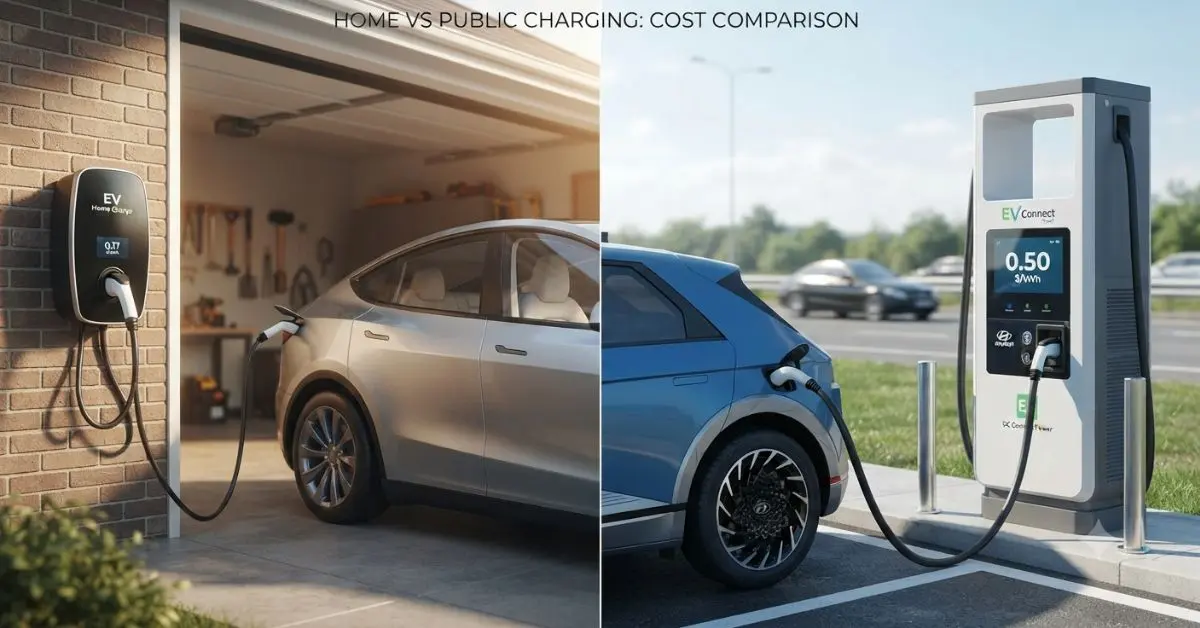
Charging an EV at home is significantly cheaper than at a public station — approximately 3–4x cheaper per kWh on average. Home Level 2 charging at the national average rate of $0.17/kWh costs approximately $0.05 per mile. Public Level 2 chargers average $0.25–$0.40/kWh ($0.07–$0.11/mile). DC fast chargers cost $0.35–$0.60/kWh ($0.10–$0.17/mile). For typical driving of 1,000 miles per month, home charging costs approximately $49/month vs $86–$143 per month relying entirely on public charging. Home charging wins on cost — public charging wins on convenience when away from home.
Home vs Public Charging Cost Comparison
| Charging Method | Cost Per kWh | Cost Per Mile (3.5 mi/kWh) | Monthly Cost (1,000 mi) | Annual Cost (12,000 mi) |
|---|---|---|---|---|
| Home Level 2 (national avg) | $0.17/kWh | $0.049/mile | ~$49 | ~$583 |
| Home Level 2 (off-peak TOU) | $0.10/kWh | $0.029/mile | ~$29 | ~$343 |
| Public Level 2 (avg) | $0.30/kWh | $0.086/mile | ~$86 | ~$1,029 |
| DC fast charging (avg) | $0.50/kWh | $0.143/mile | ~$143 | ~$1,714 |
| Free public / workplace | $0 | $0 | $0 | $0 |
Why Home Charging Is So Much Cheaper
Home charging uses residential electricity rates — among the cheapest electricity available to any consumer. Public charging networks must charge commercial rates that cover not only electricity but also site leases, hardware amortisation, maintenance staff, network software, payment processing, and profit margin. A DC fast charger costs $50,000–$150,000 to install — the $0.50/kWh rate partly recovers this infrastructure investment. At home, you pay only the marginal cost of electricity — no infrastructure overhead, no network fees, no payment processing premium.
When Public Charging Is Worth the Premium
- Road trips: DC fast charging on a road trip is unavoidable and genuinely convenient — the cost premium vs home charging is the price of range confidence on long journeys
- Apartment dwellers without home charging: For renters without access to home charging, public Level 2 becomes the primary option — costs $86/month vs $49 at home, but still far cheaper than gas ($157/month)
- Free public charging: Destination Level 2 at hotels, retail, and workplaces that is genuinely free beats home charging costs entirely — actively seek these when they align with your routine
- Emergency top-ups: Worth the premium cost to avoid being stranded — one DC fast charging session’s premium over home rates is minor insurance for peace of mind
The Optimal Charging Strategy for Minimum Cost
The lowest possible monthly charging cost combines three sources in priority order: first, free charging wherever genuinely available (workplace, free destination chargers) — cost $0; second, home Level 2 charging at off-peak TOU rates ($0.07–$0.12/kWh) — approximately $29–$34/month for 1,000 miles; third, public DC fast charging only for road trips and emergencies. Drivers who combine free workplace charging for weekdays and home Level 2 for top-ups can achieve effective monthly charging costs under $20 — making EV transportation dramatically cheaper than any gas vehicle in any segment.
Conclusion
Home charging is 3–4x cheaper than public Level 2 and 5–6x cheaper than DC fast charging per kWh. The gap is explained by simple economics — residential electricity rates vs commercial infrastructure cost recovery. For maximum savings, charge at home or free workplace stations as the primary method and treat public DC fast charging as a convenience premium for road trips. Any EV owner who can install a home Level 2 charger has access to the most affordable per-mile transportation cost available — $0.029–$0.049 per mile on a Level 2 home charger vs $0.131/mile for a 30 mpg gas car.
