
How Much Does It Cost to Replace an EV BMS?

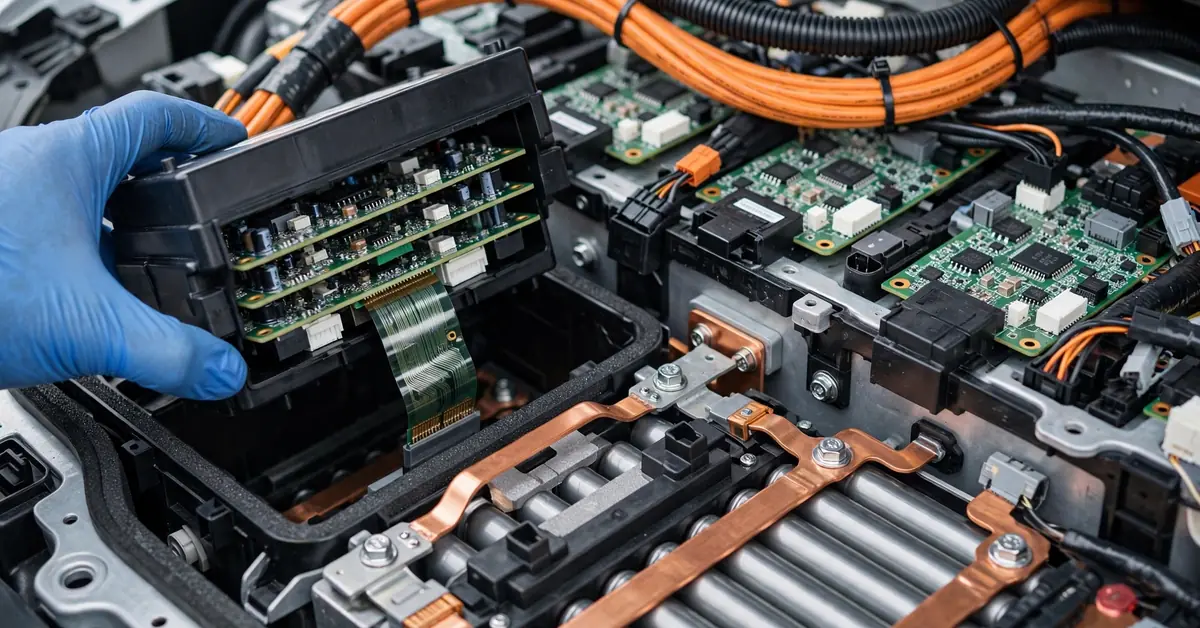
A warning light, a ‘BMS fault’ message — and then the question every EV owner asks: what is this going to cost me? The honest answer starts with a surprise: the part itself is cheap. Here’s the short version.
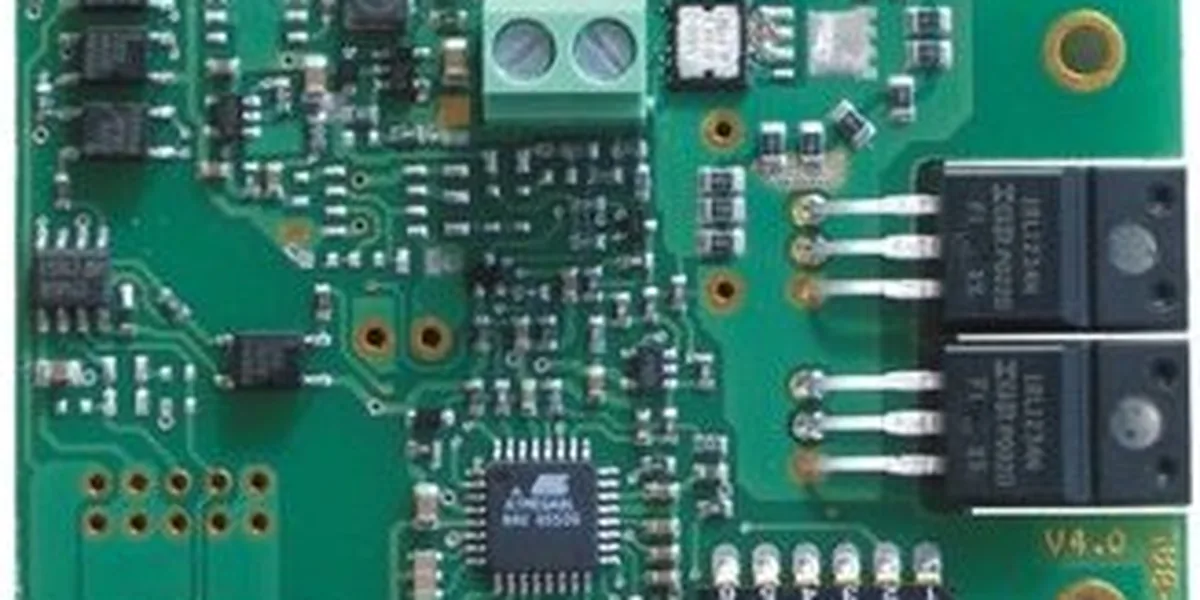
The BMS module itself is surprisingly cheap: genuine replacement units list at $275–$433 in manufacturer parts catalogs (Bolt, Mach-E and Leaf examples below). What makes the job expensive is everything around it — the labour to reach a module that lives in or on the battery pack, plus programming afterwards. And if the failure happens inside the battery warranty, the owner’s cost is normally $0.
- The part: $275–$433 list price (catalogue selling prices $275–$307)
- The bill drivers: access labour + module programming, which vary by car
- In warranty (8 years/100,000 miles on the battery system): normally $0
What the BMS module itself costs
The control module is a few hundred dollars, not a few thousand — here are real catalogue prices for three mainstream EVs.
| Car | Module | Part number | Catalogue price |
|---|---|---|---|
| Chevrolet Bolt EV | Battery Energy Control Module | 24049829 | $275.06 (list $431.91, plus a $50 core charge) |
| Ford Mustang Mach-E | Battery Energy Control Module | LJ9Z-10B687-D | $298.92 (list $353.33) |
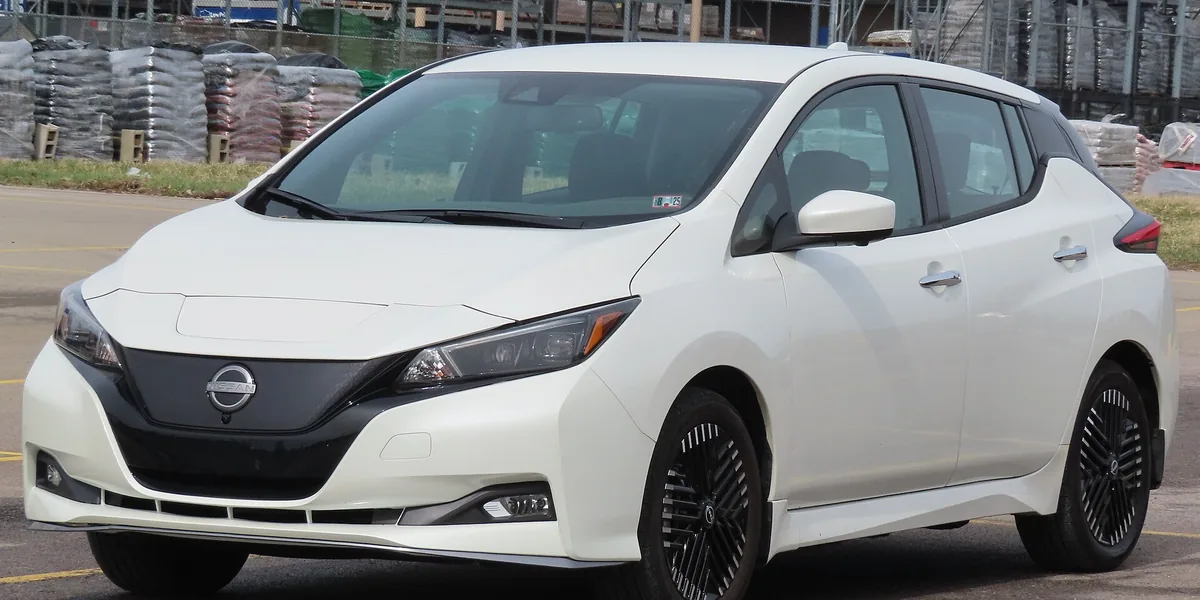
| Nissan Leaf | Controller Assembly – Battery | 293A0-5SF0B | $306.80 (list $433.33) |
Prices are the selling and list prices shown by GM Parts Giant, Ford Parts Giant and Nissan Parts Deal for the genuine modules; the Leaf’s “battery controller” is that car’s BMS under Nissan’s name for it — our guide to the Leaf’s BMS explains its layout. Two honest limits on this table: Tesla does not sell its BMS boards through a public catalogue, so no Tesla price appears (treat any exact Tesla BMS price quoted online as unverified), and a module price is not a fitted price — the next section is where the rest of the money goes.
Why the fitted bill is bigger than the part
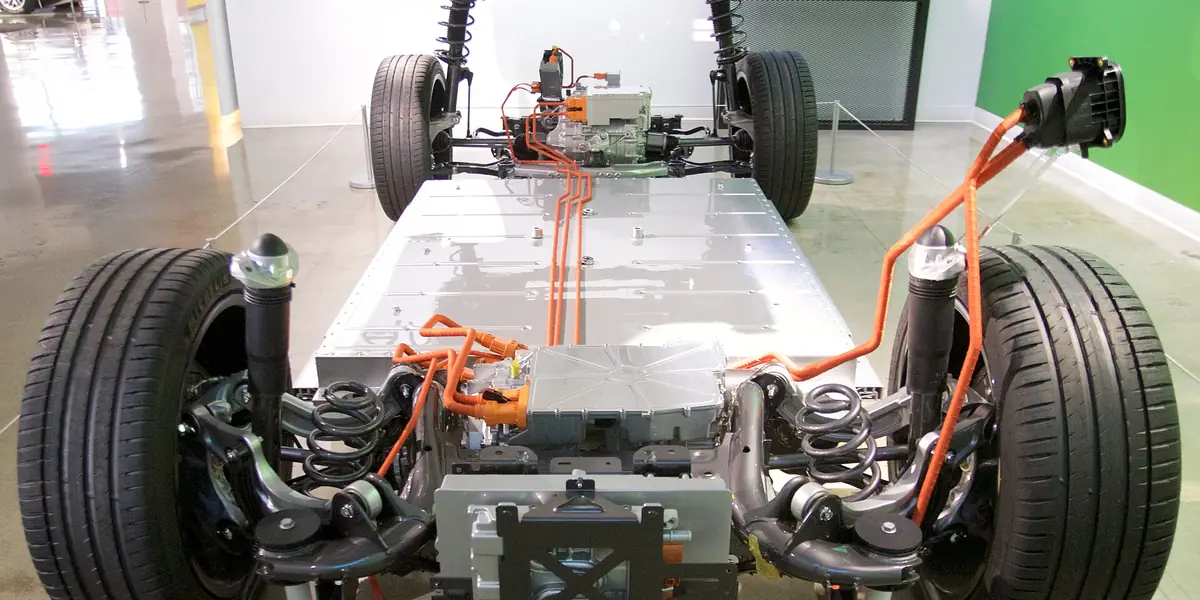
Because the module rarely sits somewhere easy: on most EVs it lives inside the battery pack or on top of it, so reaching it means lifting the car, making the high-voltage system safe, and opening or dropping the pack.
That labour is the bill. Recurrent’s walk-through of a specialist EV shop describes the pack work itself — car on a lift, pack unbolted and dropped from underneath — and while that description is for full pack swaps, the access half of the job is the same one a BMS replacement starts with. Add the second cost driver: a new module usually has to be programmed or calibrated to the car before it will manage the pack, which is dealer/specialist scan-tool work, not a spanner job.
This is also where a warning belongs. You will find tidy totals for this job quoted online — $1,500 to $2,500 is a common one. No parts catalogue and no repair source publishes a BMS-only parts-and-labour total; that figure bundles a cheap part with a worst-case guess at labour. For one car the honest total may land near it; for another, with an externally mounted module, it can be far less. Get the quote split — part, labour hours, programming — and judge the three lines separately.
First, be sure it is actually the BMS
Most “BMS faults” are not a failed BMS. The module’s job is to report on the cells — and most of the time it is reporting, correctly, that the cells are the problem.
This matters to your wallet more than any price on this page. A BMS that flags weak cells, rising internal resistance or growing imbalance is doing exactly what it was built to do. Replacing it changes nothing: the new module reads the same cells and raises the same fault. The causes worth ruling out first are the ones in our guide to what makes a BMS fail — genuine module failures do happen (water damage, board faults, connector corrosion), but they are the minority of cases wearing a BMS fault code.
A related trap is the reset. Clearing codes or resetting the BMS can tidy the dashboard for a while, but if the underlying cause is a degrading cell group, the fault returns — you have paid for a pause, not a repair. Diagnosis first, parts second: a proper cell-level health report is what separates a $300 module job from a five-figure misunderstanding.
The warranty answer: when the cost is $0
If the BMS fails while the battery warranty is running, the repair is normally the manufacturer’s problem — every new EV carries a battery warranty of at least 8 years or 100,000 miles.
Recurrent’s summary of the market puts it plainly: battery warranties run at least 8 years/100,000 miles, and unexpected battery failures are covered by the manufacturer warranty. The makers’ own pages group the coverage the same way — Nissan’s warranty page lists “battery, EV system” together under its 8-year/100,000-mile EV coverage, and Tesla’s “Battery and Drive Unit” warranty runs 8 years and 100,000–150,000 miles depending on model, with a 70% capacity floor. No manufacturer lists the BMS as a separate line item; it is covered as part of the battery system it belongs to. Our EV battery warranty guide has the per-brand terms.
The practical consequence: a BMS failure quote on a car under eight years old should start with a warranty claim, not a credit card. Degradation arguments (a pack that has merely lost capacity) are a different, harder fight — a module that has stopped working is a failure, and failures are what warranties are for.
When the real bill is a whole battery pack
If diagnosis lands on the cells rather than the module, the numbers change by an order of magnitude — and this, not the BMS, is the bill owners actually fear.
Recurrent puts out-of-warranty pack replacements at typically $5,000 to $16,000 depending on pack size and maker, while noting they are extremely rare. Its worked examples show the shape: a remanufactured 75 kWh pack for a 2020 Model 3 at $13,500 plus $2,299.27 labour ($15,799.27 all-in), and a dealer quote for a Bolt pack at $16,250 plus $870 labour. Interesting for this page: even on a five-figure pack job, labour was the small line — for full packs, Recurrent’s shop reporting puts roughly 95% of the cost in materials. A BMS-only job inverts that ratio: cheap part, labour-led bill.

Repaired, used and refurbished options
Specialist battery shops are the realistic third route between a dealer quote and a new module — but shop carefully, because not everything sold as a “BMS” fits a car.
Recurrent notes that battery specialists offer Nissan Leaf BMS units and related kits, and independent EV shops will diagnose at cell level before quoting — the diagnosis-first approach this page keeps recommending. One specific trap to name: inexpensive “Leaf BMS kits” sold online (Greentec Auto lists one at $100–$155) are Bluetooth boards for turning old Leaf modules into home energy storage. They are not car parts, they will not fix your Leaf, and the price gap exists because they do a different job. For the car itself, a used OEM module from a salvage pack is the budget route — with the standing warning that it needs programming to your car and carries no warranty worth the name.
Frequently asked questions
How much does it cost to replace an EV BMS?
The module itself lists at $275–$433 for the Bolt, Mach-E and Leaf in manufacturer catalogues (selling prices $275–$307). The fitted total adds access labour and programming, which vary by car — no repair source publishes a trustworthy single total, so judge any quote by its split: part, labour hours, programming.
Is a failed BMS covered under the battery warranty?
Normally yes, inside the term. EV battery warranties run at least 8 years/100,000 miles, cover the battery system (Nissan phrases it as “battery, EV system”), and Recurrent notes unexpected battery failures are covered by the manufacturer warranty. The BMS is part of that system, though no maker lists it as a separate line item.
Can a BMS be repaired instead of replaced?
Sometimes — specialist shops can repair board-level faults, and used OEM modules exist. But confirm the module is truly the fault first: most BMS fault codes are the module correctly reporting cell problems, and no repair to the BMS fixes degrading cells.
Why do quotes for the same job vary so much?
Because the part is the small, fixed line (~$300) and the labour is the variable one. A module that sits on top of the pack is a short job; one buried inside it starts with dropping and opening the pack, then programming. Two honest quotes can differ by hundreds of dollars on access alone.
Is a BMS reset a cheaper alternative?
A reset is cheaper and sometimes useful, but it is not a repair. If the fault comes from degrading cells, the code returns; if the module itself has failed, a reset cannot revive it. Spend the first money on a cell-level diagnosis instead.
Conclusion
The honest answer to this page’s question has three parts. The BMS module is a ~$300 part — that much the catalogues prove. The fitted bill is labour and programming, sized by how buried the module is in your particular car, which is why no single trustworthy total exists and why the split quote is your friend. And before either matters, two checks come first: is the car still inside its 8-year battery warranty (then the cost is $0), and is the module even the fault (most of the time, the cells are)? Answer those two and the third number takes care of itself.
Quick view: Part — $275–$433 list (Bolt/Mach-E/Leaf catalogues). Bill drivers — access labour + programming; beware tidy online totals, none is sourced. Warranty — failures inside 8 years/100,000 miles are normally covered. First move — cell-level diagnosis, not a parts order.
