
What BMS Does the Nissan Leaf Use?

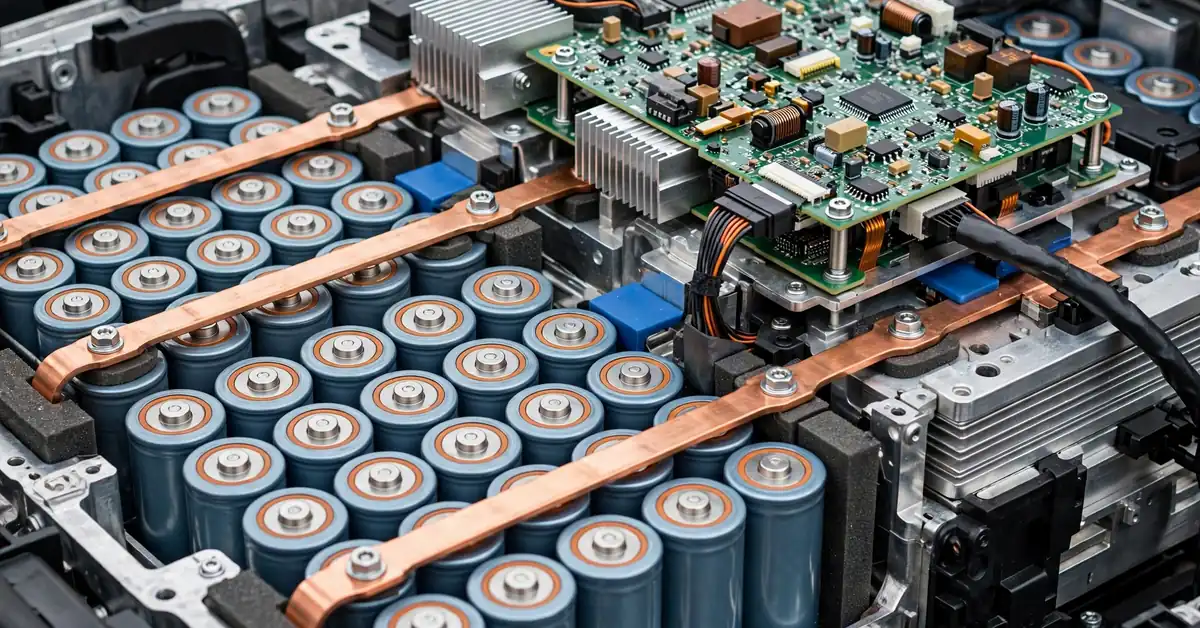
The Nissan Leaf uses a centralized BMS architecture managing a pack built from large-format laminated lithium-ion cells, a notably simpler design than the distributed or master-slave systems found in EVs with much higher cell counts, chosen specifically because the Leaf’s pack uses far fewer, larger cells than many competing designs. This simplicity has been both a practical strength and, at times, a real limitation.
Why the Leaf’s Cell Count Shapes Its BMS Design
The Leaf uses large-format, laminated (pouch-style) lithium-ion cells rather than thousands of small cylindrical cells. With meaningfully fewer individual cells to monitor compared to Tesla’s cylindrical-cell approach, a centralized BMS architecture, one controller managing the entire pack directly, remains a practical, cost-effective choice without the wiring and processing challenges that would arise at much higher cell counts.
Core Functions of the Leaf’s BMS
Like any automotive BMS, the Leaf’s system handles the standard core responsibilities: monitoring cell voltage, temperature, and state of charge, managing cell balancing, and protecting against fault conditions including overcharging and overheating. Its centralized design keeps this monitoring and control logic consolidated rather than distributed across module-level controllers.
Advantages of the Leaf’s Simpler Architecture
Reliability Through Simplicity
With fewer cells and a more straightforward control architecture, the Leaf’s BMS design benefits from reduced overall system complexity, historically a genuine advantage for cost and manufacturing simplicity in earlier EV generations.
Support for DC Fast Charging
Despite its simpler architecture, the Leaf’s BMS is built to handle the high currents involved in DC fast charging, allowing meaningful state-of-charge restoration in a comparatively short time.
The Well-Documented Thermal Management Limitation
Unlike many competing EVs, earlier generations of the Nissan Leaf notably lacked active liquid thermal management for the battery pack, relying instead on passive air cooling. This meant the BMS had considerably less thermal control capability to work with, contributing to more noticeable degradation in hot climates compared to actively liquid-cooled competitors, a limitation widely discussed among Leaf owners and reviewers over the years.
Why This Illustrates a Broader BMS Design Principle
The Leaf’s experience is a clear real-world illustration that a BMS is only as effective as the physical thermal hardware it has to work with. Even a well-designed centralized BMS can’t fully compensate for the absence of active cooling, since the BMS can only manage and command the hardware that actually exists in the vehicle.
How This Has Evolved
Nissan has continued refining battery and thermal management across Leaf generations, and broader industry movement toward more robust thermal management reflects lessons learned partly from this exact limitation, reinforcing why active thermal management has become a near-universal expectation in modern EV design.
| Feature | Nissan Leaf BMS Characteristic |
|---|---|
| Architecture | Centralized |
| Cell format | Large-format laminated (pouch) cells |
| Thermal management | Historically passive air cooling (earlier generations) |
| Fast charging support | Capable of handling high DC fast-charge currents |
Conclusion
The Nissan Leaf uses a centralized BMS architecture suited to its large-format cell design, offering simplicity and reliability advantages tied to its lower cell count compared to designs like Tesla’s. However, earlier generations’ reliance on passive air cooling rather than active liquid thermal management became a well-documented real-world limitation, illustrating clearly how even a competent BMS design is bounded by the physical thermal hardware it has available to work with.
FAQs
Does the Nissan Leaf’s BMS support fast charging well?
Yes, it’s built to handle the high currents involved in DC fast charging despite its simpler centralized architecture.
Why did early Nissan Leafs experience more battery degradation in hot climates?
Largely due to the lack of active liquid thermal management, meaning the BMS had less cooling capability available to manage heat compared to actively cooled competitors.
Has Nissan improved thermal management in newer Leaf models?
Nissan has continued refining its approach across generations, reflecting broader industry lessons about the importance of active thermal management.
