
How Does BYD’s BMS Differ From Tesla’s?

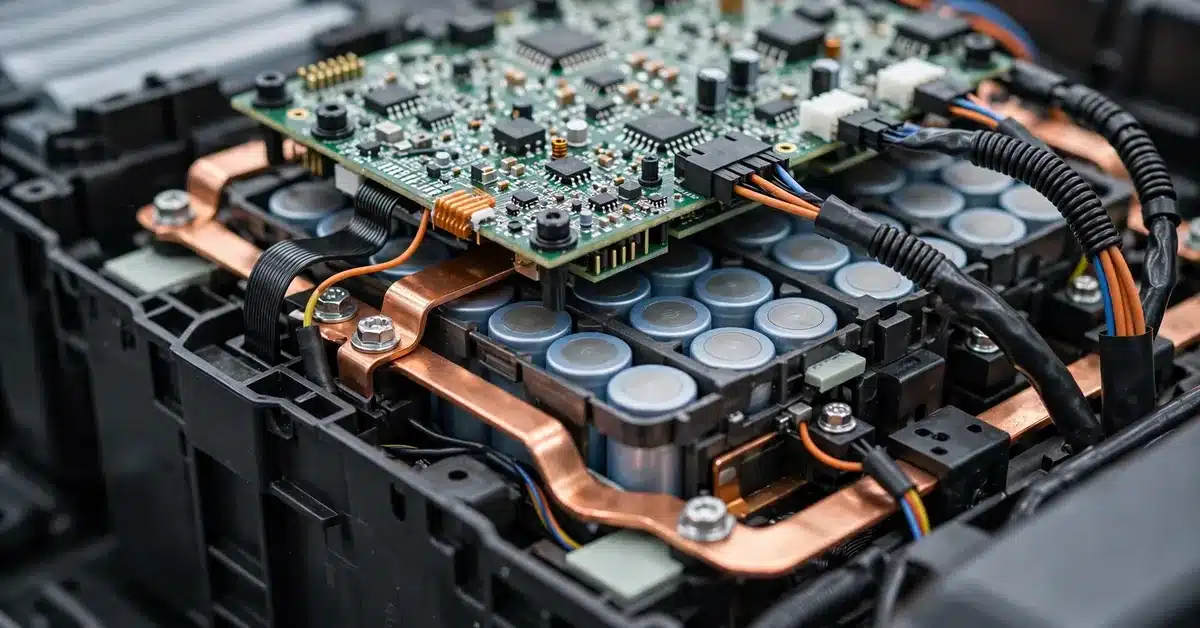
BYD’s BMS differs from Tesla’s primarily because it manages a fundamentally different pack architecture: BYD’s Blade Battery uses LFP cell-to-pack and cell-to-body integration eliminating traditional modules, while Tesla uses thousands of small cylindrical cells in a master-slave monitoring architecture. The BMS design in each case is shaped heavily by the physical battery structure it’s managing, not just software philosophy.
Why Physical Cell Architecture Drives BMS Design Differences
A BMS isn’t designed in a vacuum, it has to match the specific cell format, count, and physical layout of the pack it manages. BYD and Tesla made very different choices at the cell and pack level, and their BMS designs reflect those choices directly.
BYD’s Blade Battery and Cell-to-Pack Architecture
BYD’s Blade Battery uses long, thin LFP cells arranged directly within the pack structure, eliminating traditional battery modules entirely. This cell-to-pack (CTP) approach achieves significant space savings compared to conventional module-based designs, and BYD’s BMS is built around monitoring these larger, elongated cells directly rather than managing thousands of small individual cells the way Tesla’s system does.
Tesla’s Cell Count and Monitoring Approach
Tesla’s packs use thousands of smaller cylindrical cells, requiring its master-slave BMS architecture to manage voltage consistency across a vastly higher cell count, with distributed monitoring boards reporting to a central BMU. This is a fundamentally different monitoring challenge than BYD’s system faces with far fewer, larger-format cells.
How Chemistry Differences Shape BMS Behavior
BYD’s Blade Battery uses LFP chemistry, known for a flatter voltage curve and strong thermal stability, reportedly passing nail penetration tests without thermal runaway. Tesla has used multiple chemistries across different models and cell formats. These chemistry differences directly affect how each BMS handles SOC estimation, since LFP’s flat voltage curve makes voltage-based SOC estimation less precise, requiring different calibration approaches than Tesla’s BMS might use for its own cell chemistries.
Structural Integration and Its Impact on BMS/Thermal Coordination
BYD’s Cell-to-Body (CTB) architecture integrates the battery pack as a structural element of the vehicle itself, achieving greater torsional stiffness, while Tesla’s structural battery pack takes its own distinct approach, bonding cells directly to cast aluminum subframes in certain models. Both approaches require the BMS to coordinate closely with thermal management systems embedded within these more integrated structures, though the specific implementation details differ based on each company’s structural philosophy.
Serviceability Tradeoffs Between the Two Approaches
BYD’s approach has been characterized as “integration with boundaries,” retaining more modular serviceability despite structural integration, while Tesla’s approach has been described as “integration without compromise,” prioritizing structural efficiency even where it may reduce component-level serviceability. These differing philosophies extend to how each company’s BMS and pack design support (or limit) repair at the module versus full-pack level.
| Aspect | BYD | Tesla |
|---|---|---|
| Cell format | Long, thin LFP cells (Blade) | Small cylindrical cells (thousands per pack) |
| Pack architecture | Cell-to-pack/cell-to-body, no modules | Master-slave monitoring, structural pack in some models |
| Chemistry | LFP (flatter voltage curve) | Varies by model/generation |
Conclusion
BYD’s BMS differs from Tesla’s largely because each is built to match a fundamentally different physical battery architecture, BYD’s module-free Blade Battery with LFP chemistry versus Tesla’s high-cell-count cylindrical format with master-slave monitoring. Rather than one being simply “better” than the other, each BMS reflects the specific engineering tradeoffs its parent company made at the cell and pack level.
FAQs
Does BYD’s simpler cell count make its BMS less sophisticated than Tesla’s?
Not necessarily — fewer, larger cells present different monitoring challenges than thousands of small ones, requiring their own sophisticated approach rather than a simpler one.
Is LFP chemistry harder to manage with a BMS than Tesla’s cell chemistries?
LFP’s flat voltage curve makes voltage-based SOC estimation less precise in certain ranges, requiring different calibration strategies, though not necessarily “harder” overall.
Which company’s BMS approach is more repair-friendly?
BYD’s design philosophy has been characterized as retaining more modular serviceability compared to Tesla’s more fully integrated structural approach, though this varies by specific model.
