BYD Han Battery: Complete Guide

The BYD Han is an important car in electric vehicle history because it was the first to use the BYD Blade Battery when it launched in 2020. The original Han used a 76.9 kWh Blade Battery with a “Cell-to-Pack” design. This design allows the car to travel up to 605 km on a single charge. This is an impressive distance for this type of battery technology.
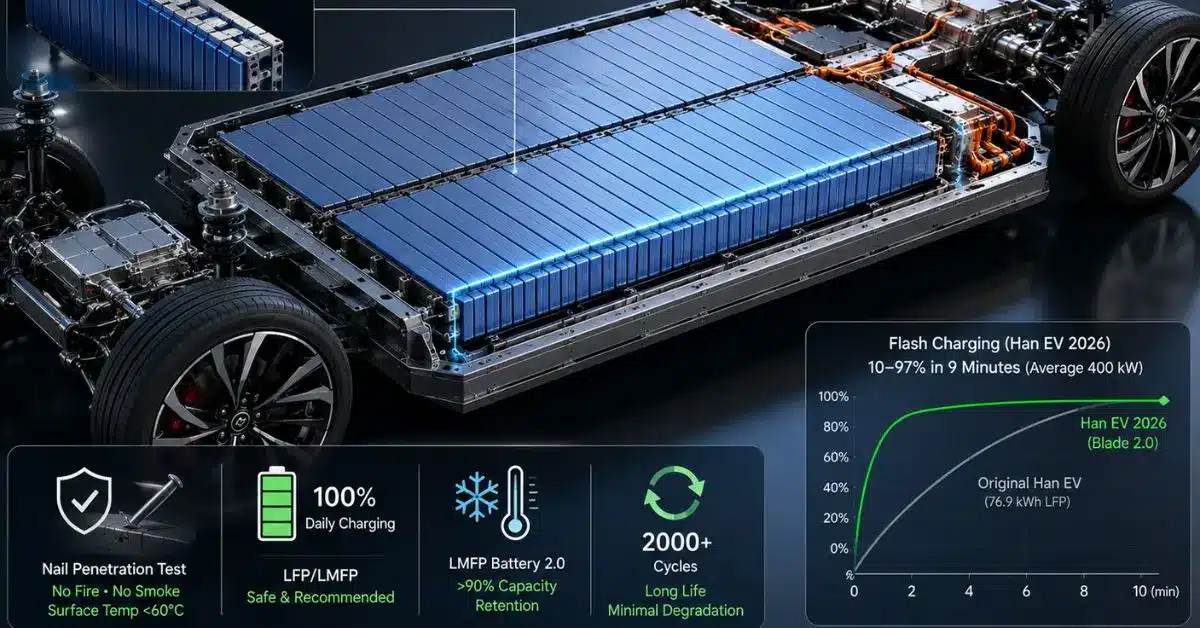
In April 2026, BYD updated the Han with the new Blade Battery 2.0. This 69.07 kWh battery uses an LMFP cathode, a specific chemical material. This upgrade enables “Flash Charging,” which means the car can charge from 10% to 97% in just 9 minutes at an average speed of 400 kW.
As the luxury flagship of the Dynasty Series, the BYD Han competes with expensive sedans from Mercedes, BMW, and Audi, but at a much lower price. The Han remains a key part of the company’s lineup alongside the BYD Seal.
BYD Han Battery: Original vs 2026 Refresh Specs
| Version | Battery | Chemistry | CLTC Range | DC Charging | 30–80% Time |
|---|---|---|---|---|---|
| Han EV (2020–2025, Standard) | 76.9 kWh | LFP Blade (Gen 1) | 605 km (376 mi) | ~120 kW | ~25 min |
| Han EV (2026 Refresh) | 69.07 kWh | LMFP Blade 2.0 | 705 km (438 mi) | Up to 1,000 kW Flash | ~9 min (10–97%) |
| Han EV Performance AWD (2020–2025) | 76.9 kWh | LFP Blade (Gen 1) | 550 km (342 mi) | ~120 kW | ~25 min |
| Han L EV (2025+) | 83.2 kWh | LFP (FinDreams) | 701 km (436 mi) | 1,000 kW Flash | 16–80% in 10 min |
The BYD Han EV and Blade Battery Technology
BYD launched the Han EV in 2020 as its luxury flagship sedan. It was the first car to use the Blade Battery. Before this, people thought LFP (Lithium Iron Phosphate) batteries could not power high-end, long-range electric cars because they held less energy than other types. The success of the Han proved this wrong.
The Han uses a 76.9-kWh LFP Blade Battery to deliver a long driving range. BYD uses a “Cell-to-Pack” design, which puts the blade-shaped battery cells directly into the car frame. This removes extra housing parts to save space and pack more battery material into the car. The Han also showed that these batteries are very safe. They passed a test in which a nail was driven into the battery without it catching fire or overheating.
2026 BYD Han EV Updates
In April 2026, BYD refreshed the Han EV with its newly unveiled Blade Battery 2.0 — a 69.07 kWh LMFP (Lithium Manganese Iron Phosphate) pack replacing the original 76.9 kWh LFP pack. While the battery has a smaller gross capacity, LMFP’s higher energy density (3.8V voltage platform vs LFP’s 3.2V) means the refreshed pack delivers more usable energy in less weight and volume. The critical breakthrough is charging speed:
- Flash Charging support: 10–97% in just 9 minutes using BYD’s 1.5 MW Flash chargers — an average charging power of 400 kW
- CLTC range improvement: 705 km vs 605 km for the original — 16.5% more range from a smaller pack, enabled by LMFP’s higher energy density
- Blade Battery 2.0 cold weather improvement: LMFP cathode significantly better than original LFP in cold temperatures — retaining more than 90% capacity at −20°C
- DiPilot AI Driver Assistance: Standard on 2026 refresh (vision-based God’s Eye C system)
LFP Blade Battery vs NMC: Han EV’s Technical Advantage
The Han EV’s LFP Blade Battery offers three specific advantages over the NMC competitors in the luxury sedan segment:
- Daily 100% charging: LFP tolerates regular full charging — Han EV owners can charge to 100% every day without accelerating degradation, unlike NMC sedans, where 80% daily limits are recommended
- Thermal safety: LFP/LMFP’s thermal runaway onset temperature is approximately 270°C — far above NMC’s 195–210°C. The Blade Battery’s cell surface area enables even better heat dissipation
- Cycle life: 2,000–5,000+ cycles before significant capacity loss — projecting to a far longer useful life than NMC at similar annual mileage
BYD Han Charging: Original vs Blade 2.0
| Charging Method | Original Han EV (76.9 kWh LFP) | 2026 Han EV Refresh (69.07 kWh LMFP) |
|---|---|---|
| Level 2 AC (7 kW) | ~12 hours full | ~11 hours full |
| Level 2 AC (11 kW) | ~8 hours full | ~7 hours full |
| DC Standard (120 kW) | ~25 min (30–80%) | ~20 min (10–80%) |
| BYD Flash Charger (1.5 MW) | Not compatible | ~9 min (10–97%) |
Han EV Battery Degradation and Longevity
The BYD Han EV has been on the road since 2020. Data from owners in China shows that the car’s LFP Blade Battery is very durable. The battery typically loses only 1% to 1.5% of its capacity each year, which is better than most other premium electric cars.
Unlike other battery types, the LFP battery handles full charging well. Owners who charge their Han EV to 100% every day experience the same small amount of wear as those who charge only to 80%. This makes the battery very convenient for daily use.
BYD offers an 8-year or 150,000 km (93,000 miles) warranty. This covers the battery if its capacity drops below 70%. This long warranty shows that BYD feels very confident in how long its Blade Battery will last.
BYD Han vs Western Luxury Sedan EVs: Battery Comparison
| Model | Battery | Chemistry | Range (Best Config) | Peak DC Rate | Daily Charge Limit |
|---|---|---|---|---|---|
| BYD Han EV (2026 refresh) | 69.07 kWh LMFP | LMFP Blade 2.0 | 705 km CLTC | 1,000+ kW Flash | 100% recommended |
| Hyundai Ioniq 6 LR RWD | 84 kWh NMC (800V) | NMC | 361 miles EPA | 233 kW | 80% recommended |
| BMW i4 eDrive40 | 83.9 kWh NMC 811 | NMC 811 | 333 miles EPA | 207 kW | 80% recommended |
| Tesla Model 3 LR RWD | ~82 kWh NCA | NCA | 358 miles EPA | 250 kW (V4) | 80% recommended |
Conclusion
The BYD Han started the Blade Battery revolution. This unique 76.9 kWh LFP (Lithium Iron Phosphate) battery proved that this safe, long-lasting chemistry could power a high-end, long-range car. If you want a similar performance car, you should look at our BYD Seal battery guide.
The 2026 Han EV refresh uses the new Blade Battery 2.0. This 69.07 kWh LMFP (Lithium Manganese Iron Phosphate) battery offers major upgrades. It allows for 9-minute Flash Charging and a 705 km range despite using a smaller battery pack. It also works much better in cold weather.
