
Can Solar Panels Power EV Charging at Home?

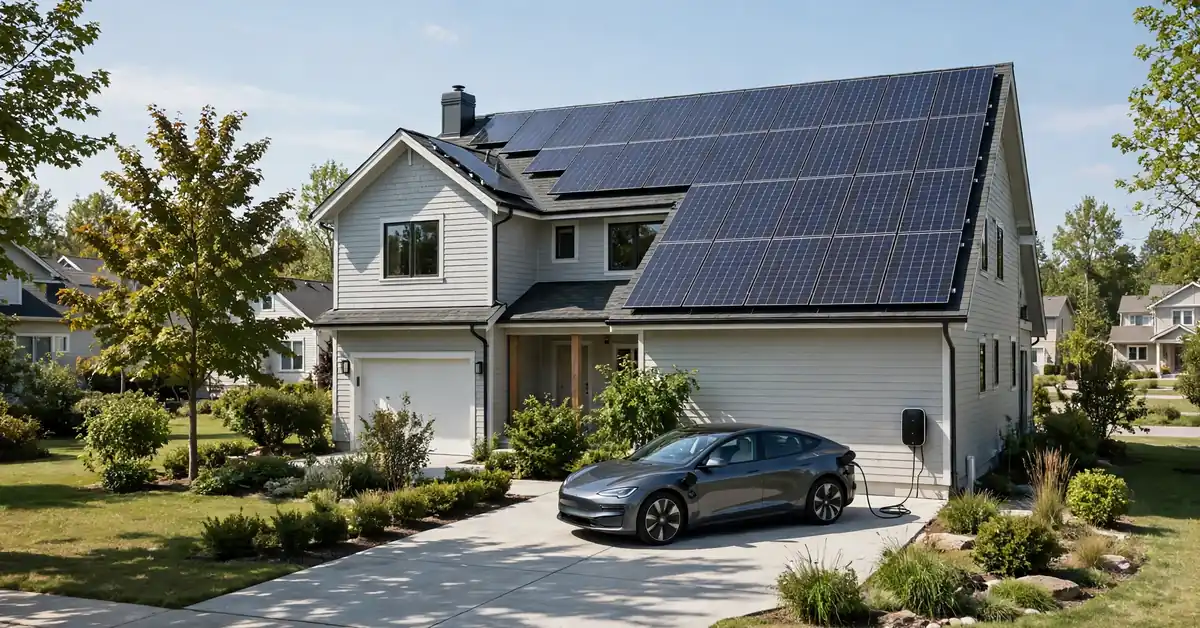
Yes — solar panels can power EV charging at home, and the combination is one of the most financially powerful moves an EV owner can make. A properly sized home solar system can cover 80–100% of your EV’s annual electricity needs, reducing your effective charging cost to near-zero after system payback. A 7 kW solar array in a typical U.S. location produces approximately 28–35 kWh per day — enough to charge most EVs for 100–130 miles of daily driving from free sunshine.
How Solar Panels Power EV Charging
Solar panels generate DC electricity from sunlight, which your home’s inverter converts to AC for household use. When solar production exceeds your home’s immediate electricity consumption, the surplus is either exported to the grid (net metering) or used to charge your EV. Smart EV chargers with solar integration — like the Wallbox Pulsar Plus, JuiceBox 48, and Emporia — can detect when solar is producing surplus power and automatically start or increase charging speed to absorb it. This “solar excess” charging turns your EV into a home battery that stores free energy for daily driving.
How Much Solar Do You Need for EV Charging?
| Daily Miles Driven | EV Efficiency | Daily kWh Needed | Solar Panels Needed (300W each) | Approx. System Size |
|---|---|---|---|---|
| 30 miles/day | 3.5 mi/kWh | ~8.6 kWh | ~3–5 panels | ~1–1.5 kW additional |
| 50 miles/day | 3.5 mi/kWh | ~14.3 kWh | ~5–8 panels | ~2–2.5 kW additional |
| 80 miles/day | 3.5 mi/kWh | ~22.9 kWh | ~8–12 panels | ~3–4 kW additional |
| 100+ miles/day | 3.5 mi/kWh | ~28.6+ kWh | ~10–15 panels | ~3–5 kW additional |
These are the additional panels needed beyond what already covers your home’s electricity use. Many homeowners find their existing solar system — sized for the home — already produces more than enough surplus in spring and autumn to cover EV charging. Summer heat reduces panel efficiency slightly; winter sun angle reduces output in northern states.
Solar + EV Charging: The Financial Case
A 7 kW solar system costs approximately $18,000–$22,000 before the 30% federal solar tax credit — reducing the net cost to approximately $12,600–$15,400. At a home electricity rate of $0.17/kWh and 286 kWh monthly for EV charging ($49/month), the solar system pays back through EV charging savings alone in approximately 21–26 years. However, solar covers your entire household electricity bill — not just EV charging. When total savings across all electricity use are counted, typical payback periods are 6–10 years, with 25+ years of largely free electricity thereafter.
Three Ways to Combine Solar and EV Charging
- Charge during peak solar production (10am–3pm): If you work from home or can plug in during the day, charge while the panels are producing — this avoids exporting power to the grid at low net-metering rates
- Smart excess solar charging (with compatible charger): Chargers like the Wallbox Pulsar Plus and JuiceBox 48 detect surplus solar production in real time and automatically charge your EV only when surplus exceeds a set threshold — fully automated solar-to-EV charging
- Battery storage + EV charging: Add a home battery (Tesla Powerwall, Enphase IQ Battery) to store daytime solar surplus, then use it to charge your EV overnight — capturing free solar energy and using off-peak timing
Net Metering: What Happens to Unused Solar Energy
Under net metering, surplus solar electricity exported to the grid earns credits on your electricity bill at the retail electricity rate. Under net energy metering 3.0 (NEM 3.0) in California — introduced in 2023 — export credits dropped significantly, making self-consumption of solar electricity (including EV charging) more valuable than exporting. This policy shift makes smart solar EV charging particularly valuable in California — it is financially better to charge your EV during the day from solar than to export that solar and charge at night from the grid.
Solar + EV: Real-World Example
A California homeowner with a 10 kW solar system, a Tesla Model 3 Long Range, and a JuiceBox 48 charger with solar integration: The solar system produces approximately 40 kWh per day in summer. Home consumption uses approximately 20 kWh. The remaining 20 kWh automatically charges the Tesla — providing approximately 76 miles of free daily driving. In winter, the system produces approximately 22 kWh daily with home consumption consuming most of it, leaving approximately 10–15 miles of free EV charging. The homeowner supplements with overnight grid charging only on winter low-solar days.
Conclusion
Solar panels are one of the most powerful tools for reducing EV charging costs — ultimately bringing marginal charging cost to near-zero. A 7 kW+ solar system combined with a smart EV charger with solar integration can cover most or all of your daily EV driving from free sunshine. The 30% federal solar tax credit reduces upfront cost significantly, and typical whole-home payback occurs within 6–10 years. For EV owners in sunny states with high electricity rates (California, Hawaii, Arizona), the solar + EV combination is one of the most financially compelling home energy investments available in 2026.
