
EV Battery Fire Extinguisher: What Actually Works

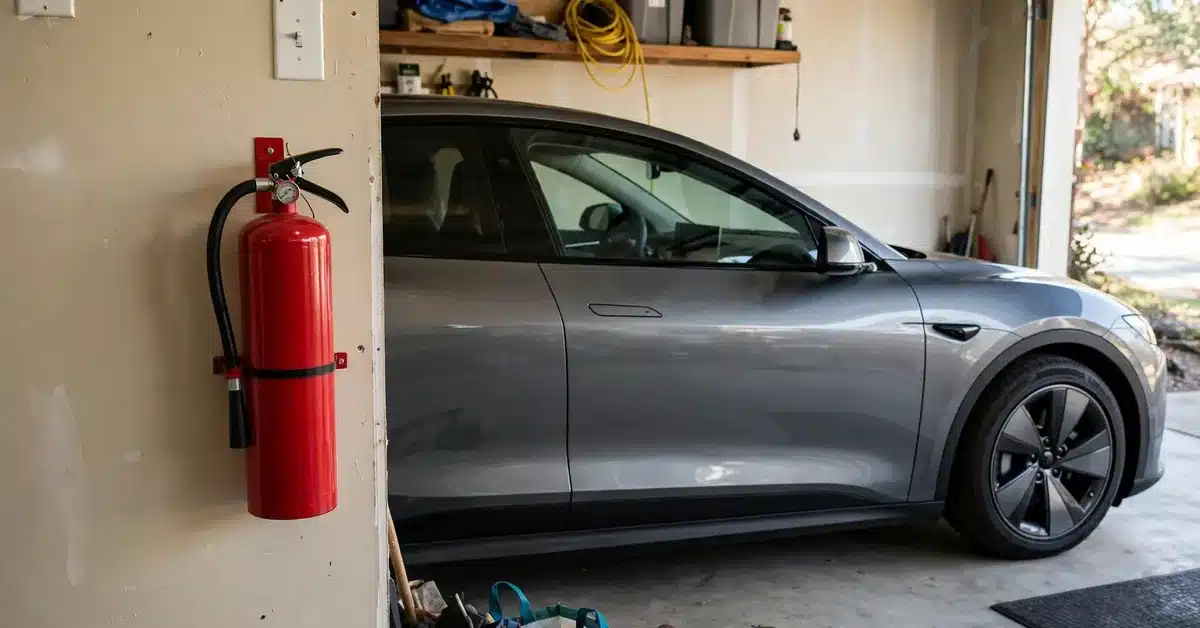
An EV battery fire extinguisher needs to do more than knock down flames. It has to cool superheated cells fast enough to stop thermal runaway. Standard extinguishers fall short here. This guide breaks down which agents work, why water volume matters so much, and what to keep in your own car.
Why Standard Fire Extinguishers Don’t Work Well on EV Batteries
Most household and vehicle fire extinguishers weren’t built for lithium-ion battery fires. They handle surface flames well. They don’t handle the internal chain reaction happening inside the cells.
Dry chemical (ABC) extinguishers stop the chemical reaction of a surface fire. They do very little to cool the battery underneath. Without cooling, thermal runaway keeps going beneath the flames, and the fire often reignites.
CO2 extinguishers displace oxygen and cool slightly. They’re non-conductive, which makes them safe near electrical components. But once the CO2 disperses, a hot battery can easily reignite.
Standard foam extinguishers work on many fuel-based fires. Most foam is water-based and conductive, which makes it risky to use on a live electrical fire until the system is confirmed de-energized.
The core problem is access. Battery packs sit inside sealed, reinforced enclosures. Extinguishing agents sprayed on the outside often can’t reach the cells where the real problem is happening.
What Type of Fire Extinguisher Works on EV Batteries?
The most effective options focus on rapid cooling, not just flame suppression. A few specialized agents stand out for lithium-ion battery fires specifically.
| Agent Type | How It Helps | Limitation |
|---|---|---|
| F-500 Encapsulator Agent | Cools cells fast, reduces flammability and toxicity | Not always available to everyday consumers |
| Aqueous Vermiculite Dispersion (AVD) | Forms an insulating layer, lowers reflash risk | Heavier than dry agents; check shelf life |
| Purpose-built EV extinguishers (e.g. Lith-Ex) | Designed specifically for lithium-ion fires | Costlier than standard extinguishers |
| Large volumes of plain water | Cools the pack directly, industry standard for fire crews | Requires huge quantities; not practical for one driver |
| Fire blankets | Contain heat, smoke, and fire spread | Don’t extinguish the internal reaction |
Fire departments increasingly carry purpose-built EV extinguishing systems and fire blankets. For everyday drivers, the more realistic goal is escape and containment, not full suppression.
Should EV Owners Carry a Fire Extinguisher?
Yes, but with realistic expectations about what it can do. A standard or specialized extinguisher can help with small, early-stage fires, like burning interior plastic or a minor electrical short.
It’s not designed to stop a full battery pack fire once thermal runaway takes hold. At that point, the safest move is to get everyone out and call for help immediately.
Some owners choose to carry:
- A small ABC extinguisher for early cabin or interior fires
- A compact fire safety device rated for vehicle use
- A basic understanding of where the emergency shutoff is located
None of these replace calling 911 the moment you suspect a battery fire.
How Much Water Does It Take to Put Out an EV Fire?
An EV battery fire typically requires far more water than a gasoline fire. A standard gas car fire often needs 500 to 1,000 gallons. EV battery fires have needed anywhere from 3,000 to over 40,000 gallons in real incidents.
Some documented cases include:
- A Tesla fire in Stamford that used 24,000 gallons over 40 minutes
- A Tesla Model Y fire that required more than 36,000 gallons to control
- A hybrid vehicle fire near Washington, D.C. that used 40,000 gallons over three hours
- Tesla’s own emergency response guide citing 3,000 to 8,000 gallons applied directly to the battery
Fire officials have described EV fires as needing up to 40 times more water than a typical gas car fire. This is because water must cool the entire pack, not just knock down visible flames.
Why EV Fires Demand So Much Water
The core issue is oxygen. A damaged lithium-ion cell generates its own oxygen as it decomposes, feeding the fire from the inside. This means the fire can keep burning even without outside air.
Cooling is the only reliable way to stop the reaction. Water absorbs heat and slows the internal chemistry, but it takes a sustained, heavy volume to bring pack temperatures down. Some fire departments now lift or tip a burning EV to get water directly onto the battery for better results.
Newer methods are improving efficiency. Piercing tools that inject water straight into the battery pack have cut water use in some tests to under 1,000 gallons. These tools remain rare outside major fire departments.
The Bottom Line on EV Battery Fire Extinguishers
An EV battery fire extinguisher works best for small, early-stage fires, not a full thermal runaway event. Specialized agents like F-500 and AVD outperform standard dry chemical or CO2 extinguishers on lithium-ion cells. Once a battery pack is fully involved, expect firefighters to use thousands of gallons of water. For drivers, the priority is always the same: get out safely and let trained responders handle the rest.
Frequently Asked Questions
Can I use a garden hose to help put out an EV fire?
It’s not recommended. Water can help cool a battery fire, but the volume needed is far beyond what a garden hose can supply. Leave water application to trained firefighters with proper equipment.
Do fire blankets replace the need for water?
No, fire blankets contain heat and smoke but don’t fully extinguish a battery fire. They’re often used alongside water application, not as a standalone solution.
Is it dangerous to spray water on a live EV battery?
Water itself isn’t the main danger, since battery packs are sealed and insulated. Risk mainly comes from a live external power source, such as an active charging connection, not the water contact itself.
Why do EV fires reignite after they seem extinguished?
Damaged cells can retain stranded energy and heat well after visible flames disappear. This is why fire crews often monitor a vehicle for hours, or even days, after the initial fire.
