
How Much Do Public EV Charging Stations Cost?

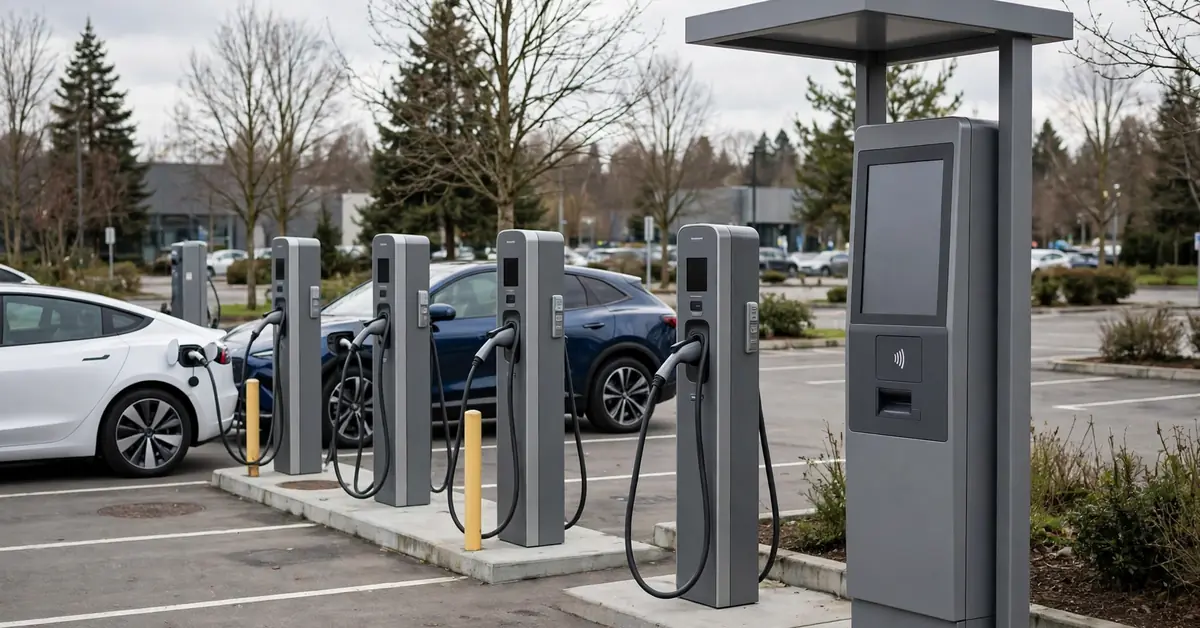
Public EV charging station costs in 2026 range from free (many Level 2 destination chargers) to approximately $0.60 per kWh at premium DC fast chargers — with the average DC fast charge session for a typical EV costing approximately $15–$30. Public Level 2 chargers cost approximately $0.25–$0.40 per kWh or $1–$3 per hour. Costs vary significantly by network, location, charger speed, and membership status. Here is a complete breakdown of public EV charging costs in 2026.
Public EV Charging Costs: Overview by Charger Type
| Charger Type | Typical Cost | Session Cost (75 kWh EV, 10–80%) | Cost Per Mile |
|---|---|---|---|
| Level 2 (free) | $0 | $0 | $0 |
| Level 2 (paid, per kWh) | $0.25–$0.40/kWh | $4–$7 for 25 miles added (1 hour) | $0.07–$0.11/mile |
| Level 2 (paid, per hour) | $1–$3/hour | $2–$6 for 20–30 miles | $0.05–$0.15/mile |
| DC Fast (50 kW) | $0.35–$0.55/kWh | $18–$29 (10–80%) | $0.10–$0.16/mile |
| DC Fast (150–350 kW) | $0.40–$0.60/kWh | $21–$31 (10–80%) | $0.11–$0.17/mile |
Costs by Major Charging Network
| Network | Without Membership | With Membership | Membership Cost |
|---|---|---|---|
| Tesla Supercharger | $0.32–$0.50/kWh | Slightly lower with Tesla subscription | Varies by vehicle/plan |
| Electrify America | $0.48–$0.56/kWh | $0.36–$0.42/kWh (Pass+) | $4/month |
| EVgo | $0.34–$0.59/kWh | Reduced rate | $7.99/month (EVgo Plus) |
| ChargePoint (DC fast) | $0.40–$0.50/kWh | Varies by station owner | N/A (station owner sets pricing) |
| Blink | $0.39–$0.79/kWh | ~$0.29–$0.49/kWh (member) | Free membership |
| IONNA | ~$0.42–$0.55/kWh | $0.34–$0.44/kWh (member) | Free / subscription tier |
Why Public Charging Costs More Than Home Charging
Public charging networks pay commercial electricity rates (typically $0.10–$0.20/kWh wholesale), plus costs for land leases, station hardware, installation, maintenance, network software, and customer support. A single 350 kW DC fast charger costs approximately $100,000–$150,000 to install — the per-kWh markup is how networks recover this investment while providing a profit margin. This is why public DC fast charging at $0.40–$0.60/kWh is 2–3x more expensive than home charging at $0.14–$0.19/kWh.
Per Minute vs Per kWh Pricing: What to Know
Some charging networks — including some Electrify America stations in states that prohibit per-kWh pricing — charge per minute instead of per kWh. This can be advantageous or disadvantageous depending on your EV’s charging speed. A fast-charging 800V EV (e.g., Hyundai Ioniq 5 at 350 kW) gets excellent value from per-minute pricing — it charges twice as fast as a 150 kW 400V EV but pays the same rate. A slower-charging EV at per-minute pricing pays relatively more per kWh of energy received.
How to Pay Less at Public Chargers
- Get network memberships: Electrify America Pass+ ($4/month) saves 25% per session — pays for itself after approximately 1–2 DC fast charges monthly
- Use complimentary charging from your car purchase: Many automakers include free DC fast charging credits — Hyundai, Kia, Ford, and others offer complimentary sessions for new EV buyers
- Find free Level 2 chargers: PlugShare’s filter for free chargers shows thousands of no-cost Level 2 stations at Whole Foods, Ikea, destination hotels, and employer locations
- Avoid premium-rate peak hours: Some networks charge more during peak afternoon hours — charging in the morning or evening can reduce per-session cost
Is Public Charging Cheaper Than Gas?
It depends on the charger type. Public Level 2 charging at $0.25–$0.40/kWh costs approximately $0.07–$0.11 per mile — still cheaper than gas at $0.13/mile (30 mpg car at $3.92/gallon). DC fast charging at $0.50/kWh costs approximately $0.14/mile — roughly equivalent to gas, with minimal savings. For frequent DC fast charging users who never home charge, EV fuel costs can actually match or exceed gas costs in high-electricity-rate states. This is why home charging (approximately $0.05/mile) remains the dominant EV charging strategy for maximum savings.
Conclusion
Public EV charging stations cost $0 (many Level 2 locations) to $0.60/kWh (premium DC fast networks) — with a typical 10–80% DC fast session costing $15–$30 for a 75 kWh EV. Network memberships reduce these costs by 20–25% for frequent users. Public Level 2 charging remains cheaper than gas; DC fast charging approaches gas-cost parity. For maximum EV savings, home Level 2 charging covers daily needs, and public charging is reserved for road trips and emergencies where the convenience premium is genuinely justified.
