
Renault Megane E-Tech Battery: Complete Guide

Researched from Renault’s specifications and launch material, EV Database (including Fastned charging data), SRA parts pricing and UK road tests, November 2026.
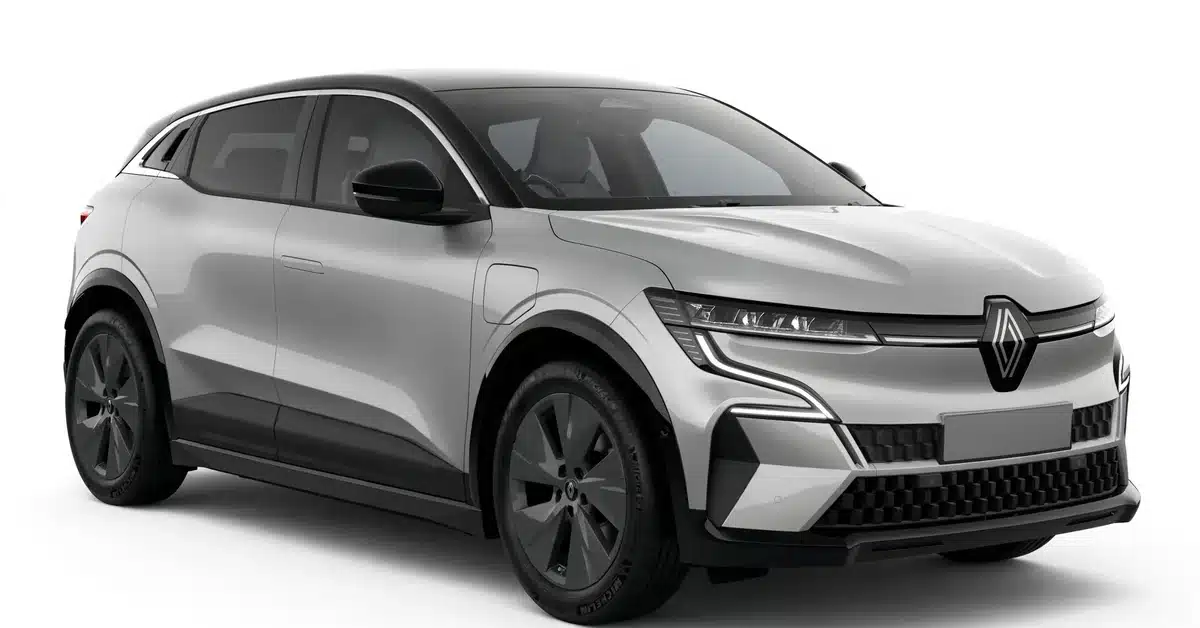
The Megane E-Tech’s battery is a lithium-ion NMC pack with pouch cells supplied by LG — 40 kWh usable in the EV40 (never sold in the UK) and 60 kWh usable in the EV60, the version Britain got. The EV60 is rated at up to 280 miles WLTP and manages about 240 miles in real driving, charging at up to 130 kW DC (80 kW average) and an unusual 22 kW on AC. A facelifted car with a 67 kWh LFP battery replaced it for 2026. And no — a 40 kWh car cannot be upgraded to the 60 kWh battery; Renault has never offered it.
Renault Megane E-Tech Battery Specs at a Glance
Three batteries across this car’s life — the table separates them, because mixing them up is how buyers get caught.
| Item | EV40 (2022–26) | EV60 (2022–26) | Facelift (2026–) |
|---|---|---|---|
| Battery (usable / total) | 40.0 / 43.3 kWh | 60.0 / 65.0 kWh | 67 kWh |
| Chemistry / cells | NMC pouch, LG | NMC pouch, LG | LFP pouch, cell-to-pack |
| Cells / configuration | 192, 96s2p | 288, 96s3p | 232 cells |
| Voltage | 352 V | 352 V | 400 V class |
| Motor | 96 kW, 250 Nm | 96 or 160 kW, up to 300 Nm | 160 kW, 300 Nm |
| WLTP range | 186 miles (300 km) | Up to 280–291 miles (450–470 km) | Up to 306 miles (UK techno) |
| DC charging | 85 kW (boost/optimum cars only) | 130 kW | 165 kW |
| AC charging | 22 kW (boost/optimum) | 22 kW at launch | 11 kW bidirectional |
| Kerb weight | 1,588 kg | 1,719 kg | Not yet published here |
The short version: British buyers only ever had one battery to think about, because the UK range was EV60-only from launch. Continental buyers had a real choice — and, as the charging section shows, a trap inside that choice. Since October 2026 the new-car answer is a third battery entirely, an iron-based pack that changes the car’s character as much as its chemistry.
What Battery Type Is in the Megane E-Tech?
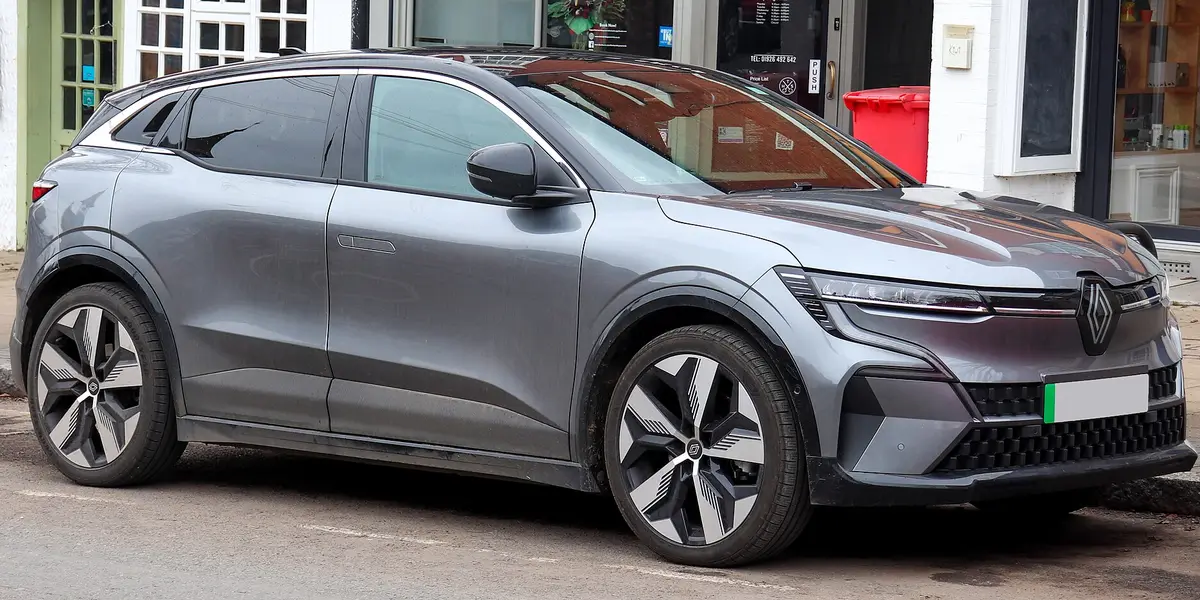
NMC pouch cells from LG in the 2022–26 cars — Renault said so at launch — and LFP in the 2026 facelift.
Renault’s own launch material describes “lithium-ion NMC (nickel, manganese, cobalt) batteries by LG, that have more nickel and less cobalt for greater energy density”. The high-nickel formula reached 600 Wh per litre — 20% denser than the Zoe’s pack — and Renault has never published the exact cathode ratio, so any source quoting one is guessing. The cells are pouches, stacked in modules: eight modules of 24 cells in the EV40, twelve in the EV60, both inside the same flat casing.
The 110 mm pack
That casing was the launch headline. At 110 mm tall, Renault called the pack “the thinnest on the market” in 2021, at 395 kg for the 60 kWh version with liquid cooling built into its lower housing. A thin pack is why the Megane keeps a normal hatchback’s seating position and floor height despite carrying its battery underneath. Both NMC packs share the footprint and the 352-volt architecture; they differ in what is inside, which becomes important when owners ask about swapping them.
The facelift’s LFP switch
The June 2026 facelift replaced the NMC pack with a 67 kWh lithium-iron-phosphate battery — 232 pouch cells fitted cell-to-pack, 495 kg, assembled at Douai alongside the car. The bigger, heavier pack raised the car by 20 mm and changed the charging story completely (165 kW DC, but AC capped at 11 kW). Renault moving its family hatchback from NMC to LFP follows the industry pattern our LFP vs NMC comparison lays out: cheaper, longer-lived cells, traded against energy density.
The Two NMC Batteries: 40 kWh vs 60 kWh
Same box, different contents: the EV40 was a continental-market car with a smaller motor and a charging trap; the EV60 is the only Megane Britain ever got.
The EV40 pairs its 40 kWh usable (43.3 kWh total) with a 96 kW motor, a 186-mile WLTP rating and a 1,588 kg kerb weight. It sold in France, Germany, Spain and other European markets — and never in the UK, where Renault launched with the EV60 only. The EV60 carries 60 kWh usable (65 total) and came with either the same 96 kW motor or the 160 kW unit British cars use, rated at 450–470 km WLTP in Europe depending on version, with UK figures of 280–291 miles by trim. At 1,719 kg it is 131 kg heavier than the EV40 — a gap that matters in the upgrade section below.
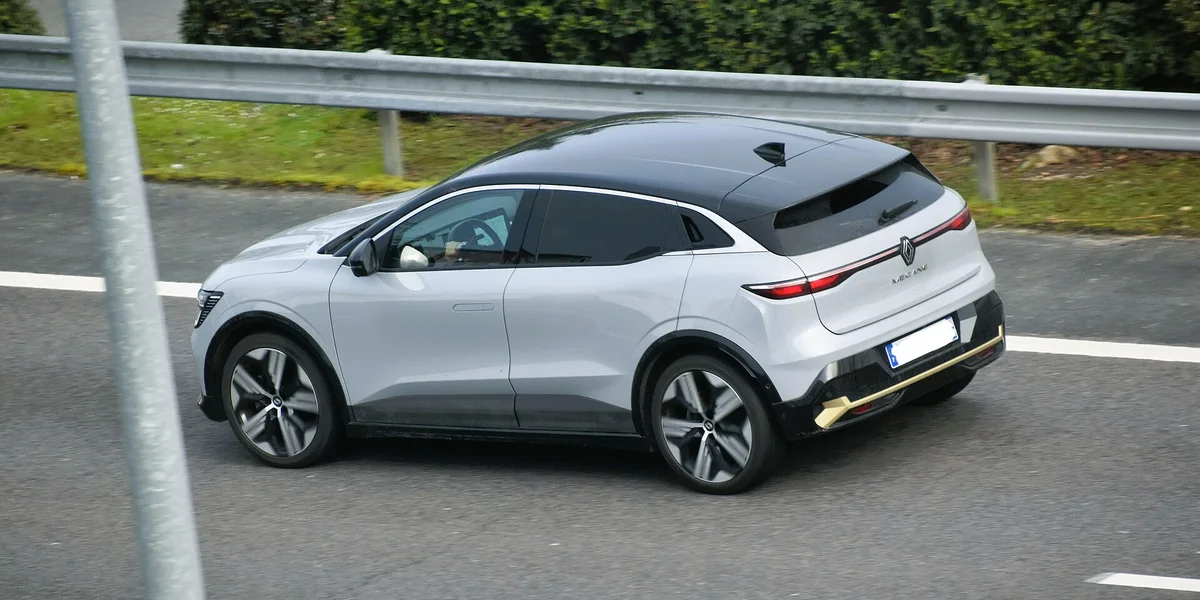
Used buyers meet these cars through imports and listings that rarely state the battery clearly. The checks that matter: confirm the variant (EV40 or EV60) from the car’s documents rather than the advert, and on an EV40 confirm the charge version as well — a “standard charge” EV40 cannot rapid-charge at all, which the next sections cover. UK-registered cars remove the guesswork: they are all EV60s.
How Far Does the Megane E-Tech Really Go?
About 240 miles in real mixed driving for the EV60 — against 280 on the label — and as little as 189 miles in a UK winter test of an early car.
EV Database estimates 240 miles of real range for the EV60, with its scenarios running from 170 miles at motorway speed in the cold to 280 miles in gentle mild-weather use. British testing agrees with the shape of that: Parkers found figures “closer to 200 miles” in their real-world running, CarGurus judges 240 an achievement even in optimum conditions, and Auto Express’s long-term car returned the equivalent of roughly 228 miles. The EV40’s real-range estimate works out at about 165 miles.
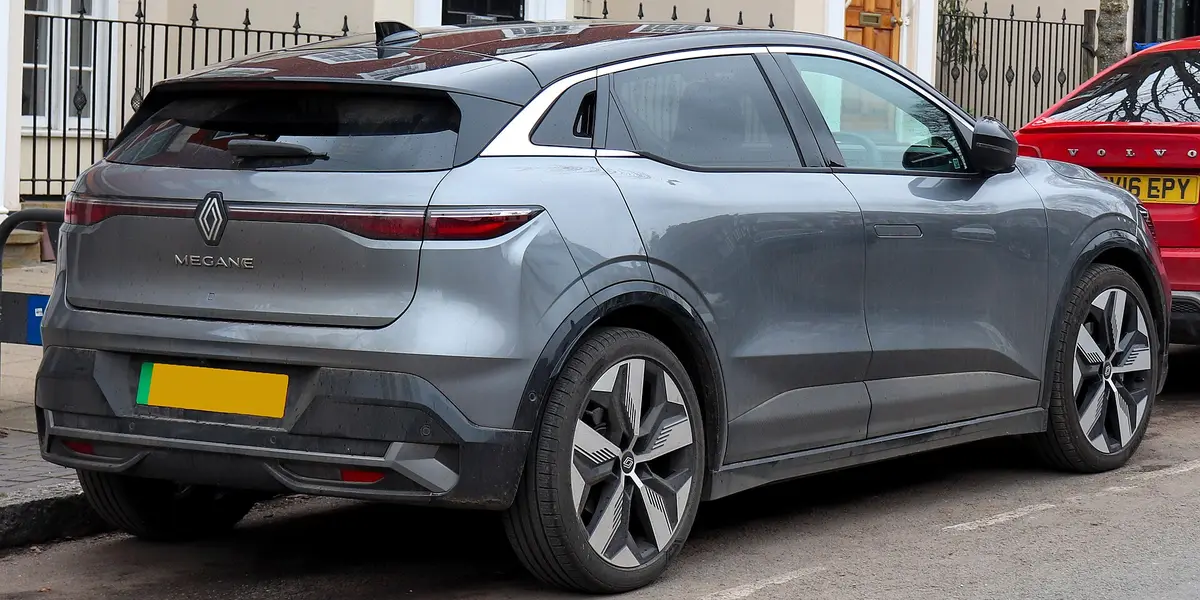
The winter number deserves its own warning. What Car?’s winter range test recorded 189 miles from an early UK car — and early UK Meganes had no heat pump, which became standard on British cars only from mid-2024 (many European cars had one from launch). A resistive heater working hard in a British winter is the difference between the 240-mile car and the 189-mile one. The facelift car, for reference, is rated at up to 306 miles WLTP in UK techno trim, with a heat pump standard — its real-world figures will settle below that, as every WLTP figure does.
How Fast Does the Megane E-Tech Charge?
The EV60 peaks at 130 kW and — the figure that matters — averages 80 kW across a 10–80% charge of about 33 minutes; the EV40 peaks at 85 kW where it can rapid-charge at all.
The averages come from Fastned network data via EV Database, and they flatter the Megane against most of its generation: an 80 kW average is strong for a 2022 car. The EV40 in boost-charge form peaks at 85 kW and averages 49 kW (about 36 minutes for 10–80%). Both cars offer battery preconditioning that warms the pack automatically when a rapid charger is set as the navigation destination — use it, because a cold Megane charges well below these figures; our preconditioning explainer covers the mechanism.
The charge-version trap
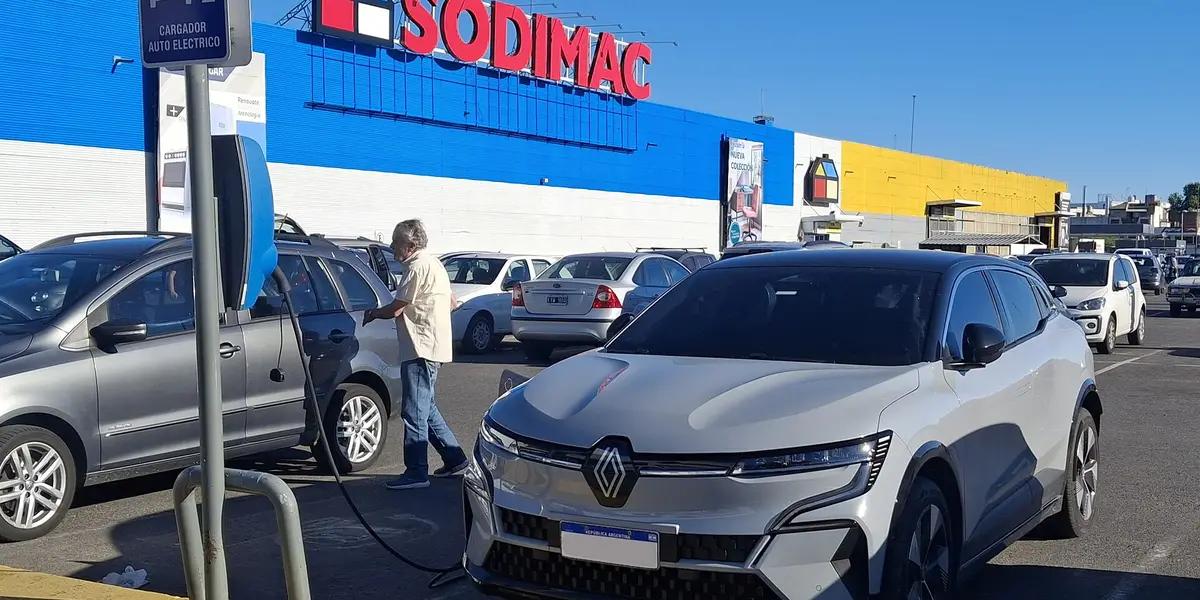
Continental launch cars were sold in named charge versions, and the base “standard charge” EV40 has no DC rapid charging at all — AC only, at 7.4 kW single-phase. Boost and optimum-charge cars added DC and the 22 kW AC charger. British cars were all optimum-charge EV60s, so the trap only springs on imports — but it springs completely: a standard-charge EV40 on a long trip is a car that cannot use a rapid charger, at any price, ever. It is the single most important check on a used import.
The 22 kW AC story — and where it went
At launch the Megane’s 22 kW three-phase AC charger was genuinely class-leading (rivals managed 11 kW), filling the EV60 in about three hours on three-phase power or roughly nine and three-quarter hours on a 7.4 kW home wallbox. Then the story reversed: the 2025 technical update brought an 11 kW bidirectional charger as standard (with the 22 kW unit optional in some markets), and the 2026 facelift caps AC at 11 kW altogether while raising DC to 165 kW — 15–80% in about 24 minutes. Newer is faster on a rapid and slower at the kerb; which matters depends on where you charge.
Can You Upgrade a Megane E-Tech’s Battery?
No. Renault has never offered a battery upgrade for the Megane E-Tech — no factory option, no dealer programme, no documented retrofit — and the two packs differ internally in ways that make a swap a rebuild, not a bolt-in.
This is the question this page is asked most, usually in the form “can an 80 kW battery be installed?” — so first, the sizes: no 70 or 80 kWh Megane battery exists. The car’s packs are 40 and 60 kWh (NMC) and now 67 kWh (facelift LFP). The 87 kWh battery some searchers have in mind belongs to the larger Scenic E-Tech, a different and longer car, and is not a Megane part.
Why the 60 kWh pack is not a drop-in
The two NMC packs share a casing footprint, a 110 mm height and a 352-volt layout — and almost nothing else. The EV40 arranges its 192 cells as 96s2p; the EV60 arranges 288 cells as 96s3p, with twelve modules against eight. The bigger car is 131 kg heavier, is type-approved as a different variant, and runs different battery management, different range prediction and different charging maps — 85 kW DC against 130 kW. Renault’s own facelift underlines the point from the other direction: fitting the 67 kWh LFP pack required raising the car’s body by 20 mm. If the factory redesigns the car around a pack change, a driveway swap is not realistic.
What about Renault’s own history?
Long memories will recall that Renault did once upgrade a battery: some European Zoe owners could move from 22 to 41 kWh from late 2017, because that pack fitted the same enclosure. It remains the exception that proves the rule — one car, one shared casing, a decade ago. No equivalent has ever been announced, priced or documented for the Megane, and Renault’s current Megane battery offer points the other way: repair, not resizing — individual modules (about €2,537 in French parts pricing) and reconditioned complete packs (an EV60 exchange pack listed at €14,416 against €20,600 new, July 2025 SRA figures, excluding labour).
The practical alternatives
- Sell and re-buy: used EV60s are plentiful, and the price gap to an EV40 is a fraction of any conversion’s cost — this is the upgrade that actually exists.
- Buying used: verify the variant and the charge version from the car’s documents, and budget for a dealer state-of-health diagnostic (owners report around €50) before money moves.
- If your battery has a fault: module-level repair and Renault’s reconditioned-pack programme are the supported routes — they restore the battery you have rather than enlarging it.
Megane E-Tech Battery Degradation and Warranty
The warranty is clear — 8 years, 160,000 km (100,000 miles in the UK), capacity held at 70% — and the degradation data, honestly, does not exist yet.
No published study, fleet analysis or long-term test measures the Megane E-Tech’s battery degradation specifically; the oldest cars date from 2022 and nearly all are still inside their warranty. Any exact per-year figure quoted for this car — including the one this page previously carried, dressed in Renault fleet statistics — is not traceable to Megane data, and we have removed it rather than repeat it.
What can be said with evidence: fleet analyses across all EVs (Geotab’s, most prominently) put average degradation around 1.8–2.3% per year across models, and the Megane’s design contains the usual protective choices — liquid cooling, usable-capacity buffers (3.3 kWh held back on the EV40, 5 kWh on the EV60) and moderate charge rates. Treat that as context for the model range, not as a measurement of this car.
For a used buyer, the warranty maths is the usable part: a 2022 car carries battery cover into 2030, with a warranted floor of 42 kWh on an EV60 — still a 200-mile car. And a dealer state-of-health check turns the unknown into a number for the specific car in front of you, which is worth more than any fleet average.
Megane E-Tech vs Its Rivals
Against the Cupra Born, VW ID.3 and MG4, the Megane’s edges were its 22 kW AC charging and thin-pack packaging; its DC average and real range sit mid-pack.
| Car | Battery (usable / total) | WLTP range | DC charging | AC charging |
|---|---|---|---|---|
| Megane E-Tech EV60 | 60.0 / 65.0 kWh NMC | 280–291 miles | 130 kW peak, 80 kW avg | 22 kW (launch cars) |
| Cupra Born 58 | 58 / 62 kWh | up to ~300 miles (refreshed car) | 120 kW peak | 11 kW |
| VW ID.3 Pro 58 | 58.0 / 62.0 kWh | 270 miles | 124 kW peak, 75 kW avg | 11 kW |
| MG4 Long Range | 61.7 / 64.0 kWh | 270–281 miles | 135–140 kW peak | 11 kW |
The VW ID.3 is the Megane’s closest analogue — similar pack, similar era, similar real range around 215–240 miles — while the refreshed Born and the MG4 show how quickly the class moved on charging speed. Renault’s own answer sits one size down: the Renault 5 E-Tech took the smaller-car role with 40 and 52 kWh batteries of its own. The Megane’s facelift, with its LFP pack and 165 kW charging, is Renault conceding where the original car had fallen behind.
Frequently Asked Questions
What type of battery does the Megane E-Tech have?
Lithium-ion NMC pouch cells supplied by LG in the 2022–26 cars — 40 kWh usable in the EV40 and 60 kWh usable in the EV60. The 2026 facelift switched to a 67 kWh LFP (lithium iron phosphate) battery with a cell-to-pack layout.
What is the Megane E-Tech’s battery size?
40 kWh usable (43.3 kWh total) or 60 kWh usable (65 kWh total) in the NMC cars; 67 kWh in the facelift. UK cars were only ever sold with the 60 kWh battery. There is no 70 or 80 kWh Megane battery.
Can I upgrade my Megane from the 40 to the 60 kWh battery?
No supported upgrade exists. Renault has never offered one, the two packs differ internally (192 cells in 96s2p against 288 in 96s3p, different management and charging maps, a 131 kg weight difference and separate type approval), and no documented retrofit exists. Selling the EV40 and buying an EV60 costs far less than any conversion would.
Does the Megane E-Tech have a heat pump?
It depends on the market and the year. Many European cars had one from launch, but UK cars did without until mid-2024, when it became standard — one reason early British cars disappointed in winter range tests. The facelift car has one as standard.
How long does the Megane E-Tech take to charge at home?
On a 7.4 kW wallbox, about nine and three-quarter hours for a full EV60 charge. On three-phase power, a launch car with the 22 kW charger takes roughly three hours; the later 11 kW cars take about six and a half. On a rapid charger, the EV60 does 10–80% in about 33 minutes.
How much does a replacement Megane battery cost?
French parts pricing (SRA, July 2025, excluding labour) lists an EV60 pack at €20,600 new or €14,416 as a reconditioned exchange unit, with individual modules at about €2,537. Most faults are repaired at module level rather than with a whole pack, and cars inside the 8-year warranty are covered by Renault.
Is the Megane E-Tech still on sale?
Yes — as the facelifted car. The NMC versions ended UK order books in October 2026; the facelift, with its 67 kWh LFP battery and prices from £28,245 after the UK Electric Car Grant, opened for UK orders on 1 October 2026. The NMC cars remain the entire used market for now.
How long will the Megane’s battery last?
Nobody can quote a measured figure yet: no Megane-specific degradation study exists, and the cars are young. The warranty guarantees at least 70% capacity for 8 years or 100,000 miles, and a dealer state-of-health diagnostic can measure the individual car — the only number worth trusting on a used example.
Conclusion
The Megane E-Tech’s battery story is really three stories: a well-judged 60 kWh NMC pack for Britain, a smaller continental car with a charging trap, and an LFP facelift that quietly admits the class had moved on.
The EV60 remains a sound used buy on the evidence: 240 real miles, an 80 kW charging average that still holds up, 22 kW AC charging almost nothing else offered, and warranty cover running to 2030 on the earliest cars. The checks are specific and cheap — variant, charge version, a measured state of health. And the question this page gets asked most has a short answer worth repeating: the battery your Megane has is the battery it keeps. Buy the car with the right one already fitted.
