
How Cathode Materials Supercharge Your EV’s Performance

Cathode materials are vital to lithium-ion batteries, serving as the positive electrode. Composed of lithium and metal oxides like cobalt, nickel, manganese, or iron, they store and release lithium ions during charge and discharge cycles. The chosen material significantly impacts a battery’s energy density, power, lifespan, safety, and cost.
What Exactly is a Cathode in an EV Battery?
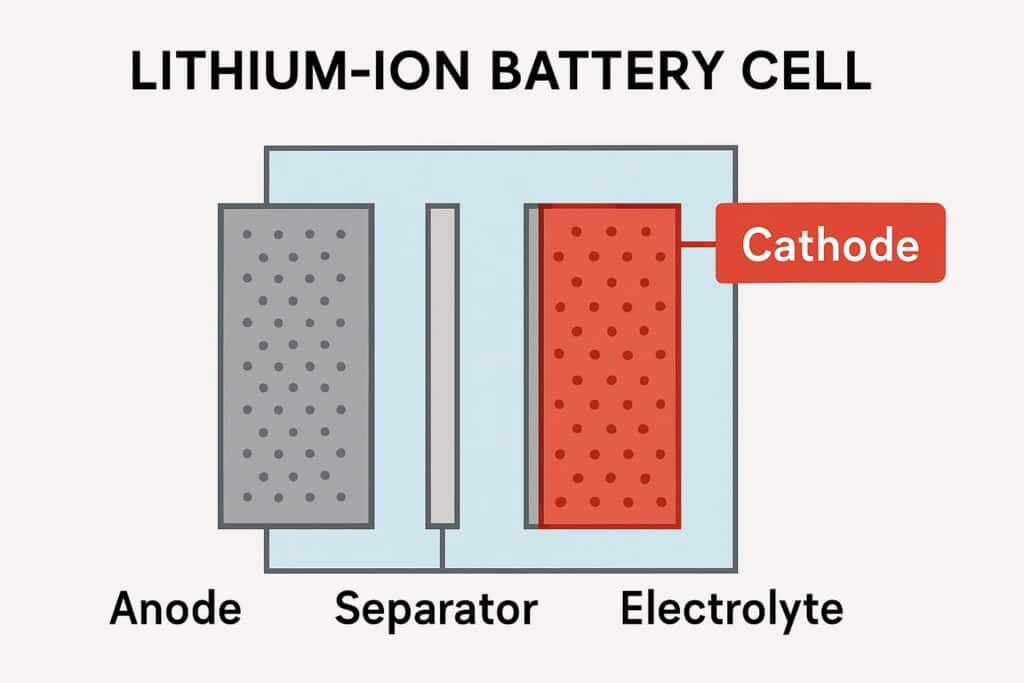
The cathode is the positive electrode inside your EV’s battery pack — and it is the single most important factor in determining how your battery performs. It is the “home base” for lithium ions: where they live when the battery is fully charged and ready to deliver power.
When you drive, lithium ions leave the cathode, travel through the electrolyte, and reach the anode. When you charge, they make the return journey. The cathode material controls how many ions it can hold, how easily they move, and how stable the structure stays over thousands of cycles. That is why cathode chemistry is the first thing engineers change when they want more range, lower cost, or longer life.
How the Cathode Drives EV Performance
The cathode material is very important for an EV’s abilities. It changes how your EV performs in key areas:
1. Energy Density (Your Driving Range)
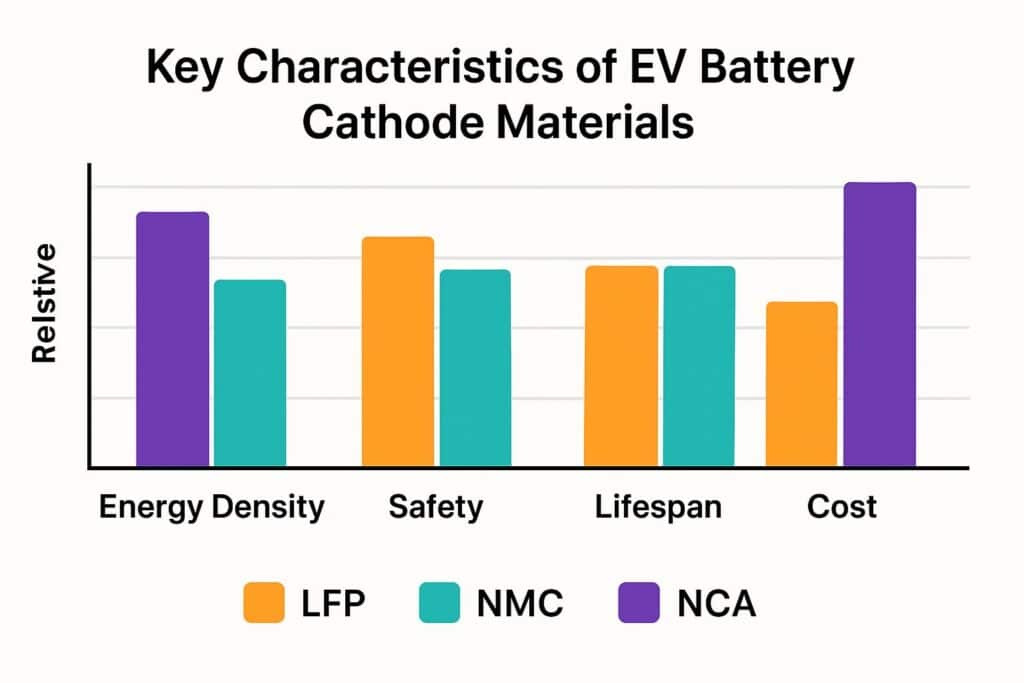
This is the big one for many drivers – how far can you go on a single charge? Energy density, which is typically expressed in Watt-hours per kilogram, Wh/kg, or per liter, Wh/L, quantifies how much energy a battery can store in relation to its size or weight. The main element influencing this is the cathode material. Some materials can pack in more lithium ions, leading directly to higher energy density and, consequently, a longer driving range for your EV.
2. Power Density (Your Acceleration)
Ever feel that instant torque when you press the accelerator in an EV? This can be attributed to the battery’s high power density, which is expressed in Watts per kilogram (W/kg) or liter (W/L). The cathode’s structure and chemistry influence how fast lithium ions can move in and out. A cathode that allows rapid ion movement contributes to higher power density, giving your car that satisfying zip.
3. Lifespan (Battery Durability)
We all want our EV batteries to last a long time. Battery lifespan, often measured in charge/discharge cycles or years, depends heavily on how well the cathode material holds up over repeated use. Some materials are more stable and resist degradation better than others, meaning they maintain their capacity to store energy for more cycles. Cathode stability is key to a long-lasting, reliable battery.
4. Safety (Thermal Stability)
Battery safety is paramount. Cathode materials react differently to high temperatures or stress. Compared to others, some are naturally more stable and less likely to overheat (thermal runaway). Manufacturers carefully select cathode chemistries with strong safety profiles, especially considering the large size of EV battery packs.
5. Cost (EV Affordability)
Why are EVs still sometimes more expensive upfront than gasoline cars? The battery is a major reason, and cathode materials account for a significant chunk of that battery cost, often over 40%! Because materials like cobalt are costly and subject to price fluctuations, producers must look for more affordable, readily available substitutes like iron or manganese without significantly compromising performance.
Common Types of Cathode Materials Explained
Let’s explore the main types of cathode materials used in today’s EVs. Each type has a unique mix of performance, cost, and safety features.
1. LCO (Lithium Cobalt Oxide – LiCoO2)
This was one of the first commercially successful cathode materials, powering early laptops and smartphones. It packs a lot of energy into a small space (high energy density). However, cobalt is expensive, its mining raises ethical questions, and LCO isn’t the safest or longest-lasting option for the demands of an EV. You won’t typically find pure LCO in modern electric cars.
2. LFP (Lithium Iron Phosphate – LiFePO4)
This one’s a rising star! LFP replaces expensive cobalt or nickel with abundant and cheap iron and phosphate. Its key strengths are excellent safety, long cycle life (it can handle many charge/discharge cycles), and lower cost. Historically, its downside was lower energy density (meaning less range compared to others). However, LFP technology is rapidly improving, making it a fantastic choice for standard-range EVs or applications where longevity and safety are top priorities. Many manufacturers are increasingly adopting LFP.
3. NMC (Lithium Nickel Manganese Cobalt Oxide – LiNiMnCoO2)
For a long time, NMC has been the go-to cathode for many EVs, especially those aiming for longer range. It balances energy density (good range), power density (good acceleration), and decent lifespan. Manufacturers can tweak the ratios of these metals. For example, you might hear about NMC 811, which means eight parts Nickel, 1 part Manganese, and 1 part Cobalt.
4. NCA (Lithium Nickel Cobalt Aluminum Oxide – LiNiCoAlO2)
Like NMC, NCA offers high energy and power density, making it suitable for long-range, high-performance EVs (Tesla has famously used NCA). It uses aluminum as a stabilizing element instead of manganese. Like NMC, it relies on nickel and cobalt, facing similar cost and supply chain challenges, driving research into reducing cobalt content.
5. LMO (Lithium Manganese Oxide – LiMn2O4)
Manganese, which is more accessible and less expensive than cobalt, is used by LMO. It offers good power output and safety. However, its energy density and lifespan aren’t as high as NMC or NCA. It’s sometimes blended with NMC to improve performance or reduce cost.
Choosing between these often involves trade-offs. Carmakers select the cathode chemistry that best matches the vehicle’s intended use and price point.
Comparing Cathode Chemistries
Feature | LFP (LiFePO4) | NMC (LiNiMnCoO2) | NCA (LiNiCoAlO2) | LMO (LiMn2O4) |
|---|---|---|---|---|
Key Advantage | Safety, Long Life, Low Cost | Balanced Energy & Power, Good Density | High Energy & Power Density | Good Power, Safety, Low Cost |
Relative Safety | Very High | Medium-High | Medium | High |
As you can see, there’s no single ‘best’ cathode—it’s about finding the right fit for the job. An LFP battery might be perfect for your daily commuter car, while an NMC or NCA might be preferred for a long-range tourer.
The Future of Charging: Next-Gen Cathodes
The world of battery cathodes is constantly evolving. Researchers and companies are working hard to push the boundaries, aiming for cheaper, safer batteries that last longer and pack even more energy.
1. Higher Nickel, Lower Cobalt
The trend in NMC and NCA is clear: reduce expensive and ethically challenging cobalt while increasing energy-boosting nickel (like NMC 811, 9.5.5, or even higher nickel ratios). This boosts range but requires careful engineering to maintain stability and lifespan.
2. Cobalt-Free Champions
The ultimate objective of many is to completely eradicate cobalt. Advanced LFP chemistries (like LMFP, adding manganese) are improving energy density. Other promising cobalt-free options include high-manganese cathodes (LNMO), which offer high voltage but face stability challenges.
3. Solid-State Compatibility
The move towards all-solid-state batteries (which replace the liquid electrolyte with a solid material for potentially better safety and energy density) presents new challenges and opportunities for cathodes. Traditional oxide cathodes sometimes struggle to work efficiently with solid electrolytes. This is driving research into new cathode materials designed specifically for solid-state systems.
Practical Advice for EV Drivers
1. Know Your Battery Type
When comparing EVs, consider whether the manufacturer specifies the battery chemistry (e.g., LFP or NMC). This can give you clues about its strengths. For a detailed side-by-side breakdown of how these two chemistries stack up on range, safety, lifespan, and cost, see our guide on how iron phosphate and NMC batteries compare. LFP generally means excellent longevity and safety, potentially at the cost of some range compared to NMC/NCA in the same size pack. NMC/NCA usually offers a higher range but might require more careful management.
2. Charging Habits
Different chemistries can have slightly different optimal charging routines. For instance, LFP batteries generally tolerate being charged to 100% more regularly than many NMC/NCA batteries, which often prefer staying between 20% and 80% for maximum longevity. Always follow your car manufacturer’s specific recommendations, but knowing the chemistry can provide context.
3. Match To Your Needs
If you primarily need a car for city driving and daily commutes, an EV with a cost-effective, long-lasting LFP battery might be perfect. If maximum range for long road trips is your priority, a model with an energy-dense NMC or NCA battery might be more suitable, even if it comes at a higher price point.
4. Don’t Sweat The Small Stuff
While the chemistry matters, remember that manufacturers build sophisticated battery management systems (BMS) to protect the battery and optimize its performance, regardless of the specific cathode used. Focus on the overall range, charging speed, warranty, and features that meet your needs.
Conclusion
The cathode might be hidden deep inside your EV’s battery pack, but its influence is everywhere – from the miles you can drive to the thrill of acceleration, the battery’s lifespan, and the car’s price tag. We’ve seen that materials like LFP offer incredible safety and value, while NMC and NCA push the boundaries of energy density for longer range. And the future looks even brighter, with researchers actively developing next-generation cathodes that promise to be cheaper, safer, and more sustainable.
As EV technology continues to advance, the humble cathode will remain at the heart of innovation. Understanding its role helps us appreciate the complex science powering our electric journeys and empowers us to make more informed choices about the vehicles that are shaping a cleaner transportation future.
For a fuller picture of battery chemistry and materials, also read about the role of electrolytes alongside the cathode, all the materials found inside an EV battery, what a cobalt-free EV battery actually means, and how cathode choice affects battery replacement cost.
