
Is an EV Battery the Same as a Phone Battery?

Figures checked against Apple’s published battery ratings and EU energy label, Battery University’s chemistry references, Geotab’s 2026 fleet degradation study of 22,700 EVs, Recurrent’s EV-versus-phone analysis and Tesla’s Impact Report.
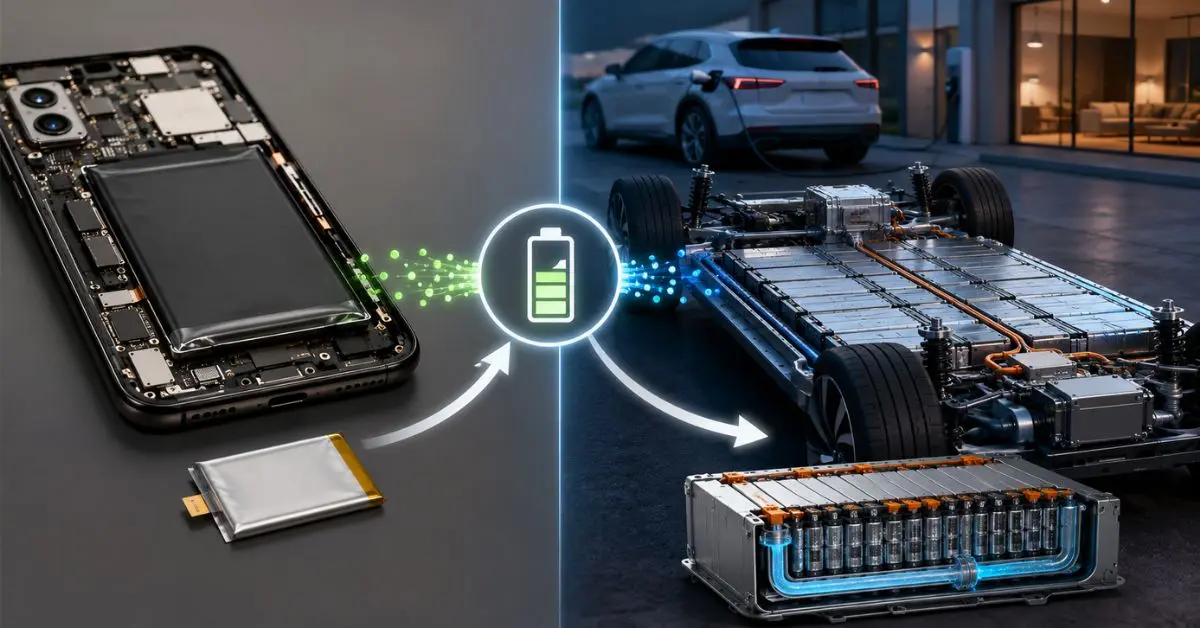
They share a surname — lithium-ion — and almost nothing else. An EV battery and a phone battery run on the same basic chemistry idea, but one stores roughly 3,800 times more energy than the other, is built from thousands of cells instead of one, and is expected to work for a decade or more, while the other is designed to be thin, cheap, and quietly worn out inside two or three years.
That gap is not an accident of size. It is a difference in priorities: a phone battery is engineered to disappear into a sliver of space and survive until your next upgrade; an EV pack is engineered like the most expensive component in a car — because it is. Here is the full comparison, with the numbers checked (including a few this page itself used to print wrong).
Same family, different animals. A flagship phone battery holds about 20 Wh in a single pouch cell; a typical EV pack holds 40–100 kWh across hundreds or thousands of cells — a 75 kWh pack equals roughly 3,800 flagship phones. Phone cells use cobalt-rich LCO chemistry tuned for smallness and are rated for about 500–1,000 full cycles; EV packs use NMC or LFP chemistry, carry buffers and liquid cooling, and are rated for 1,000–5,000+ cycles plus an 8-year warranty.
Key figures: ~20 Wh vs ~75,000 Wh · 1 cell vs 4,416 (Model 3/Y) · 3.7 V vs 350–800 V · ~1,000 vs up to 5,000+ cycles
Same Family, Different Animals: The Chemistry
Your phone runs on a cobalt-rich chemistry chosen for smallness; your car runs on chemistries chosen for life, safety and cost.
Phone batteries are built on lithium cobalt oxide (LCO) and its high-voltage blends — Battery University calls LCO “the popular choice for mobile phones, laptops and digital cameras” because it packs the most energy into the least volume (150–200 Wh/kg, specialty cells higher). Its weaknesses — shorter lifespan, lower thermal stability — are acceptable in a device you replace in three years. The newest Android flagships push further with silicon-carbon anodes, squeezing single-cell capacities up toward 6,000–7,300 mAh.
EV packs use the chemistries this site covers everywhere else — NMC and NCA for range, LFP for cost and longevity — chosen for cycle life and safety at a scale where a failure is a car fire, not a swollen phone. Nobody would build a car on LCO: too expensive, too much cobalt, too short-lived. And nobody builds a phone on LFP: at 3.2 volts and lower density, the phone would be a brick. Each chemistry is right exactly where it is used.
The Full Comparison
Side by side, with the figures corrected to current phones and current cars.
Phone battery | EV battery | |
|---|---|---|
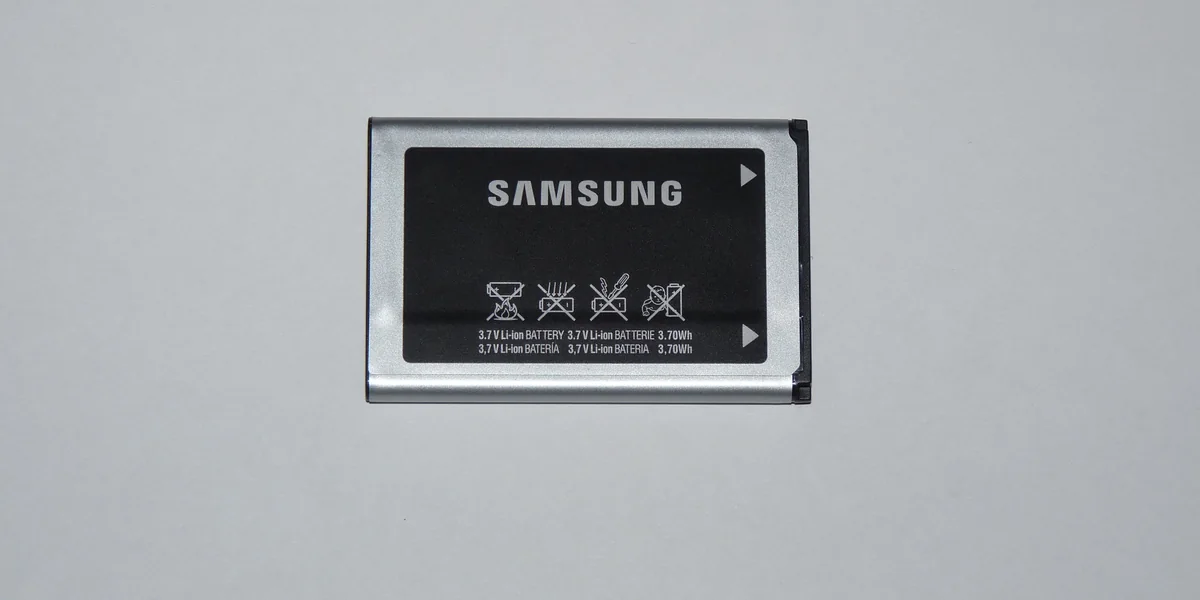
Capacity | ~15–20 Wh (flagships) | 40–100+ kWh (40,000–100,000 Wh) |
Cells | 1 pouch cell | ~100 (large prismatic) to 4,416+ (cylindrical) |
Voltage | 3.7–3.85 V (one cell) | 350–800 V (pack) |
Cathode chemistry | LCO family (cobalt-rich) | NMC, NCA or LFP |
Rated cycle life | 500 cycles (older iPhones) – 1,000 cycles (iPhone 15 and later) to 80% | 1,000–2,500 (NMC) / 2,000–5,000+ (LFP) |
End-of-life definition | 80% of original capacity | Warranty trigger at 70% |
Cooling | None — passive, body heat | Liquid cooling and heating, managed by the BMS |
Typical service life | 2–4 years | 8–15+ years; 8 yr/100,000-mile warranty is the US federal floor |
Two rows deserve a pause. The cycle row is not the whole longevity story by itself — the next section shows why the way each battery is used matters as much as its rating. And the capacity row understates the real-world gap in one way: divide a 75 kWh pack by a laptop instead of a phone and you still get about 750 laptops (a 16-inch MacBook Pro battery is 100 Wh). There is no consumer device whose battery is even within shouting distance of a car’s.
One Cell vs Thousands: How a Pack Is Built
A phone runs on a single cell at under 4 volts; a car wires thousands of cells in series and parallel to reach 400 or 800 volts.
The arithmetic of a pack is simple and worth understanding once. Wire cells in series and their voltages add: about 96–108 lithium-ion cells in series make a “400-volt” pack, and around 192–216 make an “800-volt” one. Wire cells in parallel and their capacities add.
A Tesla Model 3/Y Long Range pack is arranged 96 in series × 46 in parallel — 4,416 individual 2170 cells, each one a slightly larger cousin of the cell in a laptop or a vape pen. A Model Y built on 4680 cells needs only 828 of the bigger cans, and an LFP car on large prismatic cells may use only around a hundred — the formats differ, the series-parallel logic is identical. (The formats themselves are compared in our cylindrical vs prismatic vs pouch cells guide.)
Your phone skips all of this: one cell, one voltage, a simple protection circuit. There is nothing to balance, nothing to cool, and nothing to manage — which is precisely why it ages the way it does.
Why EV Batteries Last So Much Longer
Not one reason but four, stacked: a hidden buffer, active cooling, gentler charging, and a fraction of the yearly workload.
1. The battery never truly empties or fills
An EV pack keeps a reserve at both ends that the driver can never touch.
What the dashboard calls 0% and 100% are not the cells’ real limits — manufacturers fence off a buffer, roughly 5% at the top and up to 15% at the bottom (the split varies by maker, per Recurrent’s analysis), because lithium cells age fastest at the extremes. Your phone, by contrast, really does charge to its cell’s ceiling and drain toward its floor — 100% on a phone is genuinely full. The detailed mechanics are on our usable vs total battery capacity page.
2. The car manages temperature; the phone just endures it
Liquid cooling and heating keep an EV pack near its comfort zone; a phone battery bakes in a warm pocket and freezes on a cold dashboard.
Heat is the primary accelerator of battery aging. An EV’s thermal system pumps coolant through the pack, warms it before fast charging in winter, and cools it in summer — an entire subsystem your phone replaces with nothing at all. (How those systems work: our EV battery thermal management explainer.)
3. EVs charge gently; phones charge brutally
Relative to its size, a phone’s fast charge is far harder on its cell than a car’s fast charge is on the pack.
Charging stress is measured against capacity (the C-rate). A modern iPhone fast-charging at around 2C pushes energy at twice its capacity per hour, often daily. An EV on a home charger sips at roughly 0.1C; even a 350 kW DC fast charger works out near 1–3C for a brief, temperature-managed window. The phone’s daily habit is the equivalent of fast-charging your car at full power every single night.
4. The workload is not close
A phone burns through a full cycle almost every day; an EV uses about one a week.
Run the duty-cycle math (Recurrent’s framing): a phone charged nightly accumulates on the order of 1,000 full cycles in two years — its entire rated life, spent by design. An EV driven typical US miles cycles its pack roughly 50–60 times a year, so a 2,000-cycle LFP pack holds decades of cycle budget, and calendar aging — not cycling — becomes the limit.
The fleet data lands where the math says it should: Geotab’s 2026 study of ~22,700 EVs measured average degradation of 2.3% per year, with cars at 81.6% health after eight years; Tesla’s Impact Report shows Model 3/Y Long Range packs at roughly 15% loss after 200,000 miles. Phone batteries carry no equivalent promise — and no warranty remotely like the EV pack’s federally backed 8 years/100,000 miles. More on the cycle counts themselves: how many charge cycles an EV battery has.
How Fast Does Each One Charge?
Both advertise minutes; the phone’s number is the stressful one.
An iPhone reaches about 50% in roughly 20 minutes wired — impressive, until you remember that is 50% of a 20 Wh cell at around 2C, the hard-charging habit from the section above. A Hyundai Ioniq 5 charges 10–80% in about 18 minutes on a 350 kW charger — a similar headline time for roughly 3,000 times the energy, delivered into a pre-heated, liquid-cooled pack and tapered by the battery computer. Percentage-for-percentage the two look alike; in energy terms, the car’s charging system is a fire hose next to a tap, and it is engineered to be gentler per unit of battery.
Can an EV Battery Power Your Phone?
Yes — trivially, and increasingly through the car’s own outlets. The interesting direction is the reverse, and it doesn’t exist.
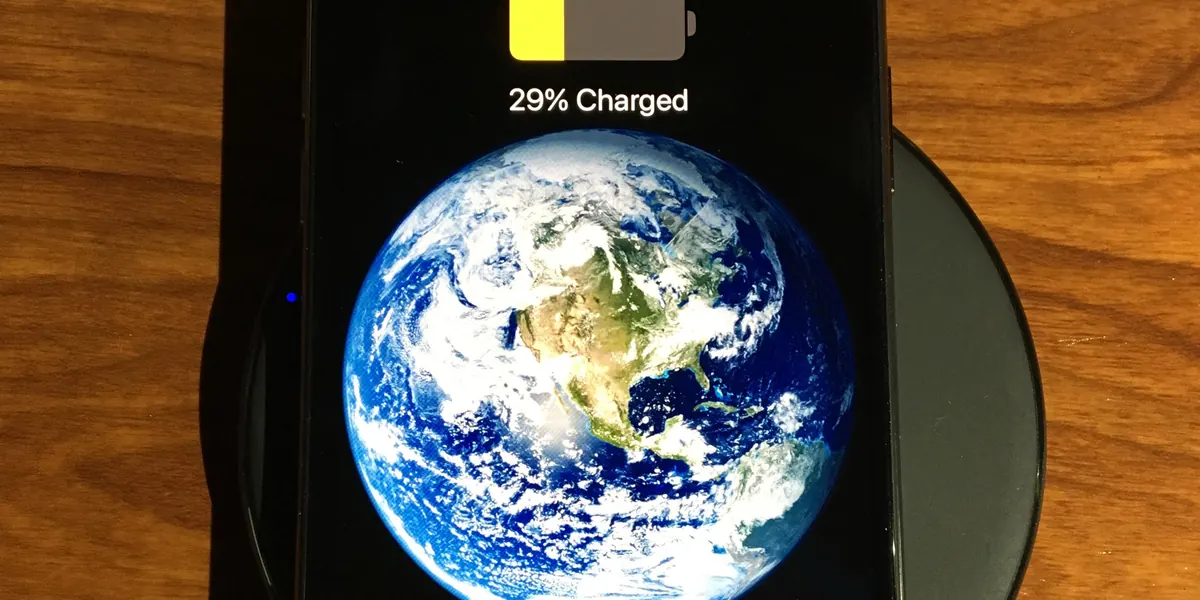
Cars with vehicle-to-load (V2L) put real power on tap: a Hyundai Ioniq 5 supplies up to 3.6 kW from its outlet, and a Ford F-150 Lightning’s Pro Power Onboard totals 9.6 kW — enough for tools, appliances, or a small house’s essentials, let alone the 0.02 kW a phone charger wants. Even without V2L, every EV’s USB ports are fed from the traction battery through a converter.
The energy math makes the party trick plain: a full EV pack holds about 3,800 phone charges. What you cannot do is run the car on phone batteries — at ~20 Wh each, matching one pack would take a small warehouse of them, with none of the cooling, structure or management that makes a pack safe.
Frequently Asked Questions
Is an EV battery the same as a phone battery?
The same lithium-ion family, a different product. Both move lithium ions between electrodes to store energy, but a phone battery is a single cobalt-rich LCO pouch cell of about 20 Wh, while an EV pack is 40–100+ kWh of NMC or LFP cells — hundreds to thousands of them — with cooling, buffers and a battery management system. Shared ancestry, opposite engineering.
How many phone batteries are in an EV?
None literally — EV packs use their own cylindrical or prismatic cells — but by energy: a 75 kWh pack holds the equivalent of about 3,800 flagship phone batteries (at ~19.8 Wh each), or roughly 5,000 typical phones, or about 750 laptop batteries.
Why does my phone battery die in two years but an EV battery lasts a decade?
Workload and treatment. A phone cycles almost daily at hard charge rates with no cooling and no buffer — it can spend its full 500–1,000-cycle rating in two years. An EV cycles about 50–60 times a year, keeps reserves at both ends, is liquid-cooled, and mostly charges gently at home. Geotab’s fleet data shows EVs degrading about 2.3% per year on average.
Do EVs use the same cells as laptops and phones?
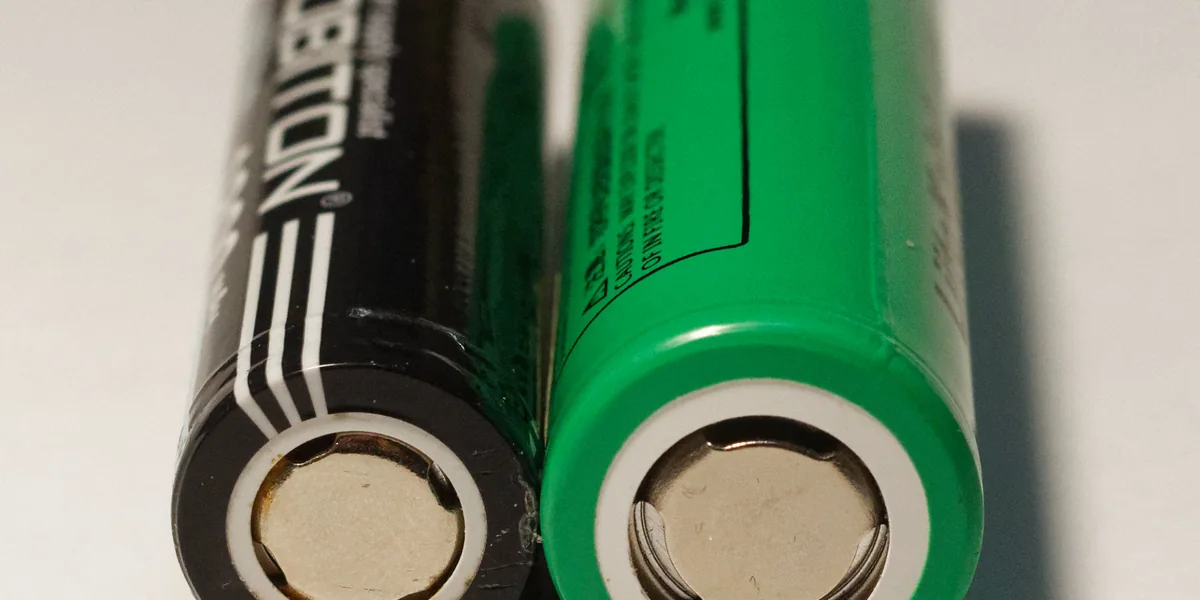
Sometimes the same formats — Tesla’s packs use 18650 and 2170 cylindrical cells, formats also found in laptops and power tools — but never the same chemistry priorities: consumer cells favour maximum density (LCO-family), EV cells are NMC, NCA or LFP chosen for cycle life, safety and cost.
Which lasts longer, LFP or a phone battery?
Not close. An LFP EV pack is rated for 2,000–5,000+ cycles and sits under an 8-year/100,000-mile warranty; a modern phone battery is rated for about 1,000 cycles to 80% (Apple’s figure for iPhone 15 and later). The LFP pack also lives an easier life — buffered, cooled, and cycled weekly instead of daily.
Can I charge my phone from an EV battery?
Yes — through the car’s USB ports in any EV, or a household-style outlet in cars with vehicle-to-load (Ioniq 5: up to 3.6 kW; F-150 Lightning: 9.6 kW total). A full EV pack holds roughly 3,800 full phone charges.
Why don’t phones use LFP batteries?
Size and voltage. LFP runs at 3.2 V with lower energy density than the cobalt-rich LCO blends phones use (150–200 Wh/kg and up), so an LFP phone would be noticeably thicker and heavier for the same runtime. Phones optimise for thinness and are replaced in a few years; LFP’s advantages — cycle life, cost, safety margin — matter far more in a car.
Will EV batteries get as small as phone batteries?
The gap is closing from both ends but will not meet: phone cells are gaining capacity (silicon-carbon anodes now push flagship cells toward 6,000–7,300 mAh), and EV cells keep improving in density. But a car needs tens of kilowatt-hours to move two tonnes — about 3,800 phones’ worth — and that physics does not shrink.
Conclusion
An EV battery is not a giant phone battery; it is what the same chemistry becomes when engineers are allowed cooling, buffers, thousands of cells and a decade-long brief. The phone battery’s short life is not a conspiracy or a flaw — it is the price of thinness, paid on a two-year replacement cycle its makers plan around. The EV pack’s long life is equally deliberate. Once you see the four mechanisms behind it — the hidden buffer, the liquid cooling, the gentle charging, the weekly workload — the obvious follow-up is why phones are not built the same way. They could be. They would just be thicker, heavier, and sold once a decade — and nobody in that industry is volunteering.
