
What Materials Are Inside an EV Battery?

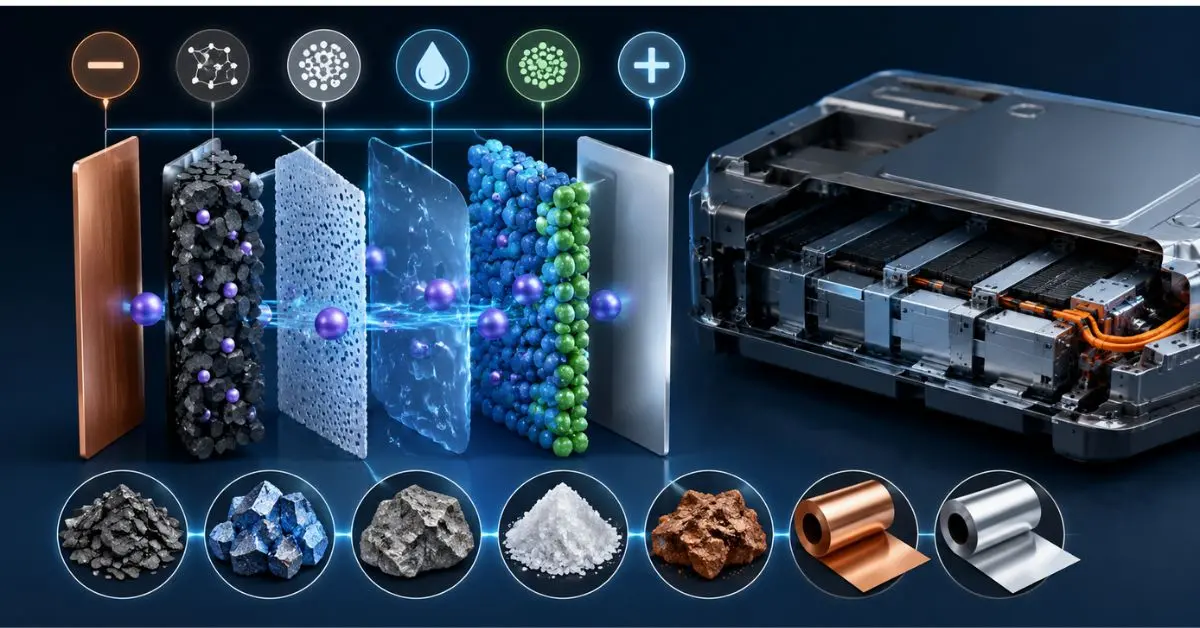
An EV battery is a complex system built from multiple carefully engineered materials. At its core, a lithium-ion cell contains five key components — cathode, anode, electrolyte, separator, and current collectors — each made from specific materials chosen for their electrochemical performance, safety, and cost.
A typical 75 kWh EV battery contains about 12 kg of lithium, 70 kg of graphite, 50 kg of nickel, 20 kg of aluminum foil, 25 kg of copper foil, and more — all working together every time you press the accelerator.
The Five Core Components Inside Every EV Battery Cell
Before looking at individual materials, it helps to understand what role each cell component plays:
| Component | Function | Primary Materials |
|---|---|---|
| Cathode (positive electrode) | Stores and releases lithium ions during discharge; determines energy density | Lithium + nickel, manganese, cobalt (NMC) OR iron, phosphate (LFP) |
| Anode (negative electrode) | Stores lithium ions during charging | Graphite (most common) or silicon-carbon composite |
| Electrolyte | Carries lithium ions between anode and cathode | Lithium hexafluorophosphate (LiPF₆) in organic solvent |
| Separator | Prevents physical contact between electrodes while allowing ion flow | Polyolefin polymer (PP/PE), often ceramic-coated |
| Current collectors | Conducts electrons in and out of the cell | Copper foil (anode side), Aluminum foil (cathode side) |
1. Cathode Materials — The Heart of the Battery
The cathode is the most expensive and chemically complex part of an EV battery. It determines energy density, voltage, cycle life, cost, and safety. The cathode material is where most of the lithium in a charged battery resides.
The two dominant cathode chemistries in modern EVs:
NMC — Nickel Manganese Cobalt (LiNiMnCoO₂)
- Nickel: Provides high energy density — more nickel = more range per kg. NMC 811 uses 80% nickel.
- Manganese: Stabilizes the crystal structure, improving safety and durability
- Cobalt: Improves conductivity and cycle stability. NMC 532 uses 20% cobalt; NMC 811 reduces this to 10%.
- Lithium: The active ion that moves during charge/discharge
A Tesla Model 3 Long Range (75 kWh) NMC 811 cathode contains approximately: 50 kg nickel, 4.5 kg cobalt, 4 kg manganese, and 12 kg lithium (Malvern Panalytical data).
LFP — Lithium Iron Phosphate (LiFePO₄)
- Iron: Replaces cobalt and nickel — abundant, inexpensive, and non-toxic
- Phosphate: Forms an extremely stable olivine crystal structure that resists thermal breakdown
- Lithium: The active ion — same role as in NMC
- Zero cobalt, zero nickel — the defining sustainability advantage of LFP
LFP’s lower energy density (~170 Wh/kg cell-level vs ~260 Wh/kg for NMC 811) means a heavier pack for the same range — but dramatically lower cost, better safety, and far longer cycle life (2,000–5,000+ cycles).
LMFP — Lithium Manganese Iron Phosphate (Emerging)
The next evolution beyond LFP adds manganese to the olivine structure, boosting energy density by approximately 14–20% while retaining LFP’s cobalt-free, high-safety profile. BYD’s second-generation Blade Battery (2026) uses LMFP. CATL is developing LMFP variants for mainstream production.
2. Anode Materials — Where Energy Is Stored During Charging
The anode stores lithium ions while the battery charges. During discharge, ions leave the anode and travel to the cathode, producing the electric current that drives the motor.
Graphite (dominant material)
Graphite is the standard anode material in virtually all commercial EV batteries today. It has a layered structure that allows lithium ions to slot between carbon layers (intercalation) without damaging the material. Key properties:
- Low cost and widely available
- Excellent cycle life — minimal structural change over thousands of cycles
- Theoretical capacity of 372 mAh/g
- China controls ~65% of global graphite supply — a growing supply chain concern for Western EV makers
A 75 kWh EV battery contains approximately 70 kg of graphite — more by weight than any other single material in the cell.
Silicon-Carbon Composite (emerging)
Silicon stores ~10x more lithium per gram than graphite — dramatically increasing potential energy density. The challenge: silicon expands up to 400% in volume when absorbing lithium, causing structural cracking over cycles. Silicon-carbon composite anodes blend silicon nanoparticles with graphite and specialized coatings to manage this expansion.
BYD’s second-generation Blade Battery uses a silicon-carbon composite anode. Panasonic, CATL, and Samsung SDI are all scaling silicon-carbon anode production for premium EV cells in 2025–2027.
3. Electrolyte — The Ion Highway
The electrolyte is the medium that carries lithium ions between anode and cathode. It must conduct ions efficiently while blocking electrons (forcing them through the external circuit). In almost all current EV batteries, the electrolyte is a liquid solution:
- Lithium salt: Most commonly lithium hexafluorophosphate (LiPF₆) — provides the Li⁺ ions
- Organic solvents: Ethylene carbonate (EC), dimethyl carbonate (DMC), and others — dissolve the lithium salt and carry ions
The electrolyte is flammable — which is why thermal management and cell design are so critical for fire safety. This is one reason solid-state batteries (with non-flammable solid electrolytes) are heavily researched.
4. Separator — The Safety Film
The separator is a thin (10–25 micron) porous polymer membrane placed between anode and cathode. It must:
- Allow lithium ions to pass through its pores
- Block direct physical contact between the two electrodes (which would cause a short circuit)
- Withstand the heat of fast charging without shrinking or melting
Most separators use polyolefin materials — polypropylene (PP), polyethylene (PE), or both in a PP/PE/PP trilayer. Many are ceramic-coated with alumina (Al₂O₃) or silica (SiO₂) to improve heat resistance and ion conductivity.
Advanced separators include thermal shutdown layers that melt and close pores if the cell overheats — providing a last-resort safety mechanism before thermal runaway.
5. Current Collectors — The Electron Pathways
Current collectors are thin metal foils that conduct electrons in and out of each electrode:
- Copper foil (anode side): ~8–10 microns thick. Copper is used because it’s highly conductive, compatible with graphite, and stable at low (anode) potentials. A 75 kWh EV battery uses approximately 25 kg of copper foil.
- Aluminum foil (cathode side): ~15–20 microns thick. Aluminum is lighter than copper, cost-effective, and stable at higher (cathode) potentials. A 75 kWh EV battery uses approximately 20 kg of aluminum foil.
Beyond the Cell: What Else Is in an EV Battery Pack?
Individual cells are assembled into modules and packs with additional materials:
- Steel casing (cylindrical cells): Each 18650, 21700, or 4680 cell has a steel can
- Aluminum pack enclosure: The outer battery pack housing — lightweight and structurally rigid
- Busbars: Thick copper or aluminum conductors connecting cells in series/parallel
- Thermal interface materials (TIMs): Thermal pads or adhesives between cells and cooling plates
- Coolant (liquid cooling): Typically, a 50/50 ethylene glycol-water mix circulating through cooling channels
- BMS electronics: Circuit boards monitor the voltage, temperature, and current of each cell
- Insulation and flame-retardant materials: Between cells and at module boundaries to prevent thermal runaway propagation
Full Material Breakdown: Tesla Model 3 LR 75 kWh Battery (Example)
| Material | Approx. Amount | Location in Battery |
|---|---|---|
| Graphite | ~70 kg | Anode |
| Nickel | ~50 kg | Cathode (NMC 811) |
| Aluminum foil | ~20 kg | Cathode current collector |
| Copper foil | ~25 kg | Anode current collector |
| Lithium | ~12 kg | Cathode + electrolyte |
| Cobalt | ~4.5 kg | Cathode (NMC 811) |
| Manganese | ~4 kg | Cathode (NMC 811) |
| Electrolyte (LiPF₆ + solvent) | ~10–15 kg | Between electrodes |
| Steel (cell casing) | ~30–40 kg | Individual cell cans |
| Aluminum (pack housing) | ~40–60 kg | Outer pack enclosure |
| Separator polymer | ~3–5 kg | Between anode and cathode |
Note: Figures are approximate and vary by manufacturing generation. Source: Malvern Panalytical / Visual Capitalist / European Federation for Transport & Environment data.
How Materials Differ: NMC vs LFP Side by Side
| Material | NMC Battery | LFP Battery |
|---|---|---|
| Cathode metals | Lithium, Nickel, Manganese, Cobalt | Lithium, Iron, Phosphate |
| Anode | Graphite | Graphite |
| Cobalt | Yes (4–20% of cathode) | Zero |
| Nickel | Yes (50–80% of cathode) | Zero |
| Cell voltage | ~3.6–3.7V | ~3.2V |
| Energy density | 150–250 Wh/kg | 90–170 Wh/kg |
| Thermal stability | Good (~210°C onset) | Excellent (~270°C onset) |
Read more: NMC vs LFP battery chemistry
Conclusion
An EV battery is a precisely engineered assembly of specific materials — each chosen for a defined electrochemical role. The cathode (NMC or LFP) determines energy density and cost. Graphite stores lithium in the anode. The electrolyte carries ions. The separator prevents short circuits. Copper and aluminum collect electrons.
Together, these materials inside an EV battery create one of the most sophisticated energy storage systems ever put into mass production. As battery technology advances toward silicon anodes, LMFP cathodes, and solid-state electrolytes, the material makeup is evolving — but the fundamental five-component cell structure remains constant.