
What Is a Sodium-Ion Battery? How It Works, Where It Stands in 2026

Researched from CATL’s Naxtra announcements, the IEA’s battery reporting, CNEVPost, InsideEVs, Faradion and BloombergNEF price data — November 2026.
Quick answer
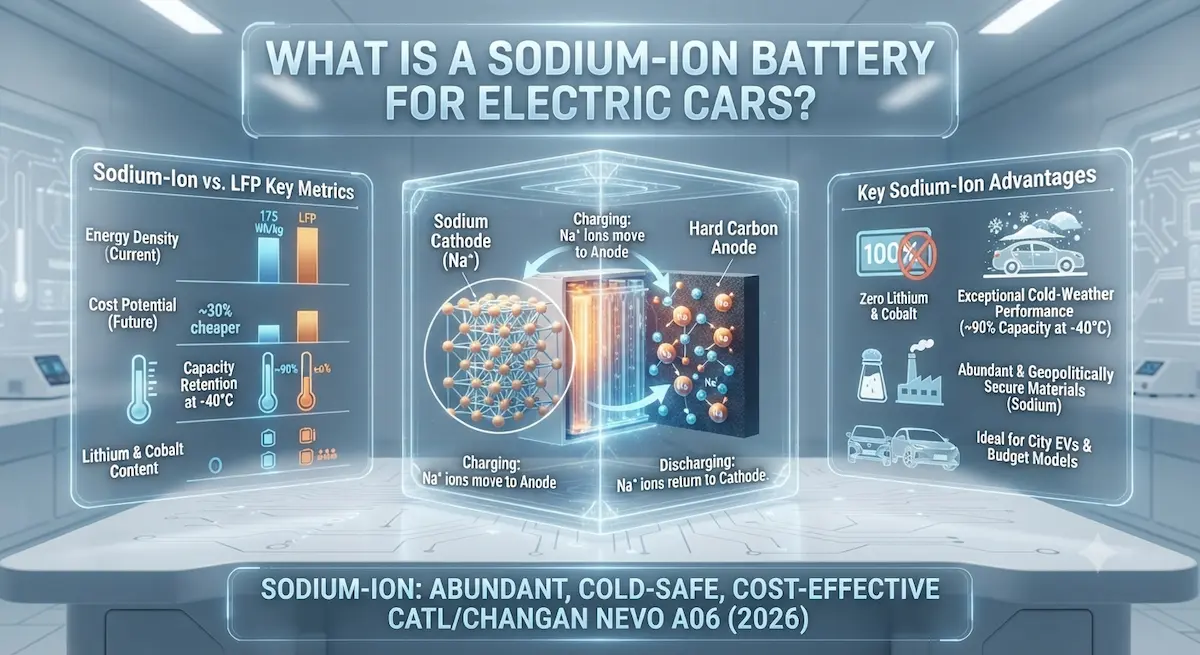
A sodium-ion battery is a rechargeable battery that shuttles sodium ions instead of lithium ions between its electrodes — the same basic trick, built from one of the cheapest, most abundant materials on Earth. The best production cells (CATL’s Naxtra) reach 175 Wh/kg, work from −40°C to +70°C and claim over 10,000 cycles. As of November 2026 you can buy a sodium-ion car only in China, sodium cells currently cost more than the LFP cells they are meant to undercut ($95–105 vs $84 per kWh), and no sodium-ion EV is on sale in the US or Europe.
- Contains no lithium, no cobalt, no nickel (in most designs) and no copper foil
- Its honest 2026 status: real, shipping, and still the challenger — not the champion
How a sodium-ion battery works
Sodium ions are bigger and heavier than lithium ions, and almost everything about this chemistry follows from that one fact.
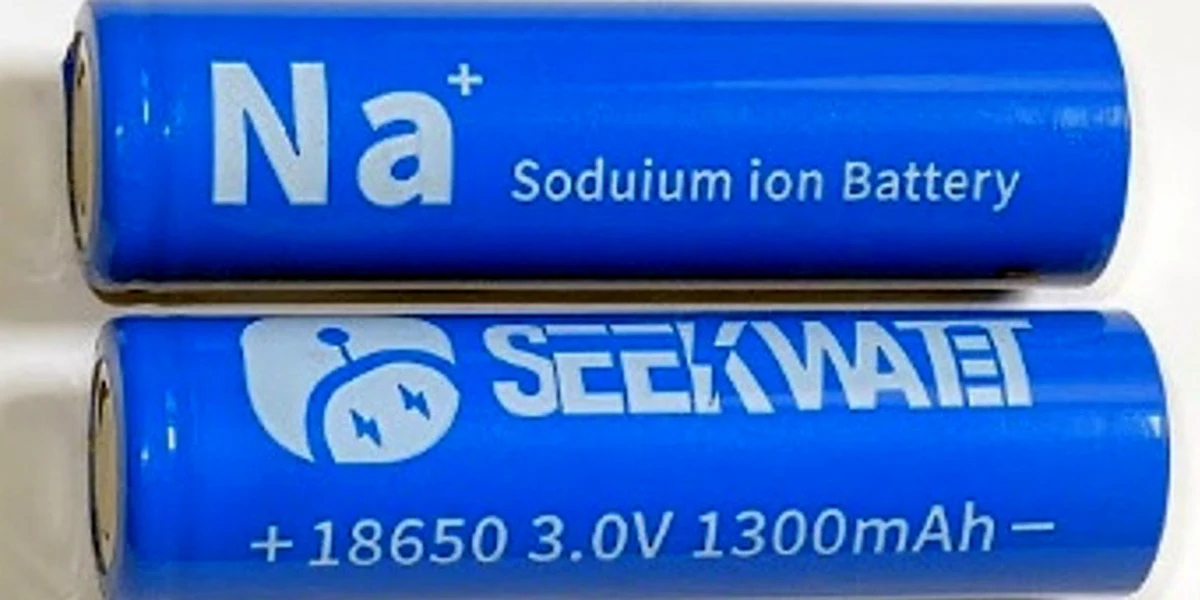
Charging pushes Na+ ions out of the cathode, through the electrolyte, and into the anode; discharging lets them flow back. The anode is not graphite — sodium barely fits inside it — but hard carbon, a disordered carbon that can host the larger ions at roughly 250–350 mAh/g. Because sodium does not alloy with aluminium the way lithium does, a sodium cell can use aluminium foil for both current collectors, deleting the copper foil every lithium cell needs. The costs of the design are physics, not engineering laziness: sodium’s extra mass and the cell’s lower voltage cap the energy density, which is why even the best sodium cells sit below good LFP.
The three cathode families
Every commercial sodium cathode belongs to one of three families, and each buys something different.
- Layered oxides — sodium layered with iron, manganese and sometimes nickel. The highest energy densities (this is the Naxtra route), but the structures shift as sodium leaves and returns, which stresses cycle life.
- Polyanionic compounds — phosphate-based frameworks with strong covalent bonds. Lower energy density, outstanding stability and safety: the durability route.
- Prussian blue analogues — open iron-based frameworks (Northvolt’s “Prussian White” was one) that let sodium move very fast. Cheap and quick, but fussy to manufacture — water content and crystal defects make or break them.
Sodium-ion against the lithium incumbents
On the numbers that decide EV range, sodium-ion in 2026 sits just below LFP — and ahead of it on cold, cycles and raw materials.
How does sodium-ion compare on the numbers?
| Sodium-ion (best production) | LFP | NMC | |
|---|---|---|---|
| Cell energy density | up to 175 Wh/kg | up to 205 Wh/kg | up to 265 Wh/kg |
| Cycle life | 10,000+ claimed (CATL Naxtra) | 2,000–5,000 typical | 1,000–2,500 typical |
| Cell price, 2026 | $95–105/kWh | $84/kWh | higher |
| Cold performance | 90% usable power at −40°C (CATL) | weakest of the three | mid |
| Key materials | sodium, iron, aluminium | lithium, iron | lithium, nickel, cobalt/manganese |
Table sources: IEA (densities), CATL (Naxtra claims), BloombergNEF (prices).
The fuller head-to-head, including pack-level and vehicle-level differences, is our dedicated sodium-ion vs lithium-ion comparison.
The cars that actually exist
Sodium-ion EVs are not a concept. They are a small, China-only market with a two-year head start on CATL’s headline car.
Which sodium-ion cars can you buy?
The first volume sodium EV was the JAC Yiwei EV3 (January 2024): a 23.2 kWh pack of HiNa cells at over 140 Wh/kg, 230 km of CLTC range, and a 10–80% charge in 20 minutes — a city car, priced like one. Jiangling’s JMEV EV3 followed with Farasis cells. The step change came in February 2026, when CATL and Changan unveiled the Nevo A06: a 45 kWh Naxtra pack, 400+ km CLTC range, discharge power at −30°C nearly triple an equivalent LFP car’s, on sale from mid-2026 — with CATL contracted to supply every Changan brand. BYD is building a third-generation sodium platform (10,000-cycle claims) and 30 GWh of planned capacity, but sells no sodium car yet. The running list of models lives on our page tracking which EVs use sodium-ion batteries.
The cold-weather superpower is real
Sodium chemistry’s party trick is genuine: at −40°C a Naxtra cell still delivers about 90% of its usable power — and can do it at 10% charge.
Why does the cold edge matter most?
That is not a marginal edge. LFP, the chemistry most affordable EVs now use, is at its weakest exactly there, which is why the first Naxtra car was unveiled in Inner Mongolia in February. For drivers in cold climates this is the one sodium advantage that exists today rather than in a forecast — and it is also why so much early sodium demand is in northern China and in grid storage. The dedicated analysis is our piece on whether sodium-ion works better in cold weather.
The cost story, told honestly
Sodium is ~1,000 times more abundant than lithium — and sodium-ion cells still cost more per kWh in 2026. Both things are true, and the second one is the one that matters this year.
When does sodium-ion get cheaper than LFP?
BloombergNEF’s survey puts early-2026 cells at $95–105/kWh for sodium-ion against $84/kWh for LFP, a 13–25% premium, because LFP is made at a scale sodium has not reached; the expected crossover is around 2028–29, and Wood Mackenzie calls 2030–35 the decisive window (while crediting sodium with a possible 21% total-cost-of-ownership edge over 20 years on cycle life). Sodium’s cost advantage is structural — soda ash instead of lithium carbonate, aluminium instead of copper, no nickel or cobalt — but structure is not scale. Our breakdown of how chemistry drives manufacturing cost shows why the cathode and density maths decide this fight.
The Western story: two pioneers, both gone
If you are reading this in the US or Europe, the relevant fact is blunt: there is no sodium-ion EV for sale to you, and the two companies that were supposed to change that both died in 2025.
What happened to Northvolt and Natron?
Northvolt validated a 160 Wh/kg sodium cell with Altris in 2023 — then filed for bankruptcy in March 2025 (its remaining assets went to Lyten that August). Natron Energy, the American Prussian-blue pioneer, reached commercial production in Michigan in April 2024 — then ceased all operations in September 2025, cancelling its $1.4 billion North Carolina gigafactory. What survives in the US is grid storage (Peak Energy is deploying multi-GWh sodium systems) — a market where energy density matters less and cycle life more. For an American EV buyer today, sodium-ion is a technology to watch, not a car to shortlist.
Safety: the 0-volt trick
A sodium-ion cell can be discharged to zero volts — completely, safely flat — and lithium-ion cells cannot. That single property removes a whole category of risk.
Why is a fully discharged sodium cell safe to ship?
Faradion’s peer-reviewed work shows a shorted, 0 V sodium cell has no short-circuit thermal-runaway potential, which is why sodium cells can be transported fully discharged while lithium cells must travel at partial charge. Reported nail-penetration tests on charged sodium cells show no flames. CATL describes Naxtra as moving from “passive defence” to “intrinsic safety” at the material level. None of this makes sodium cells indestructible — it makes their failure modes gentler, in transport, storage and crashes alike.
Frequently asked questions
Do sodium-ion batteries contain lithium?
No. The charge carrier is sodium, the anode is hard carbon, and the collectors are aluminium on both sides. Some layered-oxide cathodes contain nickel, but the mainstream designs use iron and manganese — no lithium, cobalt or copper anywhere in the cell.
Can I buy a sodium-ion EV in the US?
No — not in November 2026, and not in Europe either. Every production sodium-ion car (JAC Yiwei EV3, Changan Nevo A06 and their peers) is a China-market model. In the US, sodium-ion is arriving as grid storage first.
Will sodium-ion replace lithium-ion in EVs?
Not across the board. Its density ceiling keeps it out of long-range cars for the foreseeable future; its cold performance, cycle life and materials make it a strong challenger for city cars, entry models and stationary storage. Our full assessment is the page asking whether sodium-ion will replace lithium in EVs.
How long do sodium-ion batteries last?
CATL claims over 10,000 cycles for Naxtra — several times a typical LFP figure — and BYD claims the same for its coming platform. Those are manufacturer claims for cells, not yet a decade of fleet data; treat them as promising, not proven.
Why isn’t sodium-ion cheaper yet, if sodium is everywhere?
Scale. LFP’s price ($84/kWh per cell) is what a decade of gigafactory volume does; sodium lines are still small, and its lower density means more cell material per kWh of car. Analysts put the crossover near 2028–29.
Conclusion
A sodium-ion battery is lithium-ion’s cheaper-built, cold-proof, shorter-legged sibling: 175 Wh/kg at best, 10,000-cycle claims, on sale in exactly one country.
Its 2026 position is easy to mis-state in both directions. It is not a lab curiosity — CATL ships it, Changan sells a car with it, and its safety and cold-weather edges are measured, not promised. It is also not the lithium-killer of the headlines — it costs more per kWh today, its Western champions are bankrupt, and no American can buy one. The honest summary is the interesting one: sodium-ion has already won its first niches, and the fight for the entry-level EV starts around 2028.
Quick view: Sodium-ion is real, shipping and cold-proof — but pricier than LFP today and unavailable outside China; the entry-level fight starts around 2028.
