
Will Sodium-Ion Batteries Replace Lithium in EVs?

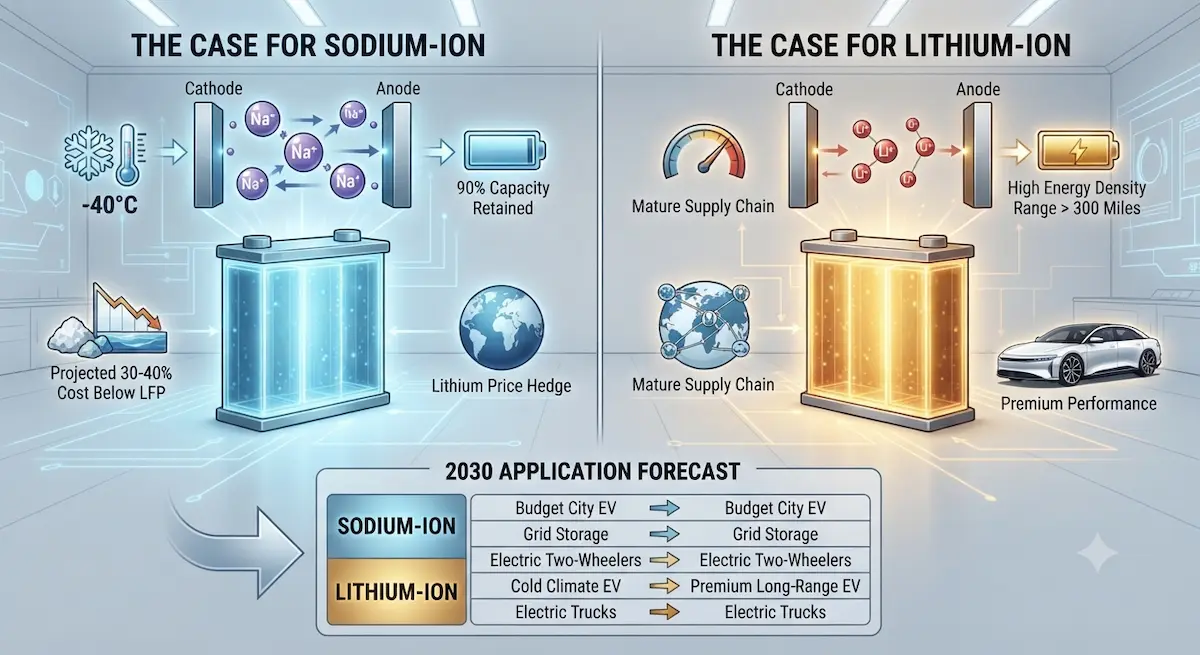
Sodium-ion batteries will not replace lithium-ion in EVs completely — but they will capture a significant and growing market share in specific applications where their advantages are decisive. The more accurate picture is a dual-chemistry era, as CATL itself describes it: sodium-ion and lithium-ion coexisting, each dominant in the applications suited to their strengths. Sodium-ion will likely replace LFP as the chemistry of choice for cold-climate markets, budget city EVs, grid storage, and two-wheelers — while lithium-ion (NMC, LFP, and next-generation LMFP) retains dominance in long-range passenger cars and premium vehicles.
New to sodium-ion itself? Start with our full explainer on what a sodium-ion battery for electric cars is.
The Case for Sodium-Ion Replacement
Three forces create genuine potential for sodium-ion to displace lithium-ion in significant market segments:
1. Cost Advantage Widening With Scale
CATL’s sodium-ion cells reached $55–70/kWh in Q1 2026 — a 35–40% discount to LFP cells at the same time. As sodium-ion production scales from CATL’s current 30 GWh annual capacity toward the 200+ GWh that LFP operates at, the cost advantage will compound through manufacturing learning curves. A LUT University (January 2026) study projects sodium-ion delivering storage at $12.76–$16.24/MWh by 2050 vs $18.56–$25.52/MWh for lithium-ion. The structural cost advantages — sodium abundance, no copper current collector, no cobalt/nickel — are permanent and become more pronounced at scale. For any application where cost per kWh is the primary decision factor, sodium-ion has a long-term structural advantage that is difficult for lithium-ion to fully overcome.
2. Lithium Price Vulnerability Creates Urgency
Lithium carbonate prices surged over 100% from late 2025 to early 2026, and over 190% from June 2025 to April 2026. These aren’t isolated spikes — lithium prices have shown extreme volatility throughout the EV era, swinging from $6,000/tonne in 2020 to over $80,000/tonne in 2022, back to $10,000/tonne in 2024, and spiking again sharply in 2025–2026. Each lithium price spike makes sodium-ion more economically compelling and accelerates adoption decisions at battery manufacturers and automakers. CATL explicitly called sodium-ion “alternative risk management” against lithium volatility. The more lithium prices spike, the faster sodium-ion adoption accelerates — creating a self-reinforcing cycle.
3. Cold-Climate Market Where Lithium-Ion Struggles
Northern China, Russia, Scandinavia, and Canada represent hundreds of millions of potential EV buyers who currently find LFP EVs limiting in winter. Sodium-ion retaining 90% capacity at -40°C vs LFP’s ~50% at the same temperature is not a marginal improvement — it is a practical game-changer for cold-climate EV adoption. In markets where winter range anxiety from LFP has genuinely slowed EV uptake, sodium-ion removes that barrier entirely while offering lower cost. For these specific markets, sodium-ion doesn’t compete with lithium-ion — it replaces it as the clearly superior solution.
See the full data behind this cold-weather edge in our guide on whether sodium-ion battery works better in cold weather.
The Case Against Complete Replacement
Despite the compelling advantages, sodium-ion will not replace lithium-ion in all EV applications:
Energy Density Is a Permanent Physics Limitation
Sodium ions are 3.3x heavier than lithium ions and form less energetically favorable bonding in electrode materials. At equivalent cell architecture, sodium-ion will always store somewhat less energy per kilogram than lithium-ion. CATL’s target of reaching LFP-equivalent energy density by ~2029 is achievable — but sodium-ion catching NMC 811 (~220–260 Wh/kg) is far harder, and matching NCA (~300+ Wh/kg) may be fundamentally impossible at sodium-ion’s current electrode material options. For premium EVs targeting 350–500 miles of range where energy density is the defining competitive metric, lithium-ion NMC and future solid-state batteries will maintain structural advantages that sodium-ion chemistry cannot overcome.
Supply Chain Inertia Favors Lithium-Ion
Trillions of dollars of investment have gone into lithium-ion mining, processing, cell manufacturing, and recycling infrastructure over three decades. Gigafactories, cathode active material plants, graphite anode factories, electrolyte facilities, and battery recycling operations are all built around lithium-ion chemistry. Transitioning this infrastructure to sodium-ion requires different cathode precursors, hard carbon anode supply chains, and modified cell manufacturing processes. While the cell manufacturing lines themselves are largely compatible between sodium-ion and lithium-ion (both use similar coaters, winders, and formation equipment), the upstream supply chain transition takes years and significant capital. This inertia means lithium-ion will dominate even in segments where sodium-ion might theoretically win on economics — simply because the supply chain exists and sodium-ion’s doesn’t yet at the same scale.
The Most Likely Outcome: Coexistence by Application
| Application | 2030 Likely Dominant Chemistry | Why |
|---|---|---|
| Premium long-range EV (300+ mi) | NMC / NCMA / Solid-state | Energy density requirements exceed sodium-ion capability |
| Mainstream EV (200–300 mi) | LFP / LMFP | Mature supply chain, proven value |
| Budget city EV (150–200 mi) | Sodium-ion / LFP | Sodium-ion cost advantage decisive |
| Cold climate EV (any segment) | Sodium-ion preferred | Winter range retention unmatched |
| Grid energy storage | Sodium-ion dominant | Cost per kWh decisive; weight irrelevant |
| Electric two-wheelers | Sodium-ion growing rapidly | Cost + safety + no temperature issues |
| Electric trucks / commercial | LFP / LMR | Range + cycle life balance favors LFP/LMR |
Frequently Asked Questions
Will sodium-ion batteries replace lithium in EVs?
Not completely — but they will replace lithium-ion in specific segments. Sodium-ion is likely to become dominant in grid storage, electric two-wheelers, budget city EVs, and cold-climate markets where its cost and cold-weather advantages are decisive. Premium long-range EVs will retain lithium-ion (NMC, solid-state) due to energy density requirements. The future is a dual-chemistry era where sodium-ion and lithium-ion coexist by application, not a wholesale replacement.
When will sodium-ion be mainstream in EVs?
Sodium-ion entered commercial EV production in mid-2026 in China (Changan Nevo A06). Broader Chinese market adoption is expected 2026–2028 as additional models launch. Western market adoption is realistically 2028–2031, contingent on IRA-compliant sodium-ion supply chain development and cell cost competitiveness vs LFP. Grid storage adoption is moving faster — CATL’s 60 GWh sodium-ion deal with HyperStrong (April 2026) demonstrates large-scale commercial deployment already underway.
Conclusion
Sodium-ion batteries will not replace lithium-ion in EVs universally — but they will replace it where it matters most for their specific strengths: cold climates, budget city vehicles, and grid storage. The IEA, CATL, and BYD all describe the future as a dual-chemistry era rather than a replacement story. Sodium-ion is a complementary technology that fills gaps lithium-ion struggles to fill economically and technically — not a universal successor. The applications where sodium-ion will win are large and growing: billions of two-wheeler riders, hundreds of millions of cold-climate drivers, and terawatt-hours of grid storage all represent massive commercial opportunities that sodium-ion can address better than any current lithium-ion chemistry. That is enough to make it one of the most important battery developments of this decade, even without ever replacing lithium-ion across the board.
Curious how this compares head-to-head against lithium-ion overall? See our full comparison of sodium-ion vs lithium-ion battery.
