
Liquid vs Gel vs Solid Electrolyte: What’s the Difference?

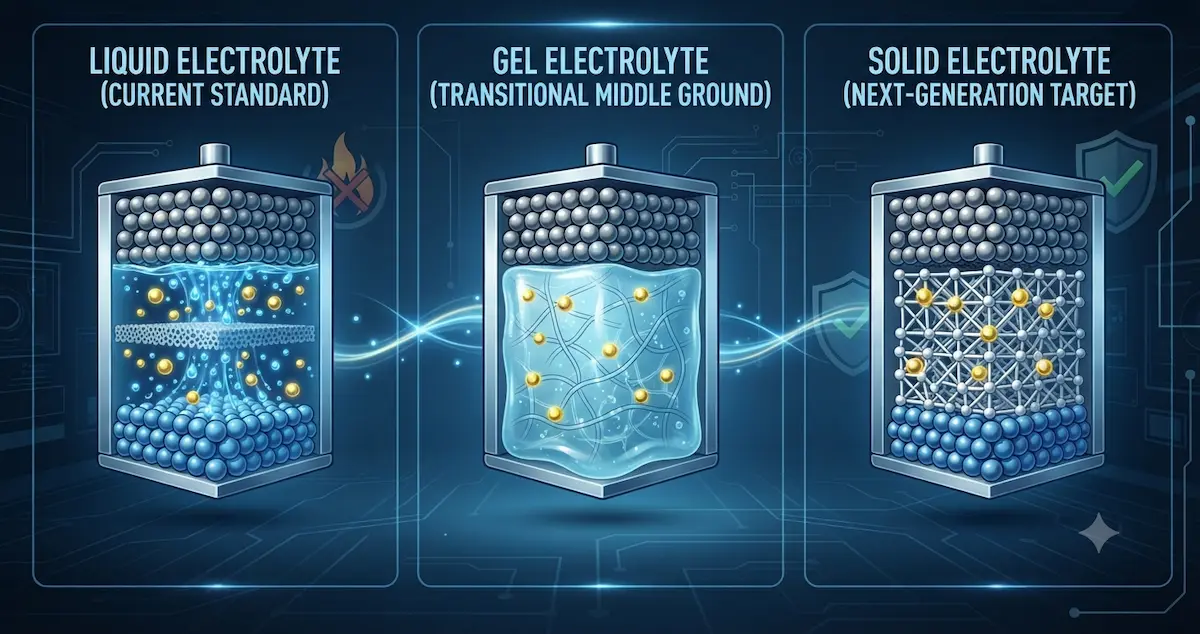
The electrolyte in a battery can take three physical forms — liquid, gel, or solid — and the choice fundamentally shapes the battery’s safety profile, energy density, operating temperature range, and manufacturing process. Liquid electrolytes dominate all current EV batteries. Gel electrolytes are a transitional technology used in some pouch cells. Solid electrolytes are the defining feature of next-generation solid-state batteries, targeting commercial EV deployment from 2027 onward. Each form represents a different tradeoff between ion conductivity, safety, and manufacturability.
For a deeper look at the polymer-specific approach, see our full explainer on what a polymer electrolyte battery is.
Liquid Electrolyte: The Current Standard
Every EV battery in mass production today uses a liquid electrolyte — a solution of lithium hexafluorophosphate (LiPF₆) dissolved in organic carbonate solvents (ethylene carbonate, dimethyl carbonate, ethyl methyl carbonate). This liquid flows through the porous separator and coats every particle of the cathode and anode, ensuring intimate ionic contact across the entire electrode surface. This perfect, self-renewing electrode contact is liquid electrolyte’s greatest practical strength — it maintains performance even as electrodes expand and contract during cycling, because the liquid simply flows to fill any gaps.
Liquid electrolyte properties in EV batteries:
- Ionic conductivity: ~10–15 mS/cm — excellent ion transport enables fast charging and high power output
- Operating temperature: Approximately -30°C to +60°C for standard formulations, though performance degrades toward these extremes
- SEI formation: The electrolyte partially decomposes on the anode surface during early cycles, forming the critical Solid Electrolyte Interphase layer that protects the anode and enables cycle life
- Flammability: The organic solvents (DMC, EMC) are flammable — the primary safety limitation of all liquid lithium-ion batteries
- Manufacturing advantage: Liquid electrolyte filling is a well-mastered, high-throughput process that can wet electrode surfaces quickly and reliably
A 75 kWh EV battery contains approximately 10–15 kg of liquid electrolyte — essential but also the component that makes thermal events dangerous if the battery is severely damaged or overheated. Research into safer electrolyte formulations (flame-retardant additives, high-concentration electrolytes, ionic liquid blends) continues actively at all major battery manufacturers.
Gel Electrolyte: The Transitional Middle Ground
Gel polymer electrolytes are a hybrid between liquid and solid — they consist of a polymer matrix (typically polyvinylidene fluoride, PVDF, or polyacrylonitrile, PAN) swollen with a liquid electrolyte to create a gel-like material. The polymer network provides mechanical integrity while the liquid phase maintains ionic conductivity. Gel electrolytes are sometimes called “quasi-solid” or “semi-solid” depending on their liquid content.
Key properties of gel electrolytes:
- Ionic conductivity: ~1–10 mS/cm — lower than liquid but significantly better than most fully solid electrolytes
- Safety improvement: Reduced liquid content means less flammable material, lower risk of electrolyte leakage, and improved mechanical stability
- Flexibility: Gel electrolytes conform to electrode surfaces better than rigid solid electrolytes — maintaining contact during electrode volume changes
- Manufacturing: Can use existing electrode coating equipment with modifications — more adaptable to current gigafactory infrastructure than ceramic solid electrolytes
- Temperature range: Typically -20°C to +70°C — similar to liquid but with reduced leak risk at elevated temperatures
Gel electrolytes have been used in pouch-format lithium polymer (Li-Po) cells for consumer electronics for decades. In the EV context, NIO’s 150 kWh “semi-solid” battery pack supplied by WeLion uses a gel/composite electrolyte — achieving approximately 300–350 Wh/kg at the cell level, significantly better than standard liquid electrolyte cells. This semi-solid technology represents the most commercially advanced transitional electrolyte technology currently in EV production, offering improved safety and energy density without requiring the full manufacturing transformation of ceramic solid electrolytes.
See our full explainer on this exact NIO/WeLion approach: what a semi-solid-state battery is.
Solid Electrolyte: The Next-Generation Target
Solid electrolytes replace all liquid content with a solid inorganic or polymer material. This is the defining feature of solid-state batteries — and the change that drives all of solid-state’s advantages in safety, energy density, and cycling performance. Solid electrolytes come in three main material classes:
Oxide Ceramics (LLZO family)
Lithium Lanthanum Zirconium Oxide (Li₇La₃Zr₂O₁₂, or LLZO) is one of the most studied solid electrolytes. It is chemically stable in air and against lithium metal — properties that make it attractive for lithium metal anode cells. Ionic conductivity: ~0.1–1 mS/cm — lower than liquid but improving with doping strategies (aluminum, tantalum, or niobium dopants raise conductivity to 1+ mS/cm). LLZO is brittle — it cracks under mechanical stress from electrode volume changes, requiring careful cell design to manage this. QuantumScape uses an LLZO-family solid electrolyte in its anode-free cell design.
Sulfide-Based Solid Electrolytes
Sulfide solid electrolytes (Li₆PS₅Cl “argyrodite,” Li₁₀GeP₂S₁₂ “LGPS”) achieve ionic conductivities of 10–25 mS/cm — matching or exceeding liquid electrolytes. This superior ion transport makes sulfides the most promising electrolyte class for fast-charging solid-state batteries. The critical weakness: sulfide materials react violently with atmospheric moisture, generating toxic hydrogen sulfide (H₂S) gas. Manufacturing requires ultra-dry conditions more stringent than current battery gigafactories. Toyota, Samsung SDI, and Solid Power use sulfide-based electrolytes as their primary approach.
Polymer Electrolytes
Polymer solid electrolytes use high-molecular-weight polymers (typically polyethylene oxide, PEO, with lithium salt) as the ion conductor. They are flexible, easily processable, and compatible with existing electrode manufacturing equipment. The fundamental limitation: PEO and similar polymers achieve acceptable ionic conductivity only above 60°C — requiring the battery to operate at elevated temperature or using a heated battery management system. Ionic conductivity at room temperature is typically <0.1 mS/cm — inadequate for high-rate charging applications. Polymer electrolytes are most practical for semi-solid or hybrid designs where a polymer matrix contains liquid or gel components, rather than as a pure solid electrolyte for automotive fast-charging applications.
Liquid vs Gel vs Solid: Full Comparison
| Property | Liquid | Gel | Solid (Sulfide) | Solid (Oxide) |
|---|---|---|---|---|
| Ionic conductivity | ~10–15 mS/cm | ~1–10 mS/cm | ~10–25 mS/cm | ~0.1–1 mS/cm |
| Flammability | Yes — flammable organic solvents | Reduced — less liquid content | No — non-flammable inorganic | No — non-flammable inorganic |
| Electrode contact | Excellent — self-wetting liquid | Good — gel conforms | Challenging — solid-solid interface | Very challenging — brittle ceramic |
| Operating temp range | -30 to +60°C (standard) | -20 to +70°C | Wide — better than liquid in cold | Wide potential range |
| Lithium metal anode compatible? | No — dendrites and reactivity | Partially | Yes — main solid-state benefit | Yes |
| Manufacturing complexity | Low — existing processes | Moderate | Very high — H₂S sensitivity | High — brittle, high-temp sintering |
| Commercial EV deployment | Mass market now | Limited (NIO/WeLion) | 2027–2028 (Toyota, Samsung SDI) | 2028+ (QuantumScape) |
Why Switching Electrolytes Changes Everything
The electrolyte choice is not an isolated component decision — it changes what electrode materials are compatible, what cell format makes sense, what manufacturing processes are needed, and what safety systems are required. Liquid electrolyte enables graphite anodes (which intercalate lithium in a liquid environment), cylindrical and prismatic cell formats, and standard roll-to-roll manufacturing. Solid electrolytes enable lithium metal anodes (which react destructively with liquid electrolyte), potentially thinner cell designs, and fundamentally different manufacturing processes. The transition from liquid to solid electrolyte is not a component swap — it is a complete reinvention of how batteries are designed and made, which is why solid-state commercialization takes so much longer and costs so much more than cell chemistry improvements within the existing liquid electrolyte framework.
Frequently Asked Questions
What is the difference between liquid, gel, and solid electrolyte?
Liquid electrolyte (LiPF₆ in organic solvents) is the current EV standard — excellent conductivity, easy manufacturing, but flammable. Gel electrolyte is a polymer matrix swollen with liquid — improved safety and mechanical stability but lower conductivity. Solid electrolyte replaces all liquid with an inorganic solid — non-flammable, enables lithium metal anodes and higher energy density, but requires entirely new manufacturing processes and faces higher interface resistance challenges.
Are gel electrolyte batteries safer than liquid?
Yes — gel electrolytes contain less flammable organic solvent than liquid electrolytes, reducing fire risk and eliminating electrolyte leakage risk. NIO’s WeLion 150 kWh semi-solid pack uses gel/composite electrolyte and delivers improved energy density (~300–350 Wh/kg) alongside better safety vs standard liquid electrolyte cells. However, gel electrolytes are still not fully non-flammable — only solid inorganic electrolytes achieve true non-flammability.
Which solid electrolyte is best for EV batteries?
Sulfide-based electrolytes offer the best ionic conductivity (~10–25 mS/cm, matching liquid electrolytes) and are the choice of Toyota, Samsung SDI, and Solid Power. Oxide ceramics (LLZO) offer better chemical stability and no moisture sensitivity — QuantumScape’s approach. Neither is definitively “best” — sulfides offer better performance but worse manufacturability; oxides offer better stability but lower conductivity. The commercial winner will be determined by which approach achieves better manufacturing scale and cost reduction first.
Conclusion
The electrolyte in an EV battery can be liquid (today’s standard), gel (transitional), or solid (next generation) — and this single choice cascades through every aspect of battery performance, safety, and manufacturing. Liquid electrolytes enable the EV revolution happening right now — mature, conductive, and manufacturable at scale, despite their flammability. Gel electrolytes offer a stepping stone with improved safety and energy density in limited commercial deployment. Solid electrolytes represent the transformative future — non-flammable, enabling lithium metal anodes, and capable of unlocking 300–500+ Wh/kg energy densities that make today’s best EVs look short-ranged. The transition from liquid to solid electrolyte is happening — slowly, expensively, but inevitably.
Today’s liquid electrolyte also has well-documented aging challenges — see our explainer on what causes electrolyte breakdown in EV batteries.
