
What Is a Polymer Electrolyte Battery?

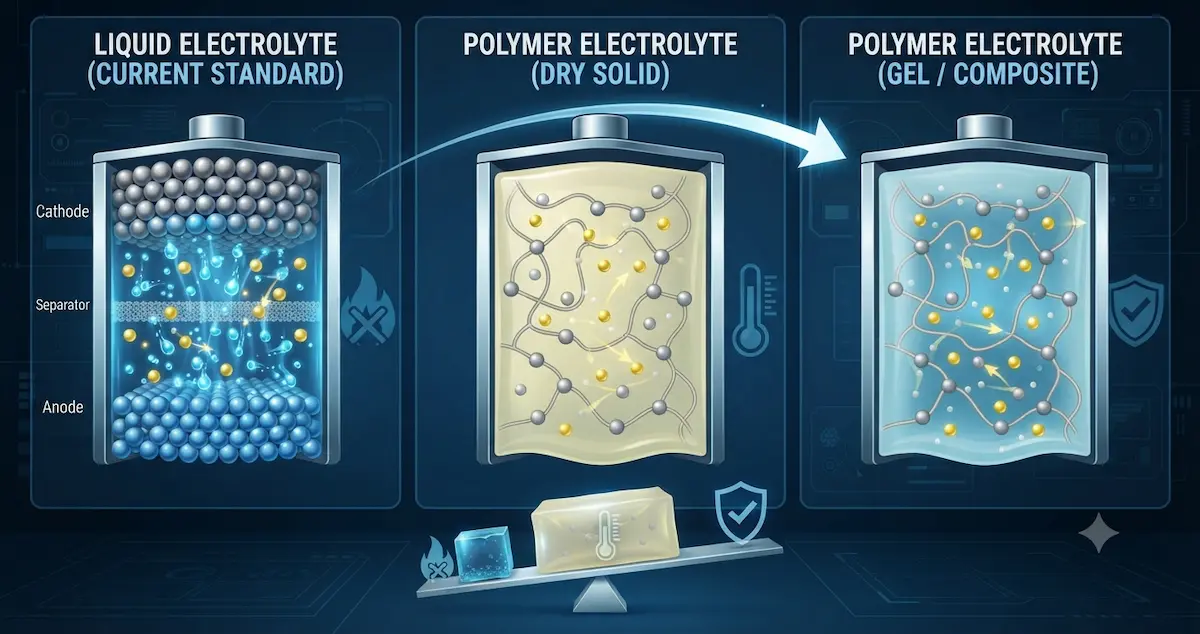
A polymer electrolyte battery uses a solid or gel polymer material instead of a liquid organic solvent to conduct lithium ions between the cathode and anode. The most studied polymer electrolyte material is polyethylene oxide (PEO) combined with a lithium salt. Polymer electrolytes represent a middle ground between liquid electrolyte batteries (current standard) and fully inorganic solid electrolytes (solid-state batteries) — offering improved safety and mechanical flexibility while avoiding the most difficult manufacturing challenges of ceramic solid electrolytes. In EV applications, polymer electrolytes are most relevant in semi-solid battery designs and as a component of composite solid electrolytes.
See the full three-way comparison of electrolyte states in our guide on liquid vs gel vs solid electrolyte.
What Is a Polymer Electrolyte?
A polymer electrolyte consists of a high-molecular-weight polymer host (most commonly polyethylene oxide, PEO, or polyvinylidene fluoride, PVDF) combined with a dissolved lithium salt. The polymer chains coordinate with lithium ions — creating ion-conducting pathways through the solid polymer matrix. Unlike liquid electrolytes where ions move freely through a solvent, in polymer electrolytes ions move through segmental motion of the polymer chains — which requires the polymer to be in a flexible, partially amorphous (non-crystalline) state to allow chain movement.
Two main types are used in battery applications:
- Dry solid polymer electrolyte (SPE): Pure polymer + lithium salt, no liquid content. Fully solid, non-flammable, but achieves adequate ionic conductivity only above 60°C (the PEO crystallization temperature). Most practical for specialized applications with battery heating, or as one component in composite electrolytes.
- Gel polymer electrolyte (GPE): Polymer matrix swollen with liquid electrolyte. Retains liquid within the polymer network — better room-temperature conductivity than dry SPE while offering improved safety vs pure liquid (no free liquid to leak or splash). This is what most “lithium polymer” (Li-Po) consumer batteries use.
How Polymer Electrolytes Work
In dry solid polymer electrolytes, lithium ion transport occurs through segmental motion — the polymer chains constantly move and flex at a molecular level, temporarily creating pathways that allow Li⁺ ions to hop from one coordination site to the next along the polymer chain. This motion requires the polymer to be above its glass transition temperature (Tg) — the temperature below which the polymer becomes rigid, and ion motion essentially stops. PEO’s Tg is approximately -60°C, but its crystallization temperature is ~65°C — meaning PEO is too crystalline at room temperature for adequate lithium transport. Above 60°C, PEO melts into a fully amorphous state with adequate ion conductivity (~0.1–1 mS/cm). Below 60°C, conductivity drops dramatically as crystalline regions form and block ion pathways.
This temperature limitation is the fundamental challenge of dry polymer electrolytes for EV applications — a battery that only works well above 60°C requires continuous heating, consuming energy and adding thermal management complexity. Strategies to overcome this include:
- Using plasticizers to disrupt PEO crystallinity
- Cross-linking the polymer network to prevent crystallization
- Blending PEO with other polymers or ceramic fillers
- Designing composite electrolytes with ceramic fillers (composite polymer-ceramic electrolytes)
Bolloré’s Blue Solutions: Polymer Electrolyte EVs in Practice
The most commercially significant deployment of dry solid polymer electrolytes in EVs is the Bolloré Blue Car / Autolib program in France. Bolloré’s Plastic State Battery (PSB) technology uses a PEO-based dry solid polymer electrolyte and operated the Blue Car EV fleet in Paris from 2011 to 2018. The battery operated at 60–80°C — maintained by a controlled heating system. This demonstrated that solid polymer electrolyte EVs are technically feasible, but the operating temperature requirement and associated heating energy penalty reduce efficiency compared to liquid electrolyte competitors. The Autolib program ultimately ended for commercial (not battery technology) reasons — illustrating that polymer electrolyte batteries are a real option but carry practical tradeoffs.
NIO’s WeLion pack is one of the most notable production examples — see our explainer on what a semi-solid-state battery is.
Polymer Electrolyte vs Liquid vs Ceramic Solid
| Property | Polymer Electrolyte | Liquid Electrolyte | Ceramic Solid (LLZO) |
|---|---|---|---|
| Room temp conductivity | <0.1 mS/cm (dry); ~1–5 mS/cm (gel) | ~10–15 mS/cm | ~0.1–1 mS/cm |
| Operating temperature | Optimal above 60°C (dry) | -30 to +60°C | Wide range, but brittle |
| Flammability | Low to none (especially dry SPE) | Yes — organic solvents | No — inorganic ceramic |
| Flexibility | High — polymer is flexible | N/A (liquid) | Very low — brittle |
| Manufacturability | Good — solution casting, roll-to-roll | Excellent | Difficult — high-temp sintering |
| Li metal anode compatible? | Partially — better than liquid | No | Yes |
| Commercial EV use | Limited (Bolloré, semi-solid designs) | Universal (all current EVs) | 2028+ (QuantumScape) |
Polymer Electrolytes in Next-Generation Designs
Rather than being a standalone electrolyte for mainstream EVs, polymer electrolytes are finding important roles in next-generation battery architectures as components of more complex designs:
- Composite polymer-ceramic electrolytes: Embedding ceramic fillers (LLZO particles, Al₂O₃ nanoparticles) in a PEO polymer matrix suppresses crystallization and improves room-temperature conductivity while maintaining processability advantages of polymers. This composite approach is attracting significant research interest as it may bridge the gap between polymers’ manufacturability and ceramics’ conductivity.
- Polymer binder in sulfide cells: In sulfide-based solid-state cells, polymer binders are used to improve the mechanical integrity of the sulfide electrolyte layer — incorporating small amounts of polymer to prevent cracking without sacrificing conductivity.
- Semi-solid batteries: NIO’s WeLion pack uses a composite electrolyte with both polymer and liquid components — capturing better safety and energy density than pure liquid while maintaining better manufacturability than pure ceramic solid electrolytes.
Frequently Asked Questions
What is a polymer electrolyte battery?
A polymer electrolyte battery uses a solid or gel polymer material (typically PEO or PVDF-based) to conduct lithium ions instead of a liquid organic solvent. Dry solid polymer electrolytes are non-flammable and more mechanically stable than liquid electrolytes but achieve adequate conductivity only above ~60°C. Gel polymer electrolytes contain liquid within a polymer matrix — better room-temperature conductivity with improved safety vs pure liquid.
Are polymer electrolyte batteries safer than liquid electrolyte batteries?
Yes — especially dry solid polymer electrolytes, which contain no liquid organic solvent and are non-flammable. Gel polymer electrolytes have reduced (but not eliminated) flammability vs pure liquid. The safety improvement comes with a performance tradeoff in room-temperature ionic conductivity — dry polymer electrolytes need external heating for adequate conductivity, which adds system complexity and energy consumption.
Why don’t more EVs use polymer electrolyte batteries?
The primary limitation is room-temperature ionic conductivity. Standard PEO-based polymer electrolytes achieve adequate conductivity only above 60°C, requiring battery heating that reduces efficiency. Liquid electrolytes achieve 10–15 mS/cm at room temperature vs. polymers’ <0.1 mS/cm without heating — a 100x+ difference that makes polymer batteries impractical for high-power EV applications without significant innovations in polymer design. Gel polymer electrolytes partially address this but still lag liquid performance and add manufacturing complexity.
Conclusion
Polymer electrolyte batteries represent an important point in the spectrum between liquid electrolyte (today’s EV standard) and ceramic solid-state (tomorrow’s target). Dry solid polymer electrolytes offer genuine safety advantages — non-flammable, leak-proof, and mechanically flexible — but the 60°C operating temperature requirement limits their practical appeal for mainstream EV applications. Gel polymer electrolytes offer a practical compromise deployed in NIO’s semi-solid battery pack. Composite polymer-ceramic electrolytes are emerging as a promising path to combining polymer manufacturability with ceramic conductivity. While polymer electrolytes may not power the majority of EVs, they play an important supporting role in the evolution from today’s liquid electrolyte cells toward tomorrow’s fully solid-state batteries.
Today’s liquid electrolytes have their own well-known aging challenges — see our explainer on what causes electrolyte breakdown in EV batteries.
