
Silicon vs Graphite Anode: Which Is Better for EVs?

Strip an EV battery down to the part that quietly decides its range, and the anode is where the fight is. Graphite has held that job for three decades; silicon can store roughly ten times more lithium — and nearly destroys itself doing it. This is the honest comparison, and why the battery in a real EV today uses both.
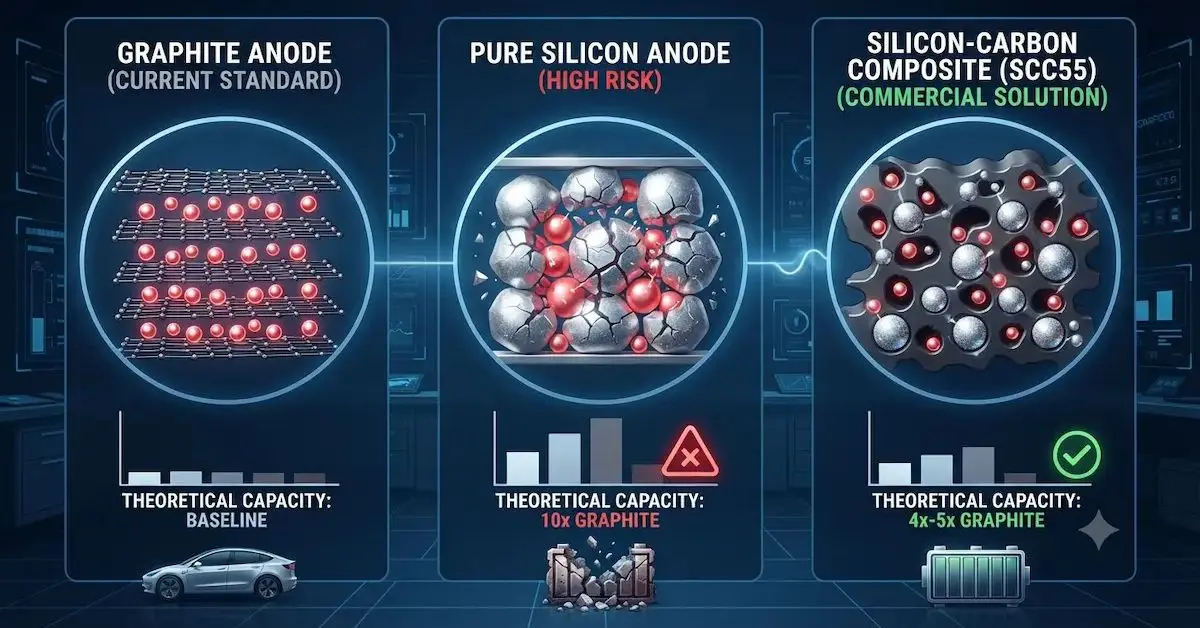
Neither wins outright. Graphite is cheap, proven and long-lived, which is why almost every EV still uses it. Pure silicon stores about ten times more lithium per gram but swells roughly 300% as it charges and tears itself apart. What actually goes into cars is the compromise: a graphite anode with silicon blended into it — a few percent in most EVs, much more in a few premium designs — trading a slice of graphite’s lifespan for a real gain in range and charging speed.
How do silicon and graphite anodes store lithium?
The two materials take in lithium in completely different ways — and that one difference explains everything else in this comparison.
Graphite works by intercalation: lithium ions slide into the gaps between its carbon layers and sit there in an orderly stack, one lithium for every six carbon atoms (LiC6). The layers swell only about 10%, the structure survives, and the same trick repeats for thousands of cycles. The cost of that tidiness is a hard ceiling — 372 milliamp-hours per gram is all graphite can ever hold.
Silicon works by alloying: it bonds with the lithium itself, forming a lithium-silicon alloy (Li15Si4 at full charge) that packs in 3,579 milliamp-hours per gram — roughly ten times graphite’s figure by weight, and about three times by volume. The catch is in the word “alloy”: the silicon’s own structure is rebuilt around the lithium, and it takes up far more room doing it.
Why does the anode matter so much?
Because the anode is one of the biggest single parts of the cell, every gram it saves is a gram the battery can spend on range.
The cathode gets most of the attention because it carries the expensive metals and the lithium inventory — the comparison in our LFP vs NMC guide is really a cathode story. But the anode occupies a large share of the cell’s volume. A higher-capacity anode can be made thinner for the same energy, freeing space for more cathode — or the whole pack can shrink. That is why a better anode lifts the whole battery, and why the simple graphite anode explainer only tells half the story.
Silicon vs graphite: the numbers side by side
On paper, silicon wins the headline number by a mile. The rest of the table is where graphite earns its place.
| Measure | Graphite | Silicon |
|---|---|---|
| Theoretical capacity | 372 mAh/g | 3,579 mAh/g |
| Swelling when fully charged | About 10% | Roughly 300% |
| First-cycle efficiency | About 92–95% | About 70–85% (pure silicon); blends land in between |
| Cycle life in commercial use | 2,000–3,000 cycles is typical | Pure silicon: a few hundred. Leading blends: 2,000+ cycles reported by their makers |
| Cost today | The lowest — a mature commodity supply chain | Far higher — a new material with factories still scaling |
| In production EVs | The standard anode in nearly every EV | Blended into graphite anodes; high-silicon designs are just arriving |
Why does pure silicon fail in an EV battery?
Silicon does not wear out gently. It breaks apart physically, a little more on every charge.
Charged, a silicon particle swells to roughly three times its resting size; discharged, it shrinks back. After enough of these cycles the particles crack and crumble — engineers call it pulverisation — and the fragments lose electrical contact with the rest of the electrode. Capacity locked inside a disconnected fragment is capacity the driver never sees again.
What is the SEI, and why does silicon keep breaking it?
The SEI is the battery’s protective skin — and silicon’s swelling tears it open on every cycle.
On the first charge, a thin film called the solid electrolyte interphase (SEI) forms on the anode’s surface. On graphite it forms once and then protects the surface for years. On silicon, the swelling cracks the film every cycle, exposing fresh silicon underneath. The battery responds by building new SEI — and building it consumes lithium and electrolyte, the two things the battery can least spare. Resistance climbs, usable capacity falls, and the cell ages far faster than its chemistry promised.
What does first-cycle loss cost the driver?
Part of a silicon cell’s capacity is spent before the car ever turns a wheel.
A graphite anode gives back about 92–95% of the lithium it takes in on the first charge. Pure silicon gives back only about 70–85% — the rest is trapped in that first SEI and in the alloy. That lithium came from the cathode, so it is range the pack was built with and never delivers. Makers compensate by oversizing the cathode or by pre-loading the anode with lithium (prelithiation), and both fixes add cost and factory complexity — one reason silicon arrived as a small blend first, not a revolution.
Why do silicon-carbon composites work where pure silicon fails?
Nobody puts bare silicon in a car battery. They hide small silicon particles inside a carbon structure that takes the strain.
The carbon does three jobs at once: it conducts electricity, it holds the electrode together, and — in the porous-scaffold designs — it leaves empty space for the silicon to swell into instead of bursting the particle. Group14’s SCC55, for example, is built by depositing silicon inside a porous carbon scaffold. Sila’s Titan Silicon puts silicon nanoparticles inside a carbon structure, and Sila says the result is cell-level swelling comparable to graphite’s.
The blend level is the dial the industry is turning. Most EV anodes on the road today carry only a few percent of silicon, often added as silicon oxide, inside a graphite anode. Research and commercial composites typically work in the 5–15% silicon range: each step up buys capacity and charging speed, and costs some of the cycle life and first-cycle efficiency in the table above. Where a maker sets that dial tells you what the battery was designed to be — a long-life workhorse, or a range and charging flagship.
Which EVs use silicon anodes today?
Almost all of them — a little. Silicon is already in the anode of a typical new EV; there just is not very much of it yet.
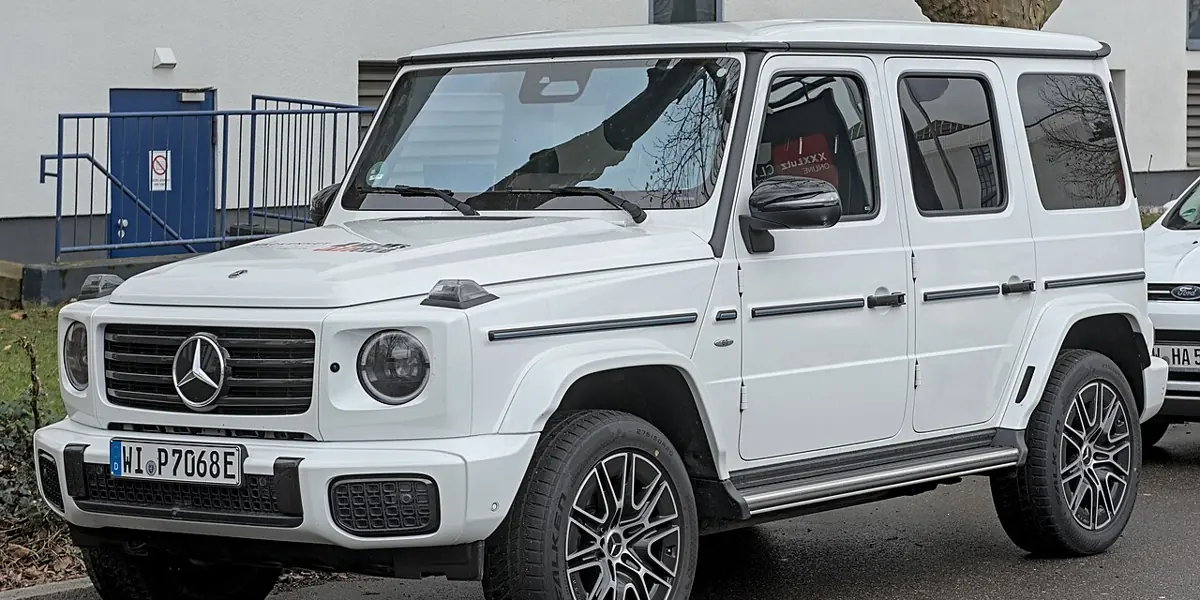
That small standard dose is the industry’s quiet consensus: a few percent of silicon buys a useful slice of extra capacity while graphite’s structure keeps the electrode honest. The headline case sits at the other end of the dial. Mercedes-Benz announced in 2022, in its own words, that the all-electric G-Class would be the first Mercedes-Benz vehicle to feature advanced battery cell chemistry from Sila Nanotechnologies as an option — and its 2021 strategy update had already said the next battery generation would use silicon-carbon composite in the anode to raise energy density. Read that carefully, because it is often reported more strongly than Mercedes said it: an announced option is not proof of what is inside every G 580 rolling off the line today, and Mercedes has published no range figure for a Sila version.
What the material makers themselves claim is on the record. Sila says replacing graphite with Titan Silicon delivers a 20% energy density boost over the industry’s best cells, that the material has achieved more than 2,000 cycles, and that it can enable fast charging in under ten minutes — the company’s figures, for its material, not a tested production car. Group14 says its SCC55 is designed to deliver up to 50% more energy density, is already powering more than 25 million devices, and is manufactured at scale in South Korea and Washington state. Between the cautious few-percent present and those claims sits the next decade of EV batteries.
Does silicon charge faster than graphite?
In demonstrations, yes — silicon cells post charging numbers graphite cannot match. Doing it every day for ten years is the part still being proven.
The potential is real, and it has a physical reason. Silicon takes in lithium at around 0.4 volts against lithium, graphite at around 0.1 volts. Graphite’s low working voltage leaves almost no headroom: push the charging current too hard and lithium starts plating onto the surface as metal instead of sliding between the layers — the failure that fast charging is designed around. Silicon’s extra headroom is why makers can demonstrate extreme charges: Sila says its material can enable sub-ten-minute fast charging, and Group14 says a commercially available Molicel cell using SCC55 has charged from 0 to 100% in 90 seconds and reached up to 3,000 cycles. Those are small commercial cells under demonstration conditions, not 100 kWh car packs — but they show where the ceiling sits.
The counterweight is endurance. Silicon’s SEI keeps re-forming and its resistance keeps growing as it cycles, which makes holding that fast-charge performance over a pack’s whole life the harder engineering problem. There is a subtler cost, too, and it lands on the battery management system: silicon’s voltage rises and falls gradually as it charges instead of staying nearly flat like graphite’s, so the car’s state-of-charge estimate — the number behind the range readout — has to work harder to stay honest. None of that blocks silicon. It just means the blend, the cooling and the software have to be designed together.
What is slowing silicon down: cost and factories
Not chemistry any more — manufacturing. Graphite has a thirty-year supply chain; silicon anodes are being built factory by factory.
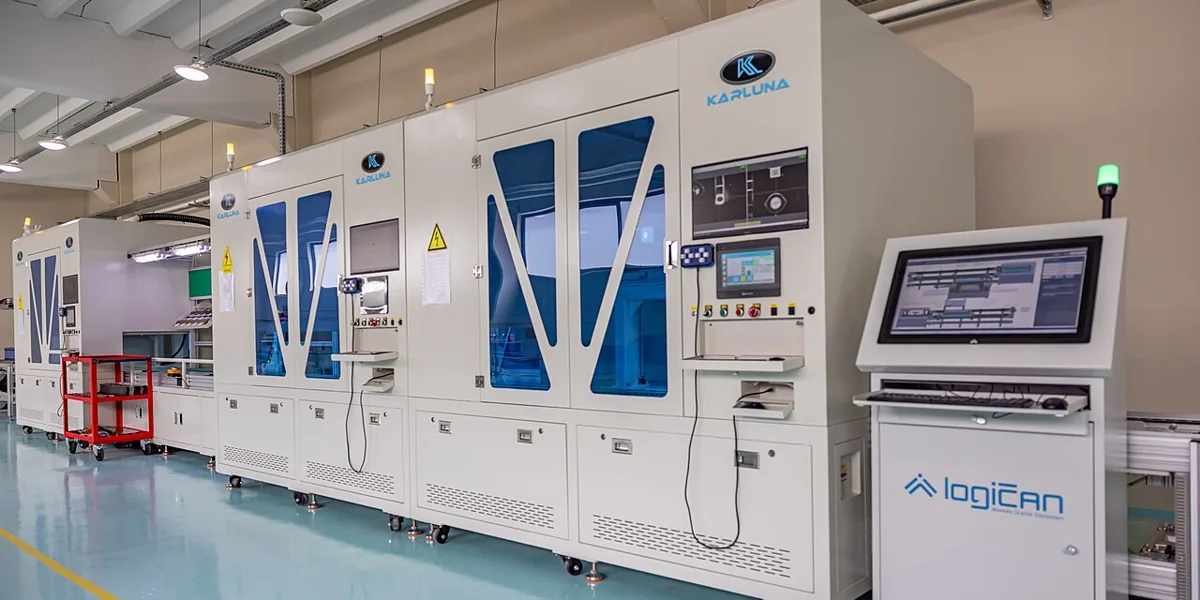
The raw material is not the problem: silicon is one of the most abundant elements on earth, refined from sand. The problem is everything after that. Battery-grade graphite is a finished, cheap commodity — though a concentrated one: Group14 itself notes that Asia controls over 90% of the world’s battery-grade graphite supply, which is part of why Western makers want a second anode technology at all. Silicon anode material, by contrast, needs dedicated plants making a far more engineered product, and today it costs far more per kilowatt-hour than graphite. Until those plants multiply, cost alone keeps the silicon share small in mass-market cars and saves the high blends for premium models that can carry the price.
Which is better for EVs: silicon or graphite?
For the battery you can buy today: graphite, with silicon’s help. For the battery the industry is building toward: silicon-carbon, with graphite still inside it.
- Graphite wins on life, cost and proof. It is the anode in nearly every EV on the road, it lasts thousands of cycles, and its supply chain exists at full scale today.
- Silicon-carbon wins on energy and charging potential. More range from the same pack size and faster charging are real, demonstrated gains — bought with higher cost and a shorter track record.
- Pure silicon wins on paper only. A 3,579 mAh/g anode that swells roughly 300% is a laboratory direction, not a showroom one; no production EV runs a pure silicon anode.
The contest is also not the only one running. Cathode-side density pushes like CATL’s condensed battery and anode alternatives like lithium metal are chasing the same prize from different directions. But the anode race has a clear shape: not a switch from graphite to silicon, but a silicon share that rises a few percent at a time as factories and warranties allow.
Frequently asked questions
Can silicon anodes replace graphite completely?
Not yet, and not soon. Full replacement runs into the swelling, first-cycle loss and factory problems covered above all at once. What is actually happening is a rising blend: graphite remains the structure while the silicon share climbs as materials and plants improve.
What are the downsides of silicon anodes?
Four, in order of how much they matter: roughly 300% swelling that cracks particles and the protective SEI layer; a first-cycle loss that can spend 15–30% of the lithium a pure silicon anode first receives; faster ageing from that constantly re-forming SEI; and a much higher material cost than graphite today.
Is a silicon anode battery good?
In blend form, yes — that is the form in which it reaches cars. A silicon-carbon anode gives more energy and faster charging than graphite alone, with the carbon structure managing the swelling. How good the trade is depends on the blend: a few percent is a gentle upgrade, a high-silicon design is a deliberate bet on range and charging over maximum lifespan.
Does a silicon anode make an EV battery safer?
The anode is not the main lever for fire risk. Thermal runaway is driven mostly by the cathode chemistry and the cell’s condition, and both anode materials are stable, oxygen-free carbons or silicon. Silicon’s problems are durability problems — cracking, resistance growth, faster ageing — not an added fire risk.
Conclusion
Graphite is not the past and silicon is not quite the present; the present is the two of them in one anode, mixed in proportions that inch upward every model year. If you are buying an EV, the practical read is simple: a maker’s talk of silicon content is a claim about range and charging ambition, while the warranty terms remain the honest measure of how long they expect the pack to last. The fuller story of the material itself is in our silicon anode battery explainer.
