
What Is a Dual-Ion Battery Chemistry?

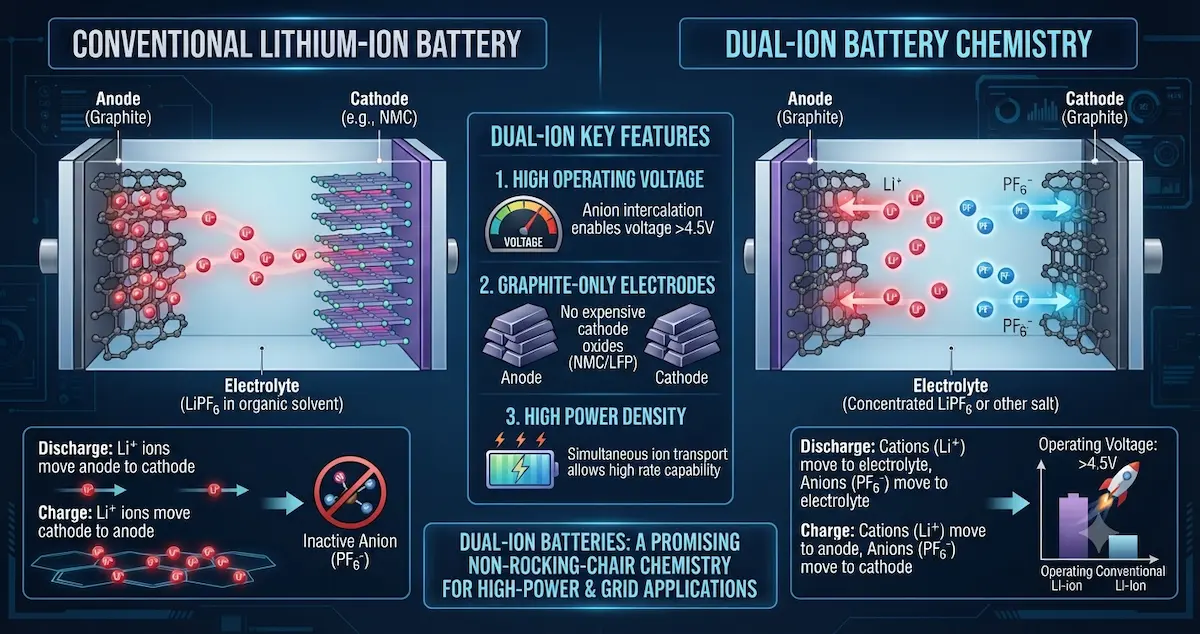
A dual-ion battery (DIB) is an energy storage chemistry in which both cations (positive ions) and anions (negative ions) from the electrolyte simultaneously participate in energy storage—with anions intercalating into the cathode during charging while cations intercalate into the anode. This is fundamentally different from conventional lithium-ion batteries, where only lithium cations move between electrodes. The dual-ion mechanism enables high operating voltages (often above 4.5V), potentially low cost through graphite-only or other abundant electrode materials, and interesting multi-ion chemistry possibilities. As of 2026, dual-ion batteries are an advanced research and early commercialization-stage technology — promising for grid storage and high-power applications, but not yet deployed in commercial EVs.
Curious about a much higher-density exotic conversion chemistry instead? See our guide on what a lithium-sulfur battery for EVs is.
How Dual-Ion Batteries Work
In a conventional lithium-ion battery, the electrolyte salt (LiPF₆) dissociates into Li⁺ cations and PF₆⁻ anions. During charging and discharging, only the Li⁺ cations move — intercalating into the graphite anode during charge and deintercalating from the cathode oxide during discharge. The PF₆⁻ anions remain essentially inert in the electrolyte — their only role is to maintain charge neutrality as lithium ions move.
Dual-ion batteries use both the cation and the anion simultaneously as active charge carriers:
- During charging: Cations (Li⁺, Na⁺, K⁺, Al³⁺, or other metal ions) intercalate into the anode (typically graphite or a metal), while simultaneously, anions (PF₆⁻, TFSI⁻, FSI⁻, or AlCl₄⁻) intercalate into the cathode (typically graphite, though other carbon materials are used). Both electrodes are simultaneously being charged from the electrolyte.
- During discharging: The process reverses — cations leave the anode and return to the electrolyte, while anions simultaneously leave the cathode and return to the electrolyte. Both ion types return to solution simultaneously, generating an electric current through the external circuit.
This simultaneous bidirectional ion transport from the electrolyte into both electrodes is called a “non-rocking-chair” mechanism — unlike the rocking-chair mechanism of lithium-ion where only Li⁺ moves back and forth between the two electrodes. The practical implication: since both electrodes draw from the same electrolyte reservoir, dual-ion batteries require a larger electrolyte volume per unit of energy than conventional lithium-ion cells — the electrolyte functions as an active energy storage medium rather than just an ion transport medium.
Types of Dual-Ion Battery Configurations
Dual-ion battery research spans multiple cation-anion combinations, creating a family of related but distinct chemistries:
Lithium-Based Dual-Ion (Graphite-Graphite)
The original and most studied dual-ion configuration uses graphite as both anode (for Li⁺ intercalation) and cathode (for PF₆⁻ or similar anion intercalation). This “dual-carbon” or “dual-graphite” battery can operate at voltages above 4.5V vs Li/Li⁺ — significantly higher than conventional NMC’s ~3.7V average. The high voltage in theory enables high energy density, but graphite’s anion intercalation capacity is limited — only specific stages of graphite intercalation compounds with anions are accessible, limiting practical capacity. EMC-based electrolytes have been shown to significantly improve performance by reducing cathode electrolyte interface resistance and enabling 90% capacity delivery at 12C rates — making lithium dual-ion batteries particularly attractive for high-power applications where rate capability matters more than peak energy density.
Sodium-Based Dual-Ion Batteries
Replacing lithium with sodium as the cation enables dual-ion batteries using no lithium at all — directly addressing lithium supply chain concerns. Sodium-based DIBs pair hard carbon anodes (for Na⁺ intercalation) with graphite cathodes (for anion intercalation). Energy density is lower than lithium DIBs due to sodium’s heavier atomic weight, but cost could be dramatically lower — sodium is 1,000x more abundant than lithium. A 2025 Korean Chemical Engineering review analyzed sodium-based, potassium-based, and magnesium-based DIBs, finding sodium-based systems the most promising near-term alternative to lithium for DIB applications.
Aluminum-Graphite Dual-Ion Batteries
Aluminum-graphite dual-ion batteries (AGDIBs) use aluminum metal as the anode (Al³⁺ ions plate/strip from aluminum metal) and graphite as the cathode (AlCl₄⁻ anions intercalate). Aluminum’s trivalent charge carrier (Al³⁺ transfers 3 electrons vs Li⁺’s 1) gives aluminum high theoretical capacity per weight. Aluminum is the most abundant metal in Earth’s crust and extremely cheap. The electrolyte is typically an ionic liquid (AlCl₃/EMIMCI or similar) rather than organic carbonate — making aluminum-graphite DIBs potentially non-flammable. Significant challenges remain: low specific capacity of the graphitic carbon cathode for anion intercalation, severe electrolyte-induced corrosion of aluminum metal, and temperature sensitivity of ionic liquid electrolytes. A comprehensive review published in Green Chemistry (November 2025) identified these as the primary barriers to practical AGDIB deployment.
Magnesium-Based Dual-Ion Batteries
Magnesium is another attractive divalent cation (Mg²⁺) for DIBs — abundant, inexpensive, and with reasonably high theoretical capacity (2,205 mAh/g for Mg metal). The challenge is magnesium passivation in conventional electrolytes — a thick passivation layer forms on Mg metal that blocks Mg²⁺ ion transport, preventing effective cycling. Developing compatible electrolyte systems for Mg²⁺ DIBs is an active research area, with ionic liquid and highly concentrated electrolyte formulations showing promise.
Dual-Ion Battery Potential Advantages
- High operating voltage: The simultaneous anion intercalation into the cathode enables operating voltages above 4.5V — higher than conventional lithium-ion (3.6–3.7V average). Higher voltage directly benefits energy density and power density for a given capacity.
- Low-cost electrode materials: Using graphite for both electrodes eliminates expensive cathode oxide materials (NMC, LFP) — a potentially dramatic cost reduction since cathode materials represent 35–45% of lithium-ion cell cost. Graphite costs $6–10/kg vs NMC cathode at $15–25/kg and LFP cathode at $10–15/kg.
- High power density: The dual-intercalation mechanism can proceed at high rates in optimized systems — making DIBs attractive for high-power applications where rapid charge/discharge is needed
- Lithium-free options: Sodium, potassium, and aluminum-based DIBs eliminate lithium dependence entirely — addressing supply chain vulnerability without the energy density sacrifices of low-voltage aqueous alternatives
Current Limitations for EV Applications
Despite their theoretical advantages, dual-ion batteries face significant barriers to EV deployment:
- Large electrolyte volume requirement: Since the electrolyte is consumed during charging (both electrodes draw ions from it), DIBs require much larger electrolyte volumes per unit energy than conventional lithium-ion cells. This substantially reduces practical cell-level energy density — current lithium-free graphite DIBs achieve only 20–70 Wh/kg at the cell level without concentrated electrolyte strategies.
- Electrolyte cost and stability: The concentrated electrolytes required for high-energy DIBs (5M ionic liquid or fluorosulfonyl salt solutions) are more expensive than standard LiPF₆ carbonate electrolytes and may have narrower stability windows or higher viscosity
- Cycle life challenges: Anion intercalation into graphite cathodes — particularly with large anions like PF₆⁻ or TFSI⁻ — causes greater structural stress per cycle than Li⁺ intercalation, limiting cycle life in many DIB designs
- Commercial immaturity: No commercial DIB EV battery exists as of 2026 — the technology is in research and early pilot stages. The application roadmap points toward grid storage and high-power industrial applications before EV deployment.
Where Dual-Ion Batteries Make Most Sense
Based on the current state of DIB technology, the most promising near-term applications are not EV propulsion but adjacent applications where specific DIB strengths are most valuable:
- Grid energy storage: Where the large electrolyte volume requirement (reducing energy density) is acceptable, and where low cathode material cost and high cycle life at moderate rates are paramount
- High-power industrial applications: Forklifts, mining equipment, and other heavy industry applications where high rate capability and cost trump energy density
- Power tools and consumer electronics: Where high power delivery at relatively short discharge times matches DIB high-voltage, high-power strengths
- EV auxiliary systems: The 12V battery systems and power electronics in EVs could benefit from high-power DIB designs before main traction batteries adopt the chemistry
- See our full explainer on another safety-focused electrolyte approach: what a semi-solid-state battery is
Frequently Asked Questions
What is a dual-ion battery chemistry?
A dual-ion battery stores energy by intercalating both cations (e.g., Li⁺, Na⁺, Al³⁺) into the anode AND anions (e.g., PF₆⁻, TFSI⁻, AlCl₄⁻) into the cathode simultaneously during charging — unlike conventional lithium-ion where only Li⁺ moves. This enables high operating voltages above 4.5V and potentially low cathode costs through graphite-only electrodes. Current energy density of 20–200 Wh/kg (depending on configuration) and large electrolyte requirements limit EV deployment, with grid storage and high-power applications being near-term commercial targets.
Are dual-ion batteries better than lithium-ion for EVs?
Not currently. Standard lithium-ion (NMC 811, LFP) outperforms current DIB implementations on practical energy density — the most critical EV metric. DIB’s advantages in operating voltage, potentially lower cost, and lithium-free options are compelling for future development, but achieving competitive energy density while maintaining cycle life and reasonable electrolyte volume remains unsolved at commercial scale. DIBs are more likely to contribute to EVs through hybrid designs or specific sub-applications before replacing lithium-ion in traction batteries.
Could aluminum dual-ion batteries replace lithium in EVs?
Theoretically attractive but practically challenging. Aluminum is the most abundant metal in Earth’s crust ($2/kg vs $15,000–80,000+/tonne for lithium carbonate), trivalent (transfers 3 electrons vs 1 for lithium), and widely available globally. Aluminum-graphite DIBs eliminate lithium, cobalt, and nickel entirely. The barriers — electrolyte corrosion, low cathode capacity, ionic liquid electrolyte sensitivity — require significant materials engineering progress before aluminum DIBs can compete with LFP or NMC for EV applications. Research published through 2025–2026 is actively addressing these barriers.
Conclusion
Dual-ion batteries represent a genuinely novel approach to electrochemical energy storage — using both ions from the electrolyte simultaneously rather than the single-cation rocking-chair mechanism of conventional lithium-ion. The potential benefits are real: high operating voltage, potential for lithium-free operation, low cathode materials cost, and excellent high-power characteristics. The barriers to EV deployment — practical energy density limitations from large electrolyte requirements, cycle life challenges from anion intercalation stresses, and commercial immaturity — are being actively researched across graphite DIBs, sodium-based DIBs, and aluminum-graphite configurations. Dual-ion batteries are not an imminent threat to lithium-ion EV dominance, but they are a technology family that could contribute meaningfully to the energy storage landscape — particularly in grid storage and high-power applications — and may eventually find roles in EV applications as the technology matures through the late 2020s.
Another abundant, low-cost metal-ion chemistry chasing similar grid-and-beyond goals is explored in our guide on what zinc-ion batteries are and whether they can power EVs.
