
What Is CATL’s Condensed Battery Technology?

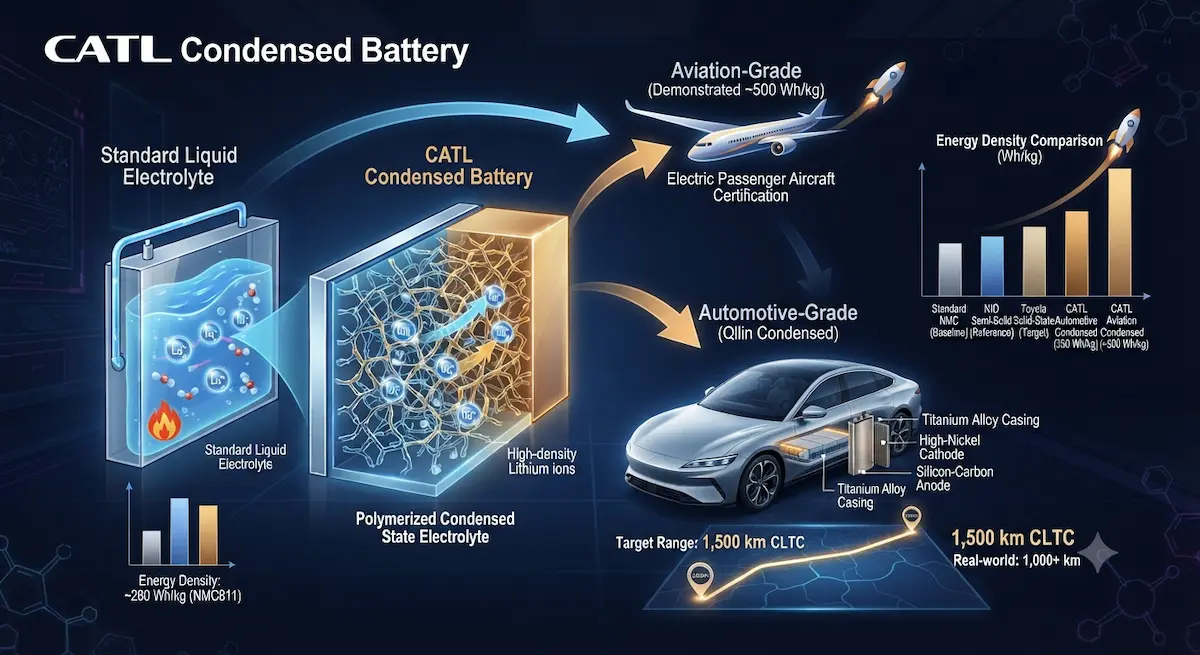
CATL’s Condensed Battery is a novel battery technology that uses a “polymerized condensed state” electrolyte — a proprietary adaptive micron-scale network structure that sits between conventional liquid and fully solid electrolyte — to achieve energy densities dramatically higher than standard lithium-ion. The aviation-grade version achieves up to 500 Wh/kg at cell level — approaching gasoline on an energy-per-mass basis. The automotive-grade Qilin Condensed Battery (revealed at CATL’s April 2026 Super Technology Day) achieves 350 Wh/kg gravimetric and 760 Wh/L volumetric energy density, enabling executive-class sedans with up to 1,500 km (932 miles) of CLTC range and large SUVs with over 1,000 km. This represents CATL’s most advanced single battery technology — bridging the gap between today’s NMC cells and tomorrow’s solid-state batteries.
See how this fits into CATL’s broader multi-chemistry roadmap in our guide on what CATL’s battery chemistry strategy is.
What Is CATL’s Condensed Battery Technology?
CATL describes the Condensed Battery as based on “condensed matter physics principles” — a reference to the study of matter in condensed phases with complex intermolecular interactions. The key innovation is the polymerized condensed state electrolyte: a material with an adaptive micron-scale network structure that adjusts inter-chain interactions during electrochemical reactions. This novel electrolyte state allows CATL to use ultra-high-energy-density cathode materials (high-nickel, and beyond) while maintaining structural stability and safety that standard liquid electrolytes cannot provide with these reactive, high-energy cathode systems.
The condensed state electrolyte is neither a standard liquid nor a fully solid ceramic — it occupies a distinct position in the electrolyte spectrum. CATL’s description suggests it functions as a high-viscosity network polymer that provides better mechanical stability and interface management than liquid electrolyte while maintaining ionic conductivity closer to liquid levels than conventional polymer solid electrolytes. Specific chemistry is proprietary, but analysis suggests it may involve crosslinked polymer networks containing lithium salt and possibly inorganic nanoparticle reinforcement — a sophisticated composite electrolyte design.
Condensed Battery Specifications: Aviation vs Automotive Versions
CATL has revealed two versions of the Condensed Battery for different applications:
| Specification | Aviation-Grade Condensed Battery (2023) | Qilin Condensed Battery Automotive (April 2026) |
|---|---|---|
| Cell energy density | ~500 Wh/kg (demonstrated) | 350 Wh/kg |
| Volumetric energy density | Not disclosed | 760 Wh/L |
| Pack weight | Not disclosed | <650 kg |
| Target range (sedan) | Not EV application | 1,500 km (932 mi) CLTC |
| Target range (large SUV) | N/A | 1,000+ km CLTC |
| Cathode | Ultra-high-energy density cathode (proprietary) | High-nickel NMC |
| Anode | New anode material (proprietary) | Silicon-carbon composite |
| Key innovation | Condensed state electrolyte enabling aviation safety | Titanium alloy casing (60% thinner, 30% lighter) |
| Application | Electric passenger aircraft (certification in progress) | Executive-class EVs, large SUVs |
The Three Technology Layers in the Automotive Condensed Battery
CATL’s April 2026 Qilin Condensed Battery achieves its 350 Wh/kg through three stacked innovations:
1. High-Nickel Cathode + Silicon-Carbon Anode Combination
The Qilin Condensed Battery pairs a high-nickel NMC cathode with a silicon-carbon composite anode — contributing approximately 50 Wh/kg energy density improvement over standard NMC + graphite designs. This cathode-anode combination is the same fundamental approach used in other advanced cells (BYD Gen 2 Blade uses silicon-carbon with LMFP; Mercedes AMG GT uses silicon-containing anode with NMC), but CATL’s condensed state electrolyte enables it to be pushed to higher performance limits than liquid electrolyte cells can achieve. The condensed electrolyte provides better interfacial stability with both the high-nickel cathode surface (where liquid electrolyte decomposition is most severe) and the silicon-carbon anode (where volume expansion continuously challenges liquid SEI stability).
2. Titanium Alloy Cell Casing
CATL replaced conventional aluminum cell casings with a titanium alloy casing — 60% thinner, 30% lighter, and three times the unit strength of aluminum. This thinner, lighter casing contributes approximately 20 Wh/kg of the energy density improvement — purely through packaging engineering rather than electrochemical change. By reducing the mass fraction of the inactive cell housing, more of each cell’s total weight is devoted to active electrode materials. Titanium alloy is significantly more expensive than aluminum, which is why this approach is used in the premium Condensed Battery rather than standard Qilin or Shenxing cells.
3. Condensed State Electrolyte Interface Management
The condensed state electrolyte enables the use of higher-energy electrode materials that standard liquid electrolytes cannot adequately protect. High-nickel cathodes above 85% Ni content undergo rapid surface degradation with liquid electrolyte — the CEI grows aggressively at high voltages. Silicon-carbon anodes require highly stable SEI formation that liquid electrolytes provide imperfectly. The condensed state electrolyte’s adaptive polymer network provides better interfacial stability with both high-energy electrodes — allowing CATL to push electrode compositions beyond what liquid electrolyte systems can sustain for adequate cycle life.
NIO/WeLion pioneered a similar gel-based approach — see our explainer on what a semi-solid-state battery is.
The Aviation Condensed Battery: 500 Wh/kg and Electric Flight
The most ambitious application of CATL’s Condensed Battery technology is electric aviation. The aviation-grade version achieves approximately 500 Wh/kg — the first commercially demonstrated battery to approach the energy density needed for meaningful electric flight. CATL originally announced the 500 Wh/kg condensed battery in April 2023 as targeting passenger aircraft electrification, and has been working with aviation partners on certification. Electric aviation requires energy densities above approximately 400 Wh/kg at the pack level to be viable for short-haul regional aircraft — a threshold that standard liquid lithium-ion cannot reach and that CATL’s condensed battery approaches with its 500 Wh/kg cell-level density.
Aviation certification for batteries is extraordinarily rigorous — equivalent to DO-311 airworthiness standards that require demonstrating safety under conditions including severe mechanical abuse, extreme temperature, altitude changes, and extended storage. CATL’s condensed state electrolyte design, with better thermal stability and reduced flammable material content vs standard liquid electrolyte, is better positioned for aviation certification than conventional NMC cells. CATL has stated it is “actively cooperating with partners in the development of electric passenger aircraft and practicing aviation-level standards and testing in accordance with aviation-grade safety and quality requirements.”
1,500 km Range: Context and Significance
CATL’s claim of 1,500 km (932 miles) CLTC range for executive-class sedans equipped with the Qilin Condensed Battery is the highest range figure ever announced for a production-intent EV battery system. For context:
- Lucid Air’s current range leader: 516 miles EPA (829 km EPA)
- Tesla Model S Long Range: 405 miles EPA (652 km EPA)
- CATL Condensed Battery sedan: 1,500 km CLTC — approximately 1,000–1,100 km real-world, or roughly 620–680 miles EPA equivalent
This range would represent approximately 60–70% more range than the current longest-range production EV. The CLTC measurement inflates range compared to EPA by roughly 20–30%, so real-world driving range would be lower — but still dramatically beyond current premium EV capabilities. At this range, a coast-to-coast U.S. drive (2,789 miles) would require just four charging stops — reducing from the 6–8 stops a standard 300-mile EV needs. Range anxiety at this level is effectively eliminated.
How CATL’s Condensed Battery Compares to Competitors
| Technology | Cell Energy Density | EV Range (approx.) | Status |
|---|---|---|---|
| CATL Qilin Condensed (automotive) | 350 Wh/kg | 1,500 km CLTC sedan | Announced April 2026; production timeline TBD |
| NIO/WeLion semi-solid | 360 Wh/kg | 1,044 km CLTC (ET7) | Limited commercial, then discontinued |
| Toyota solid-state (target) | ~400+ Wh/kg | ~1,000 km target | 2027–2028 pilot production |
| BYD Gen 2 Blade (LMFP + Si-C) | Not disclosed (est. 190–220 Wh/kg) | ~1,000+ km claimed | Commercial March 2026 |
| CATL Naxtra (sodium-ion) | 175 Wh/kg | 400 km CLTC | Commercial 2026 |
| Standard NMC 811 (Qilin 3rd gen) | 280 Wh/kg | Various | Commercial 2026 |
Frequently Asked Questions
What is CATL’s condensed battery technology?
CATL’s Condensed Battery uses a proprietary “polymerized condensed state” electrolyte — a novel adaptive polymer network structure that enables higher energy density than standard liquid electrolyte while providing better safety than pure liquid organic solvents. The automotive version achieves 350 Wh/kg and 760 Wh/L, enabling 1,500 km CLTC range in sedans. The aviation version achieves 500 Wh/kg — designed for electric passenger aircraft certification. The key engineering advances are the condensed electrolyte, high-nickel + silicon-carbon electrode pairing, and titanium alloy cell casing.
Is the CATL condensed battery better than solid-state?
Comparable in energy density but available sooner. The automotive condensed battery at 350 Wh/kg is below Toyota’s solid-state target (~400+ Wh/kg) but is available for production now rather than 2027–2028. The aviation condensed battery at 500 Wh/kg matches or exceeds initial solid-state targets. The condensed state electrolyte sits between standard liquid and fully solid — offering better safety than liquid while being more manufacturable than ceramic solid electrolytes.
When will CATL condensed battery be in EVs?
CATL unveiled the Qilin Condensed Battery at Super Technology Day in April 2026. The production timeline for automotive deployment has not been explicitly confirmed. The aviation-grade 500 Wh/kg version is awaiting aviation certification with unnamed partners. The automotive version at 350 Wh/kg is expected to enter production for executive-class premium EVs, likely targeting deployment in 2026–2027 for flagship vehicles.
Conclusion
CATL’s Condensed Battery is among the most technically ambitious battery announcements in the company’s history — pushing energy density to 350–500 Wh/kg through a combination of condensed state electrolyte engineering, silicon-carbon anodes, high-nickel cathodes, and titanium alloy cell casings. The 1,500 km CLTC range claim for sedan applications would represent the highest range figure for any production-intent EV — effectively solving range anxiety permanently. The 500 Wh/kg aviation version opens the possibility of electric regional aircraft for the first time. CATL revealed this technology at its April 2026 Super Technology Day, positioning it as the company’s answer to Toyota’s solid-state program and BYD’s Gen 2 Blade Battery — a proprietary path to the post-liquid-electrolyte battery future that uses CATL’s unique chemistry expertise rather than conventional ceramic solid electrolyte designs.
CATL is pursuing similarly ambitious cost breakthroughs on the grid-storage side too — see our explainer on what iron-air batteries are and whether they’re for EVs.
