
What Is Cathode Cracking in High-Nickel EV Batteries?

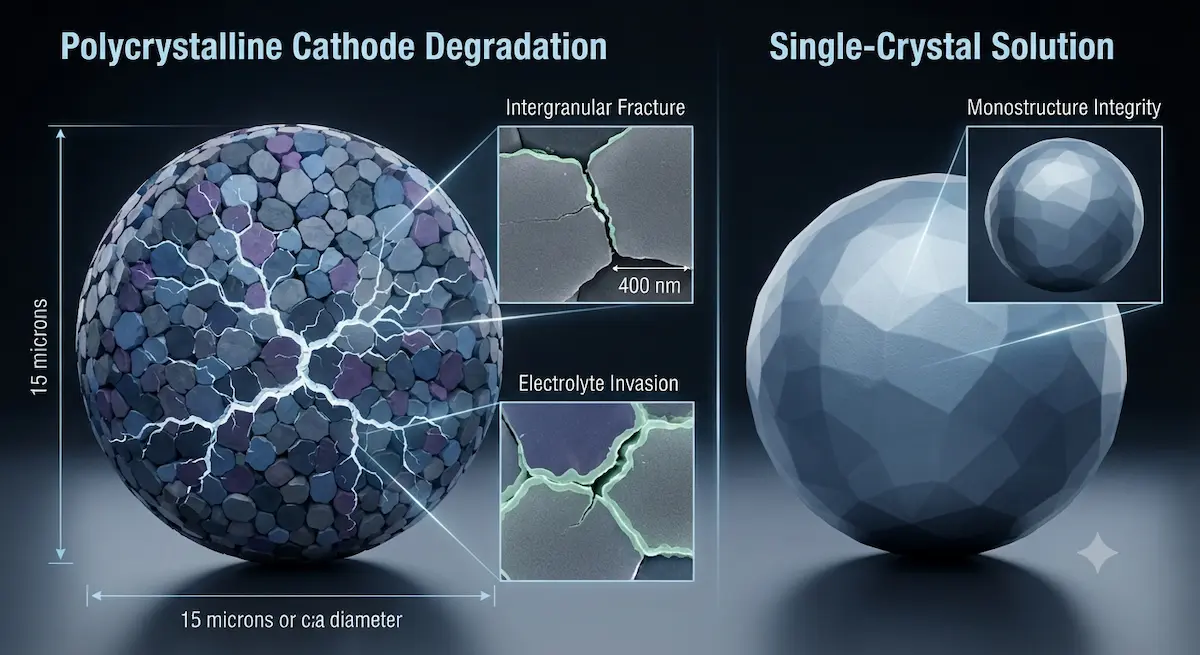
If your EV uses a high-nickel battery — and most long-range models do — its cathode is very slowly cracking apart from the inside, one charge at a time. It is the main reason these packs lose capacity over the years, and once you understand the mechanism, a lot of everyday EV advice suddenly makes sense.
Cathode cracking is the fracturing of the microscopic cathode particles inside a lithium-ion cell. In high-nickel chemistries (NMC 811, NCA), charging past roughly 75% — and above about 4.1 volts per cell — makes the crystal structure shrink unevenly and suddenly, splitting the particles along their internal boundaries. Electrolyte seeps into the cracks, fresh surfaces react and thicken, gas forms, and capacity fades. Makers fight it with single-crystal particles, doping, coatings and charge limits — none of which removes it entirely.
What cathode cracking actually is
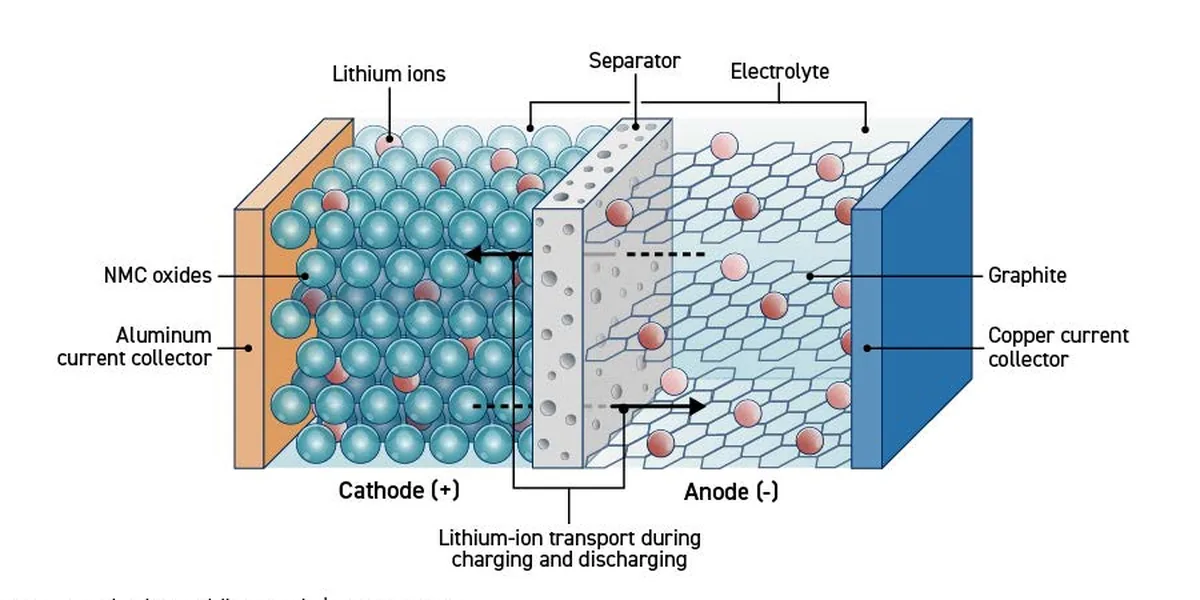
A cathode is not a solid slab. It is a coating of microscopic balls, and cracking is those balls splitting apart.
A typical high-nickel cathode particle is a secondary particle: a sphere roughly 8–15 micrometres across, itself built from hundreds of smaller primary crystals packed together. During every charge, lithium leaves these particles; during every discharge, it comes back. The crystals breathe as this happens — expanding and contracting slightly — and they do not all breathe in the same direction or by the same amount. That uneven strain is the whole story of cracking: stress builds between neighbouring crystals until the particle splits along the boundaries between them. Cracks can also form inside a single crystal, a point that matters later in this article.
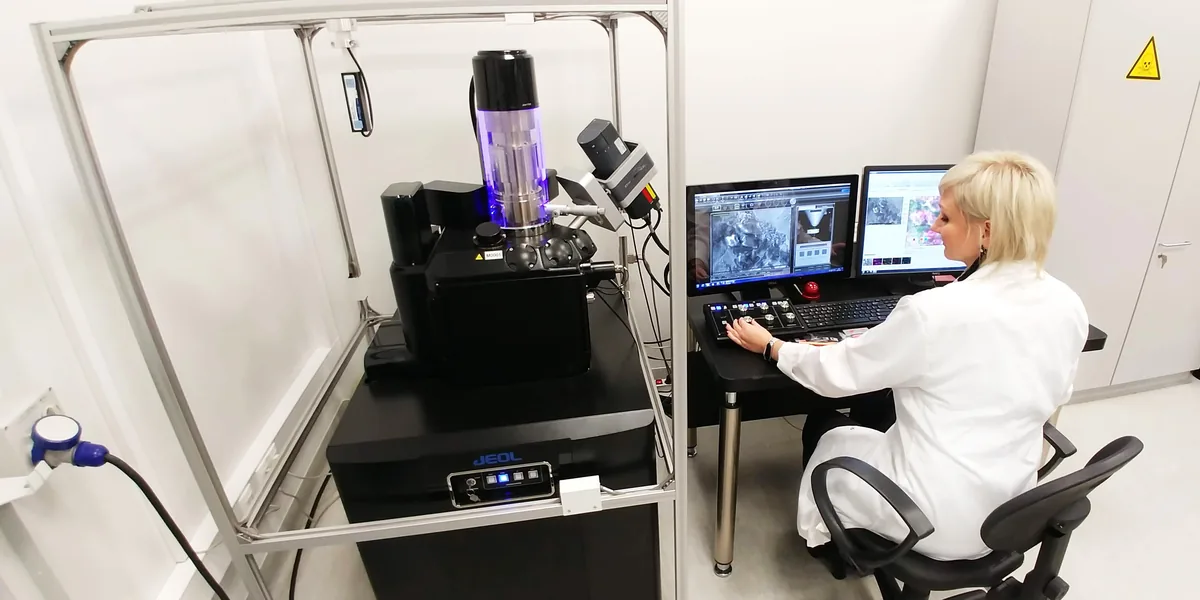
Cracking is measured in the lab, not felt in the car. Nobody’s dashboard reports it; researchers find it afterwards by cutting cells open and imaging the particles under electron microscopes. What you experience as an owner is simply its accumulated result: a battery that holds a little less charge each year.
Why high-nickel cathodes crack the most
The richer the cathode is in nickel, the harder it collapses at the top of a charge — that collapse is what tears particles apart.
Three verified mechanisms stack up in high-nickel materials, and each one gets worse as nickel content rises.
The phase change at the top of charge
As a high-nickel cathode charges, its crystal structure passes through a sequence of phases. In NMC 811, above about 4.11 volts the structure flips from the H2 to the H3 phase, and the lattice suddenly contracts — the c-axis, which had first expanded by roughly 2%, collapses. Reviews of the research put the unit-cell volume loss at 5.63% for NCA80, 7.10% for NCA88 and 8.37% for NCA95: the more nickel, the bigger the shrink. A change of structure also sets in at around 75% of the lithium removed, whatever the nickel content — which is why damage concentrates in the top slice of every charge.
Cation mixing and the rock-salt skin
Nickel has a second, chemical habit that feeds cracking. A nickel ion (Ni2+, 0.69 angstroms) is almost the same size as a lithium ion (Li+, 0.76 angstroms), so during charging nickel ions wander into the lithium layer — cation mixing. The disturbed surface rebuilds itself into a rock-salt structure that lithium can barely pass through. That stiff, inactive skin and the still-breathing crystal beneath it strain against each other, adding fatigue exactly where cracks start.
Gas from the lattice itself
At high states of charge the cathode also releases oxygen from its own lattice. That oxygen reacts with the electrolyte to form carbon dioxide and carbon monoxide. Gas inside a sealed cell means pressure and swelling — one more mechanical load on particles that are already straining — and every gas-forming reaction consumes material the battery needed.
What the cracks do to the battery
A crack is not just damage — it is a doorway. Electrolyte gets where it was never meant to be, and the chemistry follows it in.
- Capacity fade. Cracked-off fragments can lose electrical contact with the rest of the electrode and stop storing anything at all.
- Faster surface decay. Every fresh crack face is new surface for the electrolyte to attack, growing the same resistive films that age a healthy cell — only now on the inside of particles too. (This is the same family of surface reactions covered in our guide to the SEI layer.)
- Rising resistance. Blocked, rebuilt surfaces and disconnected fragments make the cell slower to charge and weaker under load.
- Gas and safety margin. Electrolyte inside cracks, plus oxygen released from the lattice, means more gas and more heat-generating side reactions — eating into the safety margin long before anything dramatic happens.
None of this happens in one bad charge. It accumulates over hundreds of cycles, worst at the top of the charge range — which is the pattern behind the familiar advice not to live at 100%.
Which chemistries are affected — and which are not
Cracking is overwhelmingly a high-nickel problem. The further a chemistry sits from nickel-rich layered oxides, the less it applies.
NCA and high-nickel NMC (811 and above) sit at the top of the risk list: highest nickel, biggest volume collapse, most gas. Mid-nickel NMC cracks less, in step with its smaller structural swings. LFP is the contrast case: its olivine structure barely changes volume as lithium moves, which is one reason LFP packs tolerate full charges and long cycle lives so well — the trade-offs sit elsewhere, as our LFP vs NMC comparison sets out. Sodium-ion cathodes have their own strain behaviours, but the classic H2-to-H3 collapse described here belongs to layered nickel oxides.
The strange upside: cracks can help charging speed
In a result that surprised the field, researchers found cracked particles charge just as fast as small ones — because a cracked particle behaves like many small ones.
A University of Michigan team measured charging in individual cathode particles directly — something earlier work could only average across whole electrodes — and found that a particle’s charging speed did not depend on its size. Their best explanation: once a polycrystalline particle cracks, lithium ions gain active surface inside the cracks, so the big particle effectively works like a bundle of small ones. The old assumption that smaller particles automatically charge faster turned out never to have been directly measured.
Two honest limits on that headline. The study reports no percentage or minutes figure for any speed gain — anyone quoting one is inventing it. And the researchers themselves stress that cracking still shortens battery life, which is why makers keep trying to prevent it. The real implication runs the other way: if you remove cracks by using single-crystal particles, those particles may need to be made smaller, or from faster materials, to keep the same charging speed. Long life and fast charging pull against each other here.
How battery makers fight cracking
There is no single cure. Production cathodes stack several partial defences, and the newest research says even the flagship defence has a failure mode of its own.
Single-crystal particles — the main defence, with an asterisk
Instead of a ball of many small crystals, a single-crystal particle is one crystal, typically 2–6 micrometres across, with no internal boundaries to split along. Trade comparisons put capacity retention after 500 full cycles at roughly 90–95% for single-crystal against 80–85% for polycrystalline high-nickel material, and single-crystal generates far less gas. It is genuinely in production — as a material: LG Chem announced in 2023 that it had begun mass-producing single-crystal high-nickel cathode material in Korea, starting with a 2:8 blend against conventional material and aiming at 50,000-plus tons a year. What cannot honestly be said is which cars use it: no maker names the cells or models, so neither will we.
The asterisk arrived in 2025, when an Argonne and University of Chicago team showed that single-crystal NMC fails differently, not never: reactions run at uneven speeds inside one particle, building internal strain — and design rules borrowed from polycrystalline cathodes had been misapplied to it. They also found the chemistry levers flip: manganese, fairly harmless in polycrystalline material, caused the most mechanical damage in single-crystal particles, while cobalt improved their durability.
Doping and coatings — reinforcing the particle
Doping slips a few foreign atoms into the crystal to hold it together: magnesium ions parked in the lithium layer act as pillars that prop the structure open during the H2-to-H3 squeeze, and molybdenum pins grain boundaries and keeps primary crystals small. Coatings armour the surface instead: materials worked into the grain boundaries themselves — one metallic-glass coating injected along the boundaries kept 95% of capacity after 500 cycles in a pouch full cell — and calcium-bearing coatings that neutralise the hydrofluoric acid the electrolyte slowly generates. Concentration-gradient particles take a third route, rich in nickel at the core for capacity and richer in manganese at the surface for stability.
Voltage discipline and electrolyte additives
The cheapest defence is simply not going where the damage is: capping charge voltage below the worst of the phase transition, which is a decision the car’s battery management makes for you. Inside the liquid, additives build tougher surface films — in the research, one borate additive held 88% capacity after 100 cycles at a 4.35-volt cutoff where a standard electrolyte managed 21%, and 1% of a fluorophosphate additive held 97% after 200 cycles. Electrolyte chemistry is unglamorous, but on these numbers it is doing real work.
What cathode cracking means for your EV
You cannot see it, prevent it entirely, or fix it — but the habits that slow it are the same ones that slow every other form of battery wear.
If your car runs a high-nickel pack — most long-range NMC and NCA models — some cracking is already part of its life and priced into its warranty. What you control is how often the cathode visits the damaging zone: the structural change sets in around the top quarter of the charge, so a daily charge limit in the maker’s recommended range (commonly 80–90%) keeps most days out of it, with full charges kept for trips. Heat adds strain to strain, so the usual advice about avoiding long, hot sits at 100% applies doubly here. And if your next car offers an LFP version, this mechanism is the honest technical reason it shrugs off full charges that a high-nickel pack would rather avoid. Cracking also works alongside the other slow failures — lithium plating on the anode side, electrolyte oxidation at high voltage — rather than instead of them.
Frequently asked questions
Does fast charging cause cathode cracking?
The trigger is the top of the charge — high voltage and deep lithium removal — more than charging speed itself. Fast charging spends its hardest minutes pushing the cathode into exactly that zone, and repeatedly charging fast to 100% is a worse combination than either habit alone. Charging quickly to 80% is a much gentler pattern than slowly pinning the pack at full.
Can a cracked cathode heal itself?
In an ordinary polycrystalline particle, no — the splits are permanent, and electrolyte damage inside them continues. There is one narrow laboratory exception: in single-crystal NMC, researchers have watched microscopic slips and cracks along one crystal plane largely glide back and close on discharge. That is a research curiosity about one material form, not something your pack can do.
Which EVs have the most cathode cracking?
The highest-nickel packs — NCA and NMC 811-class batteries, typically the longest-range versions of a model — strain the most per charge. Mid-nickel packs strain less; LFP packs, with a far more stable crystal structure, are the least affected by this particular mechanism.
Conclusion
Cathode cracking is not a defect in a few bad batteries. It is the built-in cost of squeezing maximum energy out of nickel — managed well by good cell design, and slowed by unglamorous charging habits.
High-nickel cathodes crack because charging them fully collapses their crystal structure — up to 8.37% by volume at the highest nickel levels — and does it unevenly, thousands of times over a pack’s life. The industry’s answers are real but partial: single-crystal particles that fail more slowly (and, we now know, differently), doping and coatings with measured results behind them, and voltage discipline that keeps everyday charging out of the worst zone. As an owner, your share of the bargain is small and simple: live below the top of the charge, charge full when the trip needs it, and let the chemistry do the rest.
