
Which EV Battery Chemistry Works Best in Cold Weather?

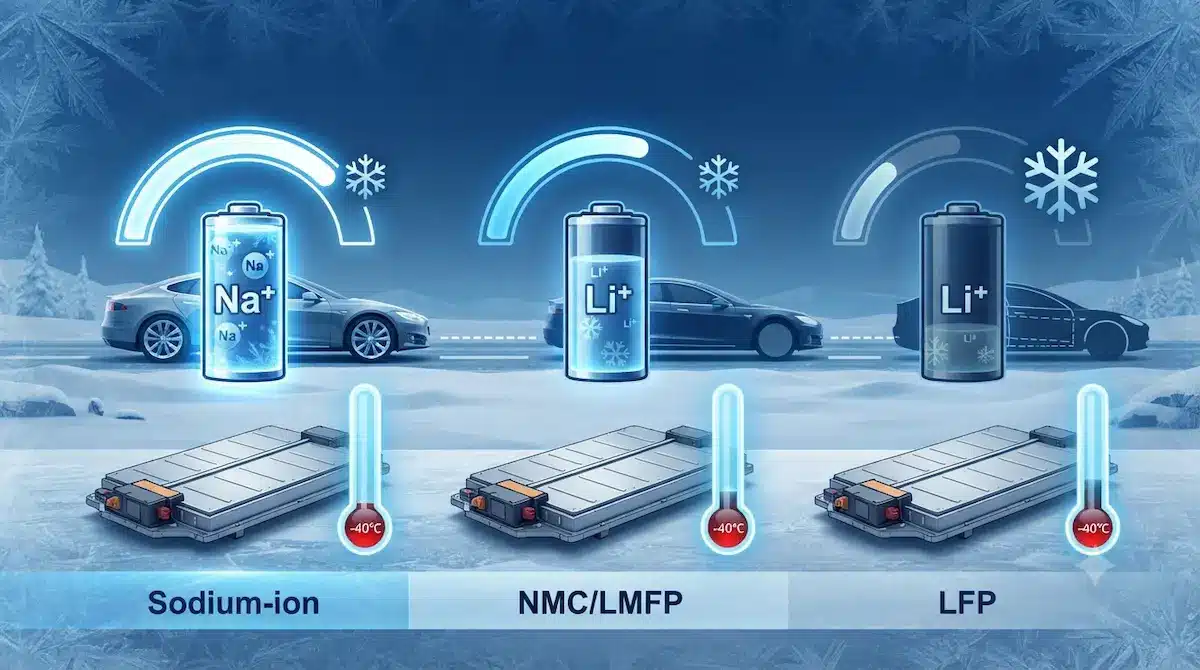
Sodium-ion batteries work best in cold weather — retaining approximately 90% capacity at -40°C, where LFP retains ~50–60%, and NMC retains ~65–75%. Among lithium-ion chemistries, NMC performs better than LFP in cold because its higher operating voltage provides more driving force for ion transport even in viscous cold electrolyte. For most practical cold-climate U.S. EV buyers choosing between available lithium-ion options, NMC 811 offers the best cold-weather performance in current production vehicles — and the Hyundai Ioniq 6 at 361 miles EPA range with 800V NMC architecture minimizes the cold-weather range reduction better than any LFP alternative in its class.
Cold Weather Performance by Battery Chemistry
| Chemistry | Capacity at 0°C | Capacity at -20°C | Capacity at -40°C | Cold Charging Capability |
|---|---|---|---|---|
| Sodium-ion (CATL Naxtra) | ~97–98% | ~93–95% | ~90% | Charges at −30°C; still delivers power at −50°C |
| NMC 811 | ~90–95% | ~75–85% | ~65–75% | Good with preconditioning; limited below -15°C |
| NCA (Tesla) | ~88–93% | ~73–83% | ~63–73% | Good with preconditioning |
| NMC 622 | ~88–93% | ~73–83% | ~62–72% | Good with preconditioning |
| LMFP (BYD Gen 2) | ~94–97% | ~85–90% | ~80–85% | Better than LFP; BYD’s Blade 2.0 (LMFP) charges 20–97% in about 12 minutes at −30°C on BYD flash chargers |
| LFP | ~85–90% | ~65–80% | ~50–60% | Slow in the cold — the pack must warm up before fast charging |
Why Chemistry Affects Cold Weather Performance
Cold temperature reduces battery performance through two primary mechanisms that differ in severity between chemistries:
Ion Transport Slowdown
Cold temperatures increase electrolyte viscosity, slowing lithium ion transport. The degree of slowdown depends on the strength of the ionic solvation shell — how tightly the ion bonds to the surrounding electrolyte molecules. Sodium ions (Na⁺) form weaker solvation bonds than lithium ions (Li⁺) — they break free from their solvation shells more easily in cold, viscous electrolyte, maintaining better ion mobility. Among lithium-ion chemistries, NMC and NCA operate at higher cell voltages (~3.7 V average) than LFP (~3.2 V average) — this higher voltage provides a larger electrochemical driving force that partially compensates for the reduced ion mobility in cold conditions.
Electrode Kinetics
The solid-state diffusion of lithium ions within electrode particles slows with temperature — both graphite intercalation kinetics and cathode lithium transport are temperature-sensitive. LFP’s iron redox couple operates at a lower voltage plateau, and the olivine structure’s lithium diffusion channels are narrower than in NMC’s layered structure — making LFP’s electrode kinetics more sensitive to cold-induced slowdown than NMC 811.
LMFP (BYD Gen 2 Blade) performs meaningfully better in cold than standard LFP because manganese addition raises the cell voltage from ~3.2V to ~3.7V — providing the higher electrochemical driving force that improves cold-weather performance while maintaining the olivine structure’s safety benefits. This is one of LMFP’s key advantages over standard LFP beyond energy density alone.
Real-World Cold Weather EV Range: What to Expect
For a concrete comparison, consider three EVs in a Minneapolis January morning at -20°F (-29°C):

- Hyundai Ioniq 6 Long Range (361 miles EPA, NMC 811): Approximately 261–280 miles effective range — loses 22–28% to cold. Still 260+ miles, comfortably adequate for even demanding daily use and most road trips.
- Tesla Model 3 Long Range (358 miles EPA, NCA): Approximately 250–272 miles effective range — similar to NMC 811 at comparable cold-weather performance.
- Tesla Model 3 Standard Range (LFP): 272 miles EPA, roughly 165–205 miles on a −20°F (−29°C) day in Minneapolis (loses about 25–40%) — tight for drivers with 100+ mile round-trip commutes.
The practical difference for the LFP buyer: a 260-mile LFP EV at -29°C may deliver only 156–195 miles — tight for drivers with 100+ mile round-trip commutes or those needing to stop at a charger that’s 90+ miles away. The NMC buyer with 360 miles has 250–280 miles available — providing a comfortable buffer for the same scenarios.
Battery Preconditioning: The Great Equalizer
Battery preconditioning — automatically warming the battery pack to 25–35°C before charging or driving — significantly reduces the cold-weather performance gap between chemistries. All modern premium EVs (Tesla, Hyundai, BMW, Porsche, Rivian) automatically precondition the battery when navigating to a DC fast charger. Tesla’s preconditioning also activates before departure in cold weather if the driver enables it in the app.
However, preconditioning has costs: it uses battery energy (about 1–3 kWh of energy to warm the pack from −20°C), takes time (about 15–45 minutes in severe cold), and is only partly effective in extreme cold (below -30°C). Sodium-ion’s advantage is precisely that it essentially doesn’t need preconditioning in most cold scenarios — maintaining 90% capacity at -40°C means even without preconditioning, the sodium-ion EV delivers adequate performance. For LFP drivers in northern climates, disciplined preconditioning is important but doesn’t fully close the cold-weather gap with NMC or sodium-ion.
Read more: how EV battery preconditioning warms the pack before a fast charge, and how to turn it on for each brand.
Frequently Asked Questions
Which EV battery chemistry works best in cold weather?
Sodium-ion batteries (CATL Naxtra) perform best in cold weather — retaining ~90% capacity at -40°C vs NMC’s ~65–75% and LFP’s ~50–60%. At −20°C, NMC typically loses about 15–25% of its capacity, while LFP loses about 20–35%. LMFP (BYD Gen 2 Blade) performs between LFP and NMC, losing approximately 15–20% at -20°C, making it a strong cold-climate LFP alternative.
Why does LFP lose more range in cold weather than NMC?
LFP operates at a lower cell voltage (~3.2V vs NMC’s ~3.7V) — providing less electrochemical driving force to overcome the increased electrolyte resistance in cold conditions. LFP’s olivine cathode also has narrower lithium diffusion channels than NMC’s layered structure, making it more sensitive to cold-induced kinetics slowdown. LMFP addresses this by raising voltage to ~3.7V while maintaining the olivine structure — significantly improving cold performance vs standard LFP.
Should I choose NMC over LFP if I live in a cold climate?
Yes — if you regularly experience temperatures below -10°C (-14°F) and need maximum real-world winter range, NMC or LMFP is preferable to standard LFP. If sodium-ion EVs become available in your market (expected in the U.S. post-2028), sodium-ion’s extraordinary cold-weather performance makes it the ideal choice for northern climates. For mild cold climates (0 to -10°C), LFP with preconditioning is adequate for most drivers. For extreme cold climates (below -20°C regularly), sodium-ion will eventually be the clear winner.
When will sodium-ion EVs be on sale?
The first mass-production sodium-ion car — Changan’s Nevo A06, using CATL’s Naxtra cells — is launching in China in 2026. No sodium-ion EV is on sale in the US yet, and US availability is expected later this decade, so for now sodium-ion is the chemistry to watch rather than one you can buy.
Does preconditioning fix LFP’s cold-weather weakness?
Mostly, for charging. Warming the pack before a fast charge restores most of an LFP battery’s charging speed, and it costs only about 1–3 kWh. It cannot bring back the capacity the cold has temporarily taken away — that returns on its own as the pack warms up while you drive.
Conclusion
Among available battery chemistries for cold climate EV driving, the hierarchy is clear: sodium-ion > NMC/LMFP > LFP in terms of cold-weather capacity retention. Sodium-ion’s 90% capacity at -40°C and ability to fast-charge at temperatures as low as -50°C make it uniquely suited for the coldest climates globally. For EV buyers in cold climates today choosing among available lithium-ion options, NMC 811 in 800V platforms delivers the best combination of cold-weather range and absolute range (260+ miles even at -20°C in premium vehicles). LFP is adequate in mild cold but becomes meaningfully limiting in extreme cold. Understanding this chemistry-climate relationship helps cold-climate EV buyers make informed purchase decisions that translate to genuine daily driving confidence — even on the coldest winter mornings.
