
What Is CATL’s Battery Chemistry Strategy?

Researched from CATL’s own releases — including its April 2026 Super Technology Day announcements — SNE Research market data reported by Electrek, and Recurrent fleet data. Figures announced by CATL are labelled as CATL’s claims throughout; this guide separates what is shipping from what is promised.
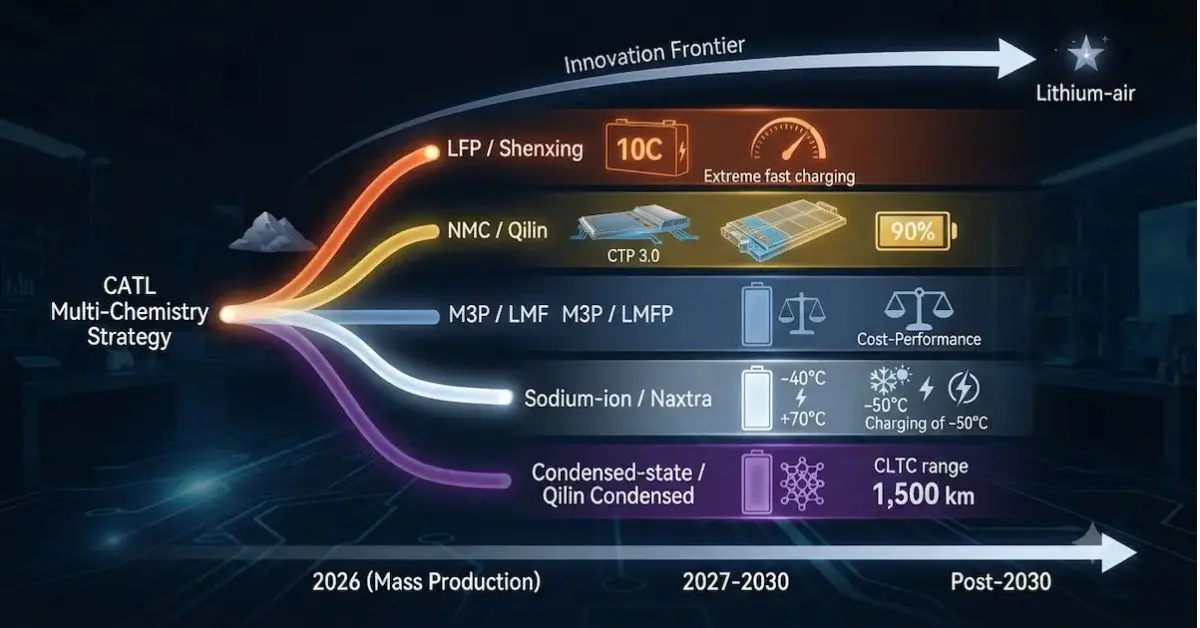
CATL does not bet on one chemistry. Its strategy splits the portfolio by job: LFP is pushed toward extreme fast charging (its chief scientist says LFP is nearing its energy-density limit), high-nickel NMC keeps the energy-density crown, sodium-ion takes cold climates and grid storage, and condensed and solid-state cells are the long game. The split is working commercially — CATL held 39.9% of the global EV battery market in the first half of 2026.
- LFP → speed: Shenxing gen-3 claims 10–80% in 3 minutes 44 seconds
- NMC → density: Qilin gen-3 claims a 280 Wh/kg cell
- Sodium → cold + storage: Naxtra claims 175 Wh/kg and 90% usable power at −40°C
- Future → condensed (350 Wh/kg cell claim) and solid-state (small-scale production 2027, per CATL)
The strategy in one table
Four chemistry families, four different jobs — that division of labour is the whole strategy.
Most battery makers lead with one chemistry and stretch it; CATL, the world’s largest maker, develops each family against a different weakness — the chemistry basics behind all four are in our EV battery chemistry explainer.
| Family | Lead products | The job it is hired for | Headline figure (CATL’s claim) |
|---|---|---|---|
| LFP | Shenxing (gen 3) | Affordable cars, extreme fast charging | 10–80% in 3 min 44 s; >90% capacity after 1,000 cycles |
| NMC (high-nickel) | Qilin (gen 3) | Premium range and performance | 280 Wh/kg cell; 1,000 km range |
| LMFP / hybrid | M3P, Freevoy | Bridging cost and density; hybrids | Freevoy gen 2: up to 600 km pure-electric range |
| Sodium-ion | Naxtra, TENER Sodium | Cold climates, budget cars, grid storage | 175 Wh/kg; 15,000-cycle storage system |
| Next generation | Condensed, solid-state | Maximum density, aviation, the 2030s | 350 Wh/kg condensed cell; solid-state from 2027 (small-scale) |
The man who runs CATL’s science said the quiet part out loud in April 2026. Chief scientist Wu Kai: “LFP is nearing its theoretical energy density limit, making it better suited for a technology roadmap centered on extreme fast charging” — while “NCM’s high energy density keeps it at the forefront of global competition.” Everything CATL announced that day follows from those two sentences.
LFP: the fast-charging pivot
If LFP cannot get much denser, it will get much faster — that is the Shenxing programme in one line.
The first Shenxing (2023) was the world’s first 4C fast-charging LFP battery, adding a claimed 400 km in 10 minutes. The second generation (2025) claimed 12C peak charging and 800 km of range. The third generation, announced in April 2026, is where the claims turn startling: CATL quotes 10–80% in 3 minutes 44 seconds, 10–98% in 6 minutes 27 seconds, and more than 90% capacity retained after 1,000 full cycles — with a 20–98% charge in about nine minutes at −30°C. Those are CATL’s figures from its own launch, not independent measurements, and this guide reports them as such; no tester has yet verified a sub-four-minute charge in a production car.
Why it matters commercially: LFP is the chemistry of affordable EVs, and charging speed was its last big disadvantage against NMC — our LFP vs NMC comparison covers the trade-off in full. If even half of the gen-3 claims survive contact with real chargers and real cars, the affordable end of the market changes shape.
NMC and Qilin: defending the density crown
For buyers who pay for range, CATL’s answer is still high-nickel NMC in its Qilin pack architecture.
Qilin — the third generation of CATL’s cell-to-pack design — launched in 2022 at a claimed 255 Wh/kg for NMC systems, packaging cells so tightly that the pack itself became the structure. The April 2026 third-generation Qilin claims a 280 Wh/kg cell, 1,000 km of range and 10C charging. Treat the accompanying performance claims (including a 3 MW peak-power figure from a track context) as launch-day material: the durable point is the direction — NMC’s density lead is the thing CATL is spending to defend, exactly as Wu Kai framed it.
The bridge chemistries: Freevoy and M3P
Between cheap LFP and premium NMC, CATL parks its hybrids — one shipping, one conspicuously quiet.
Freevoy, launched in October 2024, is a battery for plug-in hybrids and range-extenders: a claimed 400+ km of pure-electric range with 4C charging, using an “AB” layout that mixes sodium-ion and lithium-ion cells so the car still works at −40°C. It is already fitted to models from Li Auto, AVATR, Deepal, Changan Nevo and Neta, and the April 2026 second generation claims up to 600 km of pure-electric range at 230 Wh/kg, mixing LFP and NMC at the powder level.
M3P — CATL’s LMFP chemistry, announced in 2022 for production in 2023 — is the opposite story. Years on, no production car can be confirmed as using it, and CATL’s 2026 announcements pass it by. An honest strategy guide should say so: M3P reads today like a bridge the company built and then walked around, via Freevoy’s hybrid mixes instead.
Sodium-ion: Naxtra cars and TENER storage
Sodium is the strategy’s hedge — against lithium prices, against cold, and for a grid-storage market lithium does not own.
CATL’s Naxtra passenger-car battery, announced in April 2025, claims 175 Wh/kg (LFP territory), more than 10,000 cycles, and 90% of usable power retained at −40°C.
The technology itself — and why its cold-weather behaviour is genuine physics rather than marketing — is covered in our sodium-ion battery explainer.
On the storage side, the June 2026 TENER Sodium system (NFPP chemistry) claims 15,000 cycles and a 25–30-year service life, and CATL signed what it calls the world’s largest sodium-ion commercial contract the same spring: 60 GWh over three years with HyperStrong. Storage, not cars, may be where sodium pays first.
Condensed and solid-state: the long game, played slowly
CATL’s future chemistries come with the biggest numbers and the longest timelines — and the company, unusually, says so itself.
The Qilin Condensed battery claims a 350 Wh/kg cell (760 Wh/L) — a mass-production record by CATL’s reckoning — aimed at 1,500 km sedans, while 500 Wh/kg condensed systems have flown validation tests on a 4-tonne aircraft. Solid-state is where the honesty is most striking. CATL’s route is sulfide-based; its cells have reached 20 Ah trial production; and in an October 2026 investor answer the company confirmed small-scale production in 2027 with the mass market around 2030. Chairman Zeng Yuqun has rated solid-state readiness at 4 on a 1–9 scale. From the world’s biggest battery maker, that is not foot-dragging — it is a public estimate that the technology is genuinely hard, and a useful calibration for every rival’s louder promises.
Does Tesla use CATL batteries?
Yes — Tesla has fitted CATL’s LFP prismatic cells to Standard Range versions of the Model 3 and Model Y since 2021, principally in cars built at Gigafactory Shanghai.
It is the clearest proof of the multi-chemistry strategy from the customer side: the world’s most famous EV maker buys the affordable chemistry from CATL and builds its premium packs around other suppliers and its own cells. The arrangement is aging well so far. Recurrent fleet data reported in 2026 put CATL-LFP Model 3s at an average of 93.3% battery health beyond 62,000 miles — a real-world degradation datapoint for the chemistry CATL is now pivoting to speed.
For how a carmaker works the same problem from the buying side, see our guide to the chemistry GM uses in its Ultium battery.
CATL vs BYD: two different games
“Are CATL batteries better than BYD?” is the wrong shape of question — the two companies are not playing the same position.
BYD makes cars and the batteries inside them, built around one chemistry bet (its LFP Blade battery) and vertical integration. CATL makes batteries for everyone — Tesla, BMW, GM, Changan and dozens more — and hedges across every chemistry at once. The scoreboard, for now: CATL’s 39.9% share of the global EV battery market in the first half of 2026 (SNE Research) keeps it the supplier to beat. Whether a given CATL pack beats a given BYD pack depends on which chemistry, in which car, at which price — which is, of course, exactly the multi-chemistry argument.
Frequently asked questions
What is CATL’s battery chemistry strategy?
A deliberate multi-chemistry portfolio: LFP developed for extreme fast charging, high-nickel NMC for energy density, sodium-ion for cold climates and storage, hybrid mixes (Freevoy) for plug-in hybrids, and condensed and solid-state cells as the long-term programme — each chemistry matched to a market segment rather than stretched across all of them.
Why did CATL say LFP is at its energy density limit?
Chief scientist Wu Kai’s April 2026 framing: LFP is “nearing its theoretical energy density limit”, so CATL’s LFP roadmap centres on extreme fast charging instead — chasing minutes rather than watt-hours. It is a statement about where further gains are available, not an abandonment of the chemistry.
What is CATL’s sodium-ion strategy?
Two products: Naxtra for passenger cars (175 Wh/kg claimed, exceptional cold performance, first car programme unveiled with Changan in February 2026, mass production promised by end of 2026) and TENER Sodium for grid storage (15,000-cycle claim), backed by contracts such as the 60 GWh HyperStrong deal.
Are there any EV cars equipped with sodium batteries?
One programme so far: the Changan–CATL car unveiled in February 2026 as the world’s first mass-production sodium-ion passenger vehicle, slated to reach the market in mid-2026 across Changan’s brands. As of this writing it has been unveiled rather than put on general sale — announcements elsewhere of “sodium cars” should be checked against that distinction.
When can I buy CATL sodium batteries?
In cars: first via the Changan programme in China (mid-2026 per CATL). In storage: TENER Sodium deliveries began in China in 2026 with global deliveries slated from 2027. CATL does not sell cells directly to consumers, and no US-market sodium car has been announced.
Conclusion
CATL’s strategy is a refusal to choose — and at 39.9% of the world market, the refusal is working.
LFP gets speed, NMC keeps density, sodium covers the cold and the grid, and the exotic chemistries proceed at a pace CATL itself describes with unusual honesty. The claims to watch are the ones with dates attached: Shenxing gen-3’s sub-four-minute charge in a production car, Naxtra’s end-2026 mass production, and solid-state’s small-scale 2027. This guide will judge the strategy by those, and so should you.
