
What Is a Dry Electrode Battery Manufacturing Process?

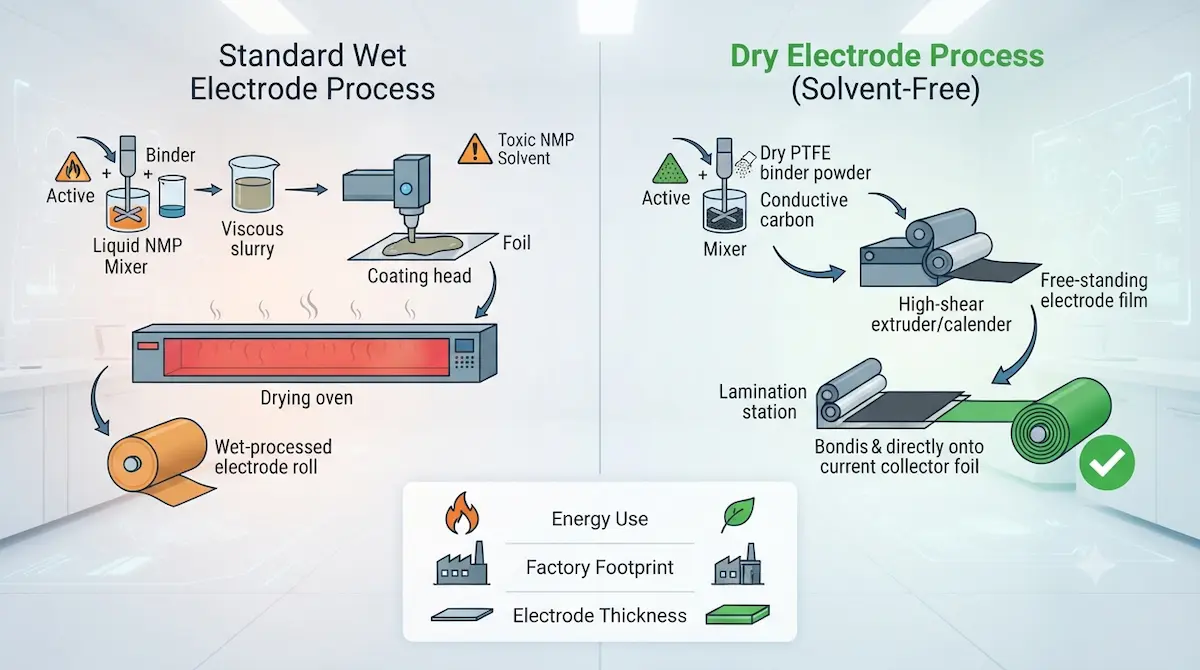
The dry electrode battery manufacturing process eliminates the toxic, energy-intensive wet solvent step from electrode production — replacing NMP (N-methyl-2-pyrrolidone) solvent-based slurry coating with a solvent-free dry powder processing method that directly creates electrode films without liquid intermediates. Tesla acquired Maxwell Technologies in 2019 specifically for this dry electrode technology and has been scaling it at Gigafactory Texas for the 4680 cell. If successful at commercial scale, dry electrode manufacturing can reduce electrode production costs by 10–20%, eliminate NMP solvent recovery infrastructure (saving $50–100 million per gigafactory), cut electrode drying energy by 90%, and enable thicker electrodes that improve cell energy density — a manufacturing innovation as significant as any chemistry advance.
See the full cost breakdown this process is trying to improve in our guide on how battery chemistry affects manufacturing cost.
How Standard Wet Electrode Manufacturing Works
To understand why dry electrode manufacturing matters, it helps to understand what it replaces. Standard (“wet”) electrode manufacturing mixes the electrode active material (cathode powder or graphite) with PVDF binder dissolved in NMP solvent and conductive carbon black to create a viscous slurry — a liquid paste that can be coated uniformly onto current collector foil. After coating, the slurry passes through a long drying oven (often 50–100 meters long at 80–130°C) where NMP solvent evaporates, leaving the active material and binder adhered to the foil.
This wet process has several significant problems: NMP is a toxic organic solvent with significant environmental and health concerns — requiring expensive recovery and recycling systems (often adding $50–100M to gigafactory construction cost). The long drying ovens consume enormous energy and occupy massive floor space. NMP recovery is never 100% efficient — some is lost as waste. And PVDF binder requires NMP as a carrier — limiting the binder options available to electrode engineers. These constraints are intrinsic to the wet slurry process and cannot be engineered away without fundamentally changing the process.
How Dry Electrode Manufacturing Works
Dry electrode manufacturing replaces the slurry-coating-drying sequence with a powder-based process where the electrode active material, binder, and conductive carbon are mixed as dry powders, then processed directly into an electrode film without any liquid carrier. The key innovation is using PTFE (polytetrafluoroethylene — the same material as Teflon) as the binder instead of PVDF. When dry PTFE powder is mixed with electrode active materials under mechanical shear (in a high-shear mixer or twin-screw extruder), the PTFE fibrillates — its long polymer chains stretch out into a fibrous, self-supporting network that binds electrode particles together without requiring any solvent.
The dry electrode film production process:
- Step 1 — Dry mixing: Active material powder, PTFE binder, and conductive carbon black are dry-blended at controlled temperature and humidity. PTFE content is typically 5–8% by weight, comparable to PVDF in wet processes.
- Step 2 — Calendering/extrusion: The dry powder blend is processed through a high-shear calender or twin-screw extruder at elevated temperature and pressure. The mechanical shear fibrillates PTFE, creating a dense, self-supporting free-standing electrode film — no current collector yet, just the electrode material itself as a solid film.
- Step 3 — Lamination: The free-standing dry electrode film is laminated onto the current collector foil under heat and pressure — bonding the film to the aluminum (cathode) or copper (anode) current collector without any solvent intermediary.
- Step 4 — Calendering/slitting: Further calendering optimizes film thickness and density, then slitting cuts to the target electrode width for cell assembly — similar to wet process steps but now applied to a dry-processed electrode.
Advantages of Dry Electrode Manufacturing
- No NMP solvent: Eliminates the toxic NMP solvent entirely — removing NMP’s health and environmental concerns, the expensive NMP recovery system ($50–100M per gigafactory), and all NMP handling/storage requirements. This simplification reduces gigafactory complexity and capital cost significantly.
- Energy savings: Drying ovens for NMP solvent evaporation are among the largest energy consumers in battery manufacturing. Eliminating them reduces electrode manufacturing energy consumption by approximately 70–90% — a meaningful contribution to reducing battery carbon footprint.
- Faster processing: Without drying oven residence time (which limits line speed), dry electrode production can potentially run at higher throughput. NMP drying ovens often constrain wet electrode coating to 30–60 m/min — dry electrode processing may eventually run faster without this bottleneck.
- Thicker electrodes: Wet-processed electrodes have practical thickness limits — thick wet coatings crack during drying because solvent evaporates unevenly through the thickness. Dry electrode films have no drying constraint, enabling thicker electrodes that pack more energy per cell without the thickness limitations of wet coating. Thicker electrodes can improve cell-level energy density by 5–15%.
- PTFE binder durability: PTFE’s fibrillar network is more mechanically resilient than PVDF’s particle-to-particle binding — potentially contributing to better electrode mechanical integrity under volume changes during cycling, particularly relevant for silicon-carbon composite anodes. See our full explainer on what a silicon anode battery is
Challenges: Why Scaling Is Hard
Tesla has been scaling dry electrode production at Gigafactory Texas since 2021 with the 4680 cell. Multiple reports through 2025 indicate ongoing challenges in scaling the dry electrode process to commercial production yields — particularly for the cathode side. The anode (graphite + PTFE) has proven relatively straightforward to scale. The cathode (NMC or LFP + PTFE) has proven significantly more difficult for several reasons:
- NMC particle morphology: NMC cathode active material particles are irregular, hard, and less amenable to PTFE fibrillation than graphite’s softer, more uniform particles. Creating a defect-free, uniform dry NMC cathode film with adequate PTFE fiber network is significantly harder than equivalent graphite anode film.
- Electrode uniformity: Wet slurry coating naturally creates very uniform electrode films because the liquid distributes active material evenly before drying. Dry powder processing is more susceptible to local density variations — non-uniformity directly causes capacity imbalances within the cell that limit performance.
- PTFE fibrillation control: The PTFE fibrillation process must be precisely controlled to create the right fiber density and distribution. Over-fibrillation creates excessive PTFE content at the expense of active material; under-fibrillation produces a weak, mechanically unstable film. Achieving consistent fibrillation across multi-meter-wide electrode sheets at production throughput requires sophisticated process control that was not required for wet processing.
- Film-to-collector adhesion: Laminating the dry electrode film to the current collector foil requires sufficient bonding strength to prevent delamination during cell assembly and cycling. Achieving adequate adhesion without additional adhesive layers (which would add resistance and weight) requires careful optimization of lamination temperature, pressure, and foil surface treatment.
Who Else Is Developing Dry Electrode Technology?
Tesla is the furthest advanced in commercial-scale dry electrode manufacturing, but significant development is underway at other organizations:
- CATL: Has filed patents on dry electrode processes and is researching dry cathode manufacturing — though has not publicly committed to commercial dry electrode production timelines
- LG Energy Solution: Active dry electrode research program; LGES has published dry electrode patents and research papers
- Samsung SDI: Has researched dry electrode manufacturing for next-generation cells
- Fraunhofer Institute (Germany): Leading academic research on dry electrode processes; collaboration with BMW and other European OEMs
- Battery Streak: A startup specifically targeting low-cost dry electrode manufacturing for grid storage applications
Frequently Asked Questions
What is a dry electrode battery manufacturing process?
Dry electrode manufacturing replaces the standard wet slurry process (active material + PVDF binder + NMP solvent → coat → dry) with solvent-free powder processing (active material + PTFE binder → mechanical shear → fibrillate → laminate to foil). Eliminating NMP solvent removes significant cost, environmental burden, energy consumption, and factory complexity. Tesla is commercializing this for its 4680 cell, though scaling the cathode process has proven technically challenging.
What are the benefits of dry electrode manufacturing?
No NMP toxic solvent (saving $50–100M in recovery infrastructure per gigafactory), 70–90% reduction in electrode manufacturing energy, potential for thicker electrodes improving energy density 5–15%, faster processing without drying oven bottleneck, and more mechanically robust PTFE binder network vs PVDF. If fully scaled, dry electrode manufacturing could reduce battery cell production costs by 10–20% and significantly reduce manufacturing carbon footprint.
Why is dry electrode manufacturing difficult to scale?
The primary challenge is creating defect-free, uniform electrode films at commercial throughput — particularly for cathode materials. NMC particles are harder and more irregular than graphite, making consistent PTFE fibrillation more difficult. Film-to-collector adhesion without liquid intermediaries requires precise lamination conditions. Achieving the same uniformity that wet slurry coating naturally provides through liquid self-leveling requires significantly more sophisticated dry process control. Tesla has faced production yield challenges for exactly these reasons at Gigafactory Texas since 2021.
Conclusion
Dry electrode battery manufacturing is one of the most important manufacturing process innovations in the EV battery industry — eliminating the toxic NMP solvent, reducing energy consumption by 70–90%, and enabling thicker, more energy-dense electrodes. Tesla’s pioneering scale-up at Gigafactory Texas for the 4680 cell has demonstrated both the technology’s potential and its scaling challenges, particularly for cathode electrode production. If the cathode scaling challenges are resolved — through improved PTFE fibrillation control, better NMC particle engineering, and optimized lamination processes — dry electrode manufacturing could reduce battery cell production costs by 10–20% while making EV batteries significantly more sustainable to produce. The entire battery industry is watching Tesla’s progress closely, knowing that a proven commercial dry electrode process would reshape gigafactory economics globally.
