
How Does Battery Chemistry Affect Manufacturing Cost?

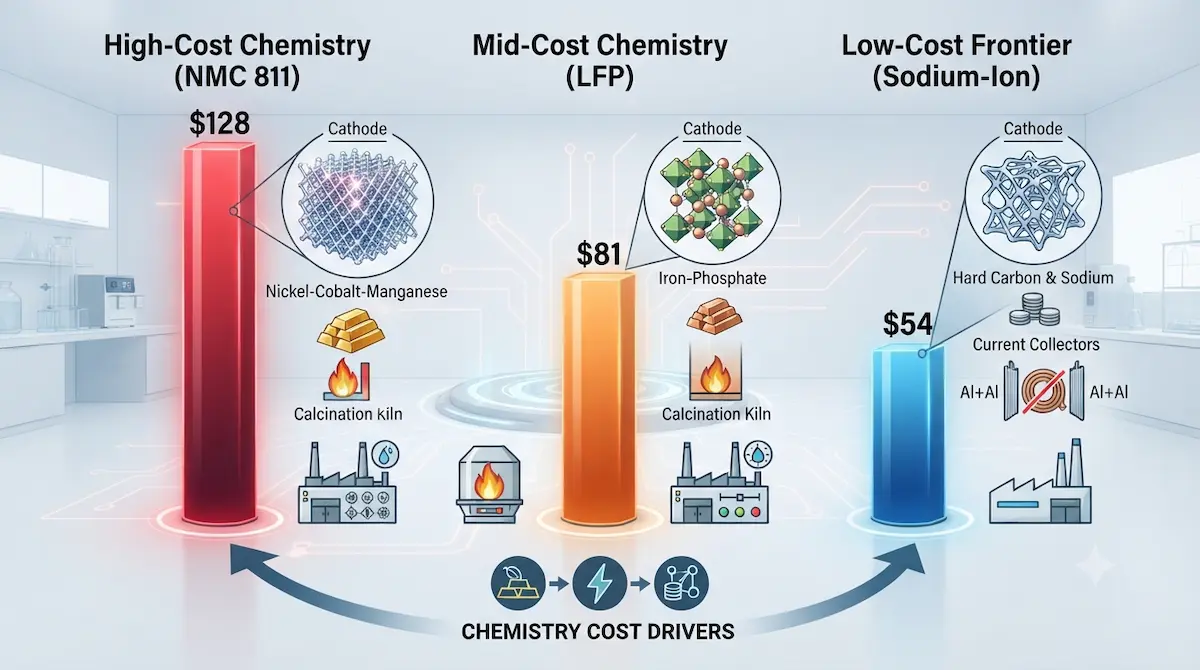
Researched from BloombergNEF’s 2025 battery price survey, Argonne National Laboratory’s BatPaC cost model (September 2025) and IEA battery reports — November 2026.
Chemistry sets most of a battery’s cost because it sets the cathode — and the cathode is the expensive part. In Argonne National Laboratory’s cost model, cathode material alone is about 57% of a cell’s materials cost and 32% of the whole pack price. NMC’s cathode powder costs $22.5 per kg against LFP’s $8.5, which is why BloombergNEF’s 2025 market prices put LFP packs at $81/kWh and NMC at $128. But chemistry is not the whole story: materials are ~62% of pack price, manufacturing ~22% — and LFP’s lower energy density claws back part of its cathode advantage.
- Cathode active material: NMC955 $22.5/kg vs LFP $8.5/kg (Argonne)
- Market pack prices 2025: LFP $81/kWh vs NMC $128/kWh (BloombergNEF)
- In a modeled US plant the two nearly tie: $101.7 vs $103.1/kWh (Argonne)
The cathode is where the money is
Follow a battery’s cost and you end up at one component: the cathode.
How much of the pack price is the cathode?
| Cost item (NMC pack, Argonne model) | Per pack | Share |
|---|---|---|
| Cathode active material | $3,132 | 32.3% of pack price · 56.9% of cell materials |
| All cell materials | $6,030 | 62.2% of pack price |
| Manufacturing (all steps) | $2,156 | 22.3% |
| Purchased items (housings, interconnects…) | $1,067 | 11.0% |
| Pack integration (BMS, thermal) | $434 | 4.5% |
| Total pack price to the carmaker | $9,687 | 94 kWh pack |
Why does the cathode dominate the cost conversation?
Nothing else comes close to the cathode line. The anode’s graphite is $813 per pack; the separator $480; the electrolyte $472. Argonne’s summary is blunt: the cathode powder, graphite, separator and electrolyte together are 89% of cell material cost — and the powder alone is most of it. This is why chemistry, which is really a choice of cathode, dominates the cost conversation. The deeper chemistry comparison sits in our LFP vs NMC guide; here the question is what that choice does to the factory bill.
Why NMC’s cathode costs two and a half times more
It is the metals shopping list — nickel above all, priced per kilogram of powder.
How much more does NMC’s cathode powder cost?
What makes up the $22.5 per kilogram?
Argonne builds the NMC price up ingredient by ingredient: nickel sulfate contributes $9.3 of the $22.5, lithium hydroxide $4.5, the powder-making process itself $8.1, with manganese and cobalt sulfates nearly rounding errors ($0.1 and $0.5). Two lessons hide in that build-up. First, cobalt — the metal that dominates headlines — is a minor cost: the IEA put cobalt at about 5% of an NMC811 cell’s price back in 2021, and high-nickel recipes have cut it further since. Second, even the lithium comes in a pricier form: as the IEA puts it, “LFP relies on lithium carbonate rather than hydroxide used for nickel-rich chemistries”, and carbonate from brine cannot serve high-nickel cathodes at all. LFP’s powder, by contrast, is iron and phosphorus — among the cheapest industrial materials on earth — plus the same lithium in its cheaper carbonate form.
The density tax: why LFP’s advantage shrinks per kWh
Here is the twist most cost articles miss: priced per kilogram, LFP wins easily; priced per kilowatt-hour in a modeled factory, it barely wins at all.
What do market prices and Argonne’s model say?
BloombergNEF’s 2025 survey of actual market prices shows a wide gap — LFP packs at $81/kWh, NMC at $128 — and the IEA likewise found LFP packs more than 40% cheaper than NMC per kWh in 2025. But Argonne’s bottom-up model of a US plant tells a different story: an LFP pack at $101.7/kWh against NMC’s $103.1. Both are honest numbers measuring different things — market transactions (dominated by China’s enormous LFP scale) versus one modeled factory’s costs — and the difference between them is the density tax.
How does lower energy density erase the advantage?
LFP stores less energy per kilogram (Argonne models its cells at 232 Wh/kg against NMC’s 320, and its cathode at 157 mAh/g against 210). So an LFP pack needs more kilograms of everything — more cathode, more separator, more electrolyte, more factory time — to deliver the same kilowatt-hour. The cheaper powder is spread thinner. What rescues LFP in the real market is design and scale: cell-to-pack construction, which the IEA credits as “particularly important in enabling the deployment of LFP batteries in EVs”, deletes the module layer entirely — BYD says its Blade design raises space utilisation by 50% — and China’s LFP lines run at volumes no modeled single plant assumes.
Chemistry changes the factory, too
The two powders are not just priced differently — they are cooked differently, in opposite atmospheres.
How are NMC and LFP powders cooked differently?
NMC precursor is co-precipitated from nickel, manganese and cobalt sulfate solutions, blended with the lithium source and calcined at roughly 800–950 °C for 10–20 hours. High-nickel versions must be sintered in a near-pure oxygen furnace (industry references specify above 98% O₂) to keep the crystal structure ordered. LFP is calcined in the opposite world: a nitrogen atmosphere with oxygen held below 10 parts per million, in two stages, because its iron must not oxidise — and then it needs a step NMC never needs, a carbon coating of roughly 1.5–3% by weight, without which LFP powder barely conducts electricity at all (uncoated resistivity around 850 Ω·cm falls to roughly 50 with the coating).
What stays the same below the cathode?
Below the cathode, the factory converges. Every lithium-ion cell is assembled in clean, dry rooms to keep moisture out (the IEA describes the whole process that way), and the big manufacturing lines are shared: in Argonne’s model, electrode processing is 5.2% of pack price and formation cycling, testing and sealing 4.3% — the slow, capital-hungry steps chemistry cannot escape. Process innovation attacks exactly those lines; our explainer on the dry electrode process covers the best-known attempt.
Sodium-ion: the cheapest ingredients are not yet the cheapest battery
Sodium-ion removes the expensive metals entirely — and still costs more per kWh today, because cost is ingredients multiplied by scale.
Why does sodium-ion cost more per kWh today?
Its cathode uses no nickel and no cobalt; its anode collector is aluminium instead of copper (sodium does not alloy with aluminium, so both collectors can be aluminium foil); its namesake metal comes from salt and soda ash. Yet industry reporting of BloombergNEF’s April 2026 survey puts sodium-ion cells at roughly $95–105/kWh against LFP cells at about $84 — a premium, not a discount, with crossover now expected around 2028–2029. The IEA’s figures show why the wait: the latest sodium-ion cells reach up to 175 Wh/kg against LFP’s 205, so more cell is needed per kWh, and LFP’s terawatt-hours of production have driven its price down faster than a young chemistry can chase. Sodium-ion’s cost case is real; it is simply a scale case, and scale is the one thing it does not yet have.
Frequently asked questions
Which battery chemistry is cheapest to manufacture?
Per kWh at market prices, LFP — BloombergNEF put 2025 LFP packs at $81/kWh against $128 for NMC. Per kilogram of cathode the gap is wider still ($8.5 vs $22.5, Argonne). The honest caveat: in a bottom-up model of a single US plant, Argonne found the two nearly equal per kWh ($101.7 vs $103.1), because LFP’s lower energy density means more material per kWh.
What is the most expensive part of an EV battery?
The cathode. In Argonne’s model it is 56.9% of cell materials cost and 32.3% of the entire pack price — $3,132 of a $9,687 pack. Materials overall are about 62% of pack price; all manufacturing steps together are about 22%.
Does cobalt drive NMC battery cost?
Less than its reputation suggests. Nickel sulfate is the largest single ingredient in high-nickel cathode cost ($9.3 of $22.5 per kg in Argonne’s build-up); cobalt sulfate contributes about $0.5, and the IEA estimated cobalt at roughly 5% of an NMC811 cell’s price. Cobalt matters for supply risk and price spikes more than for the baseline bill.
Why are Chinese-made batteries cheaper?
BloombergNEF’s 2025 survey found North American pack prices 44% higher and European prices 56% higher than China’s. The drivers are scale, integrated supply chains (China dominates cathode and anode production), the LFP mix, and fierce domestic competition amid manufacturing overcapacity — chemistry is one factor among several.
Will sodium-ion batteries undercut LFP on cost?
Eventually, on current trajectories — industry reporting expects crossover around 2028–2029. Sodium-ion’s ingredients are structurally cheaper (no lithium, nickel, cobalt or copper collector), but its energy density is lower (up to 175 Wh/kg vs LFP’s 205, per the IEA) and its production scale is a fraction of LFP’s, so today it carries a premium instead.
Conclusion
Chemistry affects manufacturing cost mainly through one door — the cathode — but the bill that arrives has three authors: the powder’s price per kilogram, the kilograms the chemistry needs per kilowatt-hour, and the scale of the factory making it.
That is why LFP’s cathode can cost a third of NMC’s while its market pack advantage is 37% and its modeled-plant advantage nearly zero; why cobalt’s headlines outweigh its invoice; and why the next cost war will be fought as much in cell-to-pack design and plant volume as in the periodic table. A chemistry’s cost is never just its ingredients — it is its ingredients, its density, and its production line, all multiplied together.
Read more: which EV battery chemistry is most recyclable.
Quick view: The cathode sets the cost, density sets how much cathode each kWh needs, and factory scale sets how far either advantage goes — so the cheapest chemistry on paper is not always the cheapest per kWh in a real plant.
