
Hyundai Tucson PHEV Battery: Size, Range, Charging and Warranty


Researched from Hyundai’s US, UK and German spec and warranty pages, fueleconomy.gov, EV Database, Edmunds’ range test and MotorTrend, November 2026.
The Hyundai Tucson Plug-in Hybrid has used the same battery since it launched — Europe in March 2021, the US as a 2022 model — and almost everything written about that battery gets one thing wrong: the famous 13.8 kWh figure is the pack’s gross size. The usable capacity Hyundai never publishes is about 11.6 kWh, and that hidden buffer shapes everything else about the car, from its 32–33 miles of electric range to how gently the pack ages.
This guide gives the battery the full treatment: gross and usable capacity, the range figures split honestly by model year and market, the charging speed the old version of this page got wrong, and a battery warranty that is quietly one of the best in the class. If you are new to how a plug-in hybrid splits work between its engine and battery, our explainer on what a hybrid car is covers the basics first.
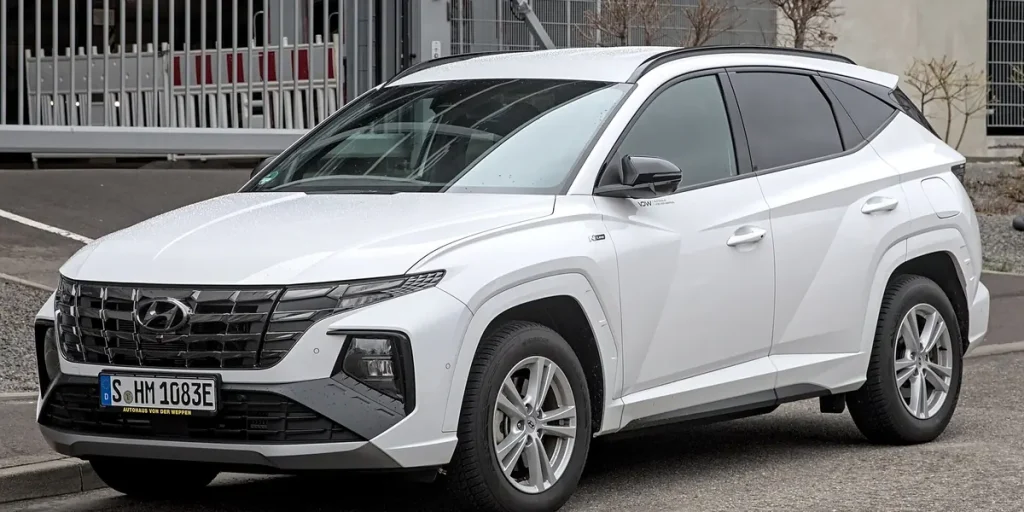
The Tucson PHEV carries a 13.8 kWh (gross) lithium-ion polymer pack — about 11.6 kWh usable — under the cargo floor. It has never changed across the NX4’s life, in any market.
• Electric range: 33 miles EPA (2022–2024), 32 miles (2025–2026); WLTP up to about 43.5 miles on current UK cars
• Charging: 7.2 kW AC only — no DC fast charging; a full charge takes about 2 hours on a wallbox
• Battery warranty (US): 10 years / 100,000 miles with a 70% capacity floor — and it transfers to the next owner in full
• System power: 261 hp (2022–2024 US), 268 hp (2025–2026 US)
The Battery: 13.8 kWh Gross, About 11.6 kWh Usable
Hyundai quotes one number for this pack — 13.8 kWh — and it is the gross figure; the usable capacity is roughly 11.6 kWh according to EV Database, and Hyundai does not publish its own usable figure at all. That ~2.2 kWh buffer is not wasted space: a plug-in hybrid’s small pack works far harder per kilowatt-hour than a big EV battery, cycling deeply every day, and the reserved margin is how Hyundai protects it. The pack is a 360-volt lithium-ion polymer unit — Hyundai’s term for its pouch-cell construction — rated at 88 kW of output, sitting under the rear cargo floor (which is why PHEV cargo space, 31.9 cubic feet behind the seats, trails the other Tucsons’ 38.7).
One pack, unchanged since 2021
Across two facelifts and every model year from the European launch in March 2021 through the 2026 cars, the battery never changed: 13.8 kWh gross in the US, UK, EU and Australia alike. What changed around it was the tuning — power and range ratings moved by year, as the next section shows — but a battery question about a 2022 Tucson PHEV and a 2026 one has the same answer. One question has no sourced answer at all: who makes the cells. No credible source names a supplier for this pack, and this page will not guess — claims tying it to a specific maker are not backed by anything Hyundai has published.
Electric Range: Split by Year, Split by Market
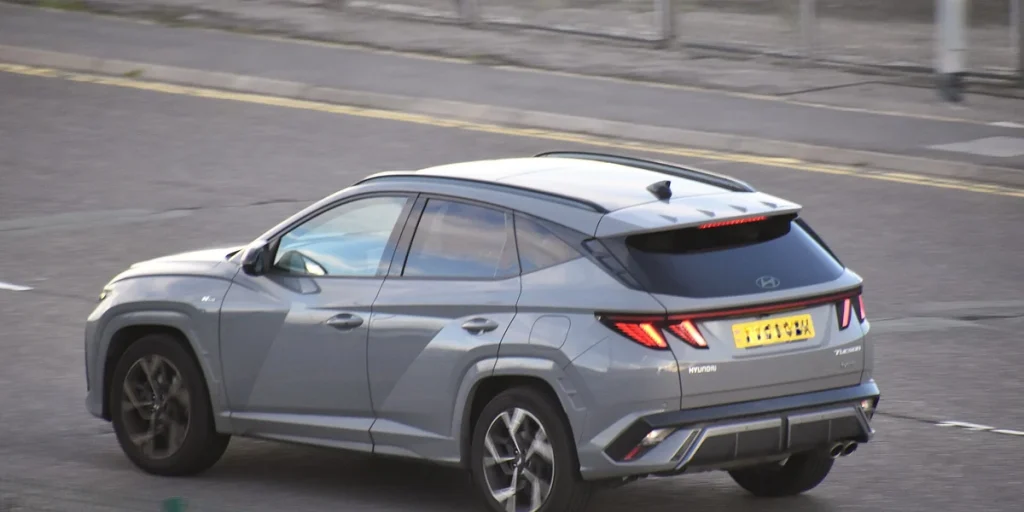
The Tucson PHEV’s electric range is 33 miles on the US EPA cycle for 2022–2024 cars and 32 miles for 2025–2026 — and any page printing one number for all years, or a single WLTP figure, is out of date. Europe’s WLTP ratings climbed over the car’s life as the facelift cars were re-homologated:
| Market / rating | Electric range | Notes |
|---|---|---|
| US EPA, 2022–2024 | 33 miles | 80 MPGe; total range 420 miles |
| US EPA, 2025–2026 | 32 miles | 77 MPGe; Hyundai’s official total range 388 miles |
| WLTP, 2021 launch cars | about 62 km (38 miles) | UK launch spec |
| WLTP, later NX4 | 65 km | Euro 6e-era cars |
| WLTP, current UK/EU facelift | up to 43.5 miles (about 67–70 km) | Hyundai UK’s current headline |
The total-range lines deserve a word, because third-party sites repeat “420 miles” as if it were current. It was the EPA total for the early cars; Hyundai USA’s own figure for the current car is 388 miles — still a full day’s driving on a tank and a charge, but the smaller number is the honest one for a 2025–2026 car. Gas-only economy is 35 mpg combined throughout.
Power changed too — by market
The system output is the other figure that moved. US cars made 261 hp and 258 lb-ft for 2022–2024, then 268 hp and 271 lb-ft from the 2025 facelift, with the electric motor growing from 66.9 to 72 kW. European cars ran 265 PS at launch, 252 PS in the facelift, and 288 PS in the latest model-year update. All US Tucson PHEVs are all-wheel drive (HTRAC) as standard; Europe also sells front-wheel-drive versions, which is why European range figures sometimes edge higher.
Real-World Range: What Drivers Actually Get
Expect roughly 29–31 miles of electric driving in normal conditions — Edmunds measured 29.3 miles on its standard EV test route — and nearer 25 miles in deep cold. EV Database’s modelled estimates for the European car tell the same story in kilometres: about 47 km combined in cold weather with the heating on, against 65 km of WLTP rating. One owner’s log on a database site recorded 53 km in warm weather and 38 km in winter — a single car, but it matches the pattern.
Why cold costs this car more: there is no heat pump
The Tucson PHEV has no heat pump, and its cabin heating depends on the petrol engine. Below freezing, the engine will start to make heat even with a full battery and EV mode selected — the single most common owner complaint about this car, and a mechanical fact, not a fault. It means winter “electric range” is partly a question of how warm you want the cabin. Short winter trips on a pre-warmed, plugged-in car stay electric longest; a cold start with the heater blasting will burn petrol from the first minute. Rivals with the same layout share the behaviour; it is the honest price of a PHEV without a heat pump.
Charging: 7.2 kW and About Two Hours
The Tucson PHEV charges at up to 7.2 kW on AC — the old version of this page said 6.6 kW, which is the Toyota RAV4 Plug-in’s figure, not this car’s — and a full charge takes about two hours. Hyundai’s own UK figure is 1 hour 42 minutes on a 7 kW wallbox; the US spec line says 1.7 hours at 240 volts. On a household Level 1 supply the same charge takes 10.6 hours — overnight-plus, which is why most owners fit a wallbox: with one, the car is full again between dinner and bedtime, every night.
| Charging | Power | Full charge (0–100%) |
|---|---|---|
| Level 2 wallbox (home/public AC) | up to 7.2 kW | about 1.7–2 hours |
| Level 1 (US household outlet) | about 1.4 kW | 10.6 hours |
| DC fast charging | — | Not supported |
No DC fast charging — and why it matters less here
There is no DC fast charging on any Tucson PHEV, in any year. On a battery-electric car that would be a serious limit; on a 13.8 kWh plug-in hybrid with a petrol engine aboard, it is mostly a spec-sheet line. The car’s design assumes you charge slowly at home or work and let the engine handle the rest — trying to rapid-charge 11.6 usable kilowatt-hours on a road trip would save minutes, not hours. New for 2026 in the US: a dual-voltage portable cable (Level 1 and Level 2) is included with the car. Our guide to how to charge a PHEV covers the daily routine in full.
Warranty: The Battery Term Is the Generous One
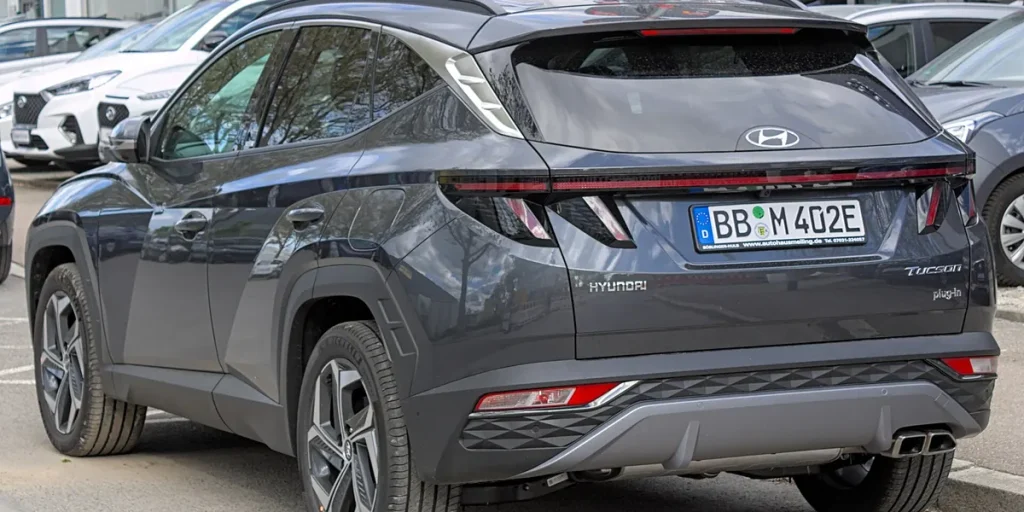
In the US, the Tucson PHEV’s battery carries 10 years or 100,000 miles of cover with a written 70% capacity floor — and unlike Hyundai’s famous powertrain warranty, the battery term transfers to the next owner at full length. For used buyers, that transfer is the most valuable line in this section: a 2023 car bought second-hand in 2026 keeps its battery cover to 2033 or 100,000 miles.
| Market | Battery warranty | Capacity promise |
|---|---|---|
| United States | 10 years / 100,000 miles | at least 70% of original capacity; transfers in full |
| United Kingdom | 8 years / 100,000 miles | High-voltage battery warranty (separate from the 5-year unlimited-mileage car warranty) |
| European Union | 8 years / 160,000 km | Battery certificates for European cars state a floor above 75% |
Keep the car’s warranties separate in your head, because sellers mix them: the US 10-year/100,000-mile powertrain warranty is original-owner only (later owners get 5 years/60,000 miles), while the battery warranty above is not cut down for second owners. In Europe the headline car warranty is shorter, but the battery term — eight years in both the UK and EU — is the one that matters for a plug-in hybrid.
Battery Life and Replacement: One Certificate, No Price List
There is no published degradation study of the Tucson PHEV — no fleet data, no owner survey, nothing this page can honestly average for you. What exists is exactly one hard data point, and it is a good one.
An independent battery certificate (SOCO/Moba, January 2026) for a July 2022 car at 57,885 km found all 11 kWh of its usable capacity still present on the car’s own battery data, with a tight 20 mV spread between its highest and lowest cells. One car proves nothing about a fleet — but a three-and-a-half-year-old PHEV showing no measurable loss is consistent with what the design predicts: that big gross-to-usable buffer means the pack rarely sees a truly full or truly empty state, which is precisely what wears lithium cells out.
Replacement cost gets the same honest treatment: Hyundai publishes no price for this pack, and no dealer quote or parts figure exists in the open. The $6,000–$9,000 figures on estimate sites are unsourced. In practice, the 10-year/100,000-mile US battery warranty (and the eight-year European terms) covers the realistic risk window; outside it, any quote would come from a dealer’s parts desk for the specific car. Hyundai does design its hybrid packs for module-level repair in principle — but no Tucson-specific module price is published either, and this page will not invent one.
The 12V battery: the one that actually strands people
The battery that genuinely gives Tucson owners trouble is the ordinary 12-volt one — a conventional lead-acid battery (US cars) under the rear cargo area. Owner-problem guides for the NX4 hybrid family report it draining flat after roughly 10–14 days standing, thanks to a small constant draw from the car’s electronics; a jump pack or a trickle charger on long-parked cars is the cheap insurance.
If a Tucson PHEV refuses to wake after a holiday, suspect the 12V first, not the traction pack. Two more owner-lens items from the same guides are worth knowing: onboard-charger failures are a reported repair (covered by the general car warranty, not the battery term), and cold-climate cars have a service bulletin (TSB 23-EE-002H) for fuel diluting the engine oil on short winter trips — a PHEV pattern, since the engine runs briefly and cold.
Tucson PHEV vs Its Rivals’ Batteries
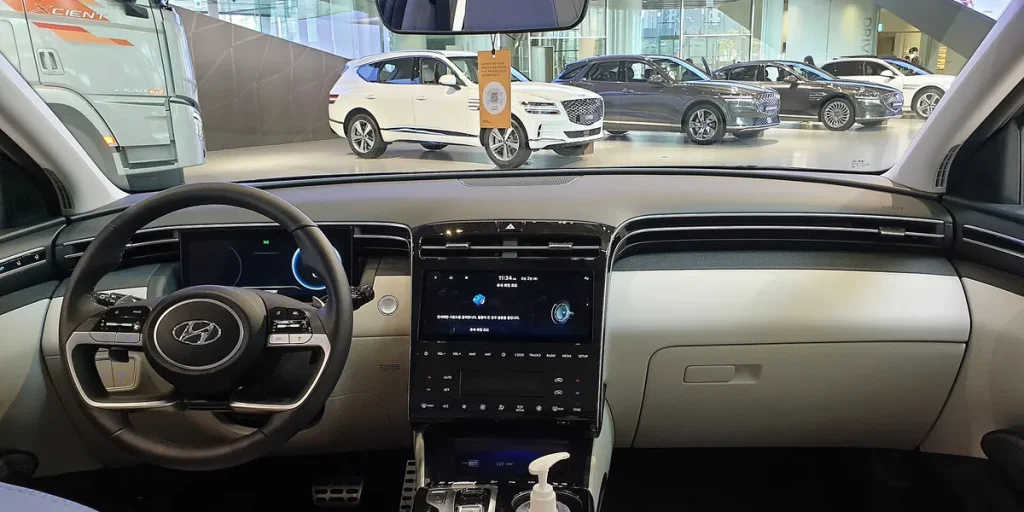
The Tucson sits in the middle of its class on battery size — matched exactly by its Kia Sorento cousin, beaten on capacity by Toyota and Mitsubishi — and the segment has reshuffled around it. The table compares the cars a Tucson shopper actually cross-shops:
| Model | Battery (gross) | EPA electric range | DC fast charging |
|---|---|---|---|
| Hyundai Tucson PHEV | 13.8 kWh (about 11.6 usable) | 32–33 miles | No |
| Kia Sorento PHEV | 13.8 kWh | 32 miles | No |
| Toyota RAV4 Plug-in (through 2025) | 18.1 kWh | 42 miles | No |
| Mitsubishi Outlander PHEV (2023–2025) | 20 kWh | 38 miles | Yes — CHAdeMO |
Notes that matter more than the table: the Outlander is the segment’s charging exception — the only one with DC fast charging — and for 2026 its pack grows to 22.7 kWh with a 45-mile EPA rating. The RAV4 comparison is now two cars: an all-new 2026 RAV4 Plug-in pairs a 22.7 kWh pack with roughly 50 kW DC charging on European data (US ratings were still pending at the time of writing).
The Tucson’s bigger Hyundai sibling has left the fight in America — the Santa Fe PHEV, which shares this car’s 13.8 kWh pack family, was dropped from the US line-up with its 2024 redesign and is Europe-only now. Ford’s Escape PHEV is in its final phase as Ford ends Escape production, and the Dodge Hornet PHEV is confirmed gone. The Tucson’s remaining pitch is the one it started with: standard AWD in the US, and that transferable battery warranty. Buyers weighing it against Toyota’s sedan-shaped alternative may also find our Toyota Prius Plug-in guide useful.
Prices — and the End of the Line
Current prices, dated: in the US the 2026 Tucson PHEV starts at $40,675 (SEL AWD) with the Limited at $48,900, before freight; in the UK the facelift range starts at £36,680 (Hyundai UK, November 2026); in Germany the latest model year launched from €44,690 (Hyundai’s November 2025 release). Prices in this class move with incentives and model-year changeovers, so treat those as the entry points of the current lists, not promises.
One last fact reframes all of them: this is the last Tucson PHEV America gets. Hyundai unveiled the all-new Tucson in October 2026, and its plug-in version pairs a larger 17.1 kWh battery with a target of up to 81 km (about 50 miles) of WLTP electric range — for Europe, launching in 2027. Reports from the unveiling say the new car’s PHEV will not be sold in North America at all. If you want a plug-in Tucson in the US, the NX4 on sale now — with its unchanged 13.8 kWh pack and its long, transferable battery warranty — is not the outgoing model to wait past. It is the only one there will be.
Frequently Asked Questions
How big is the Hyundai Tucson PHEV battery?
13.8 kWh gross. The usable capacity is about 11.6 kWh (EV Database’s figure); Hyundai does not publish a usable number. The difference is a protective buffer that helps the small, hard-working pack last.
How far does the Tucson PHEV go on electricity?
33 miles on the EPA cycle for 2022–2024 cars, 32 miles for 2025–2026. In real driving expect about 29–31 miles in mild weather (Edmunds measured 29.3) and nearer 25 in deep cold, partly because the engine runs to heat the cabin — the car has no heat pump.
How long does a Tucson PHEV take to charge?
About 1.7–2 hours from empty on a Level 2 wallbox at up to 7.2 kW. On a US Level 1 household outlet it takes 10.6 hours. There is no DC fast charging on any model year.
What warranty does the Tucson PHEV battery have?
In the US: 10 years or 100,000 miles, with at least 70% of original capacity guaranteed, and the term transfers in full to later owners. In the UK: 8 years or 100,000 miles. In the EU: 8 years or 160,000 km.
How long will the Tucson PHEV battery last?
There is no fleet study to quote. The one independent certificate we found — a 2022 car at 57,885 km — showed no measurable loss of usable capacity. The pack’s large protective buffer and the long warranty terms both point the same way, but any exact lifespan figure would be a guess.
What does a replacement Tucson PHEV battery cost?
No published price exists — Hyundai does not release one, and the figures on estimate sites are unsourced. Within the warranty period a failed or excessively degraded pack is a claim, not a purchase.
Does the Tucson PHEV have the same battery as the Santa Fe PHEV?
Same family and the same 13.8 kWh gross size. The Santa Fe PHEV is no longer sold in the US (it left with the 2024 redesign and continues in Europe), so the Tucson is now Hyundai’s only US plug-in SUV.
Will there be a new Tucson PHEV with a bigger battery?
In Europe, yes: the all-new Tucson shown in October 2026 gets a 17.1 kWh pack targeting up to 81 km WLTP, launching in 2027. Reports say that PHEV will not be sold in North America, making the current car the last US Tucson PHEV.
Conclusion
The Tucson PHEV’s battery is a study in doing one thing consistently: a 13.8 kWh gross, roughly 11.6 kWh usable pack, unchanged since 2021, charged at an honest 7.2 kW, rated at 32–33 EPA miles depending on the year, and covered in the US by a 10-year battery warranty that survives a change of owner.
The old version of this page flattened those details into single numbers — some of them wrong. The real picture is better and more useful: know the year, know the market, expect about 29 miles of real electric driving, and if the car will stand parked for a fortnight, look after its little 12-volt battery. Do that, and the pack underneath should be the least of your worries for as long as the warranty runs — and on the early evidence, well beyond it.
