
What Is Load Balancing for Home EV Charging

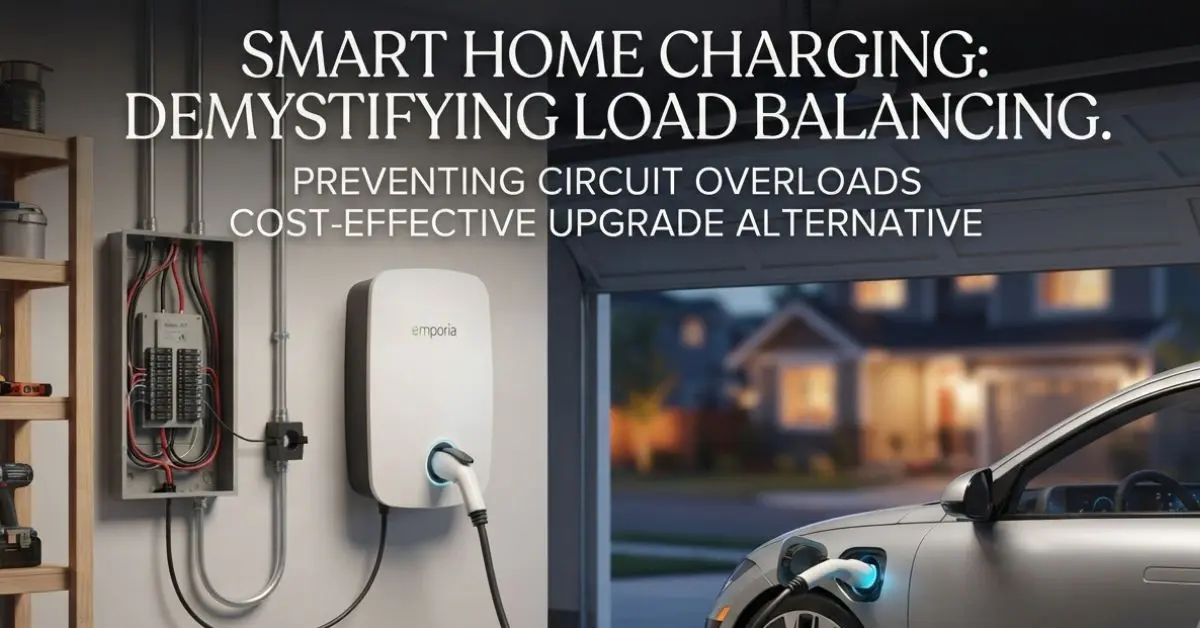
Your EV charger does not have to compete with your home’s other appliances for power. Load balancing helps your EV charge safely while keeping your electrical system from overloading.
Load balancing for home EV charging is technology that automatically manages the electricity demand of your EV charger alongside other home appliances, preventing circuit overloads and allowing faster chargers to operate safely on panels that might otherwise need expensive upgrades. In simple terms, load balancing lets your EV charger “know” when your dryer, oven, or air conditioner is running and reduce its output accordingly to prevent tripping your main breaker.
This kind of upgrade may also qualify for savings — see our guide on state rebates for home EV charger installation.
Why Load Balancing Matters for Home EV Charging
A 48A Level 2 EV charger draws approximately 11.5 kW from your electrical panel. Combined with a clothes dryer (5 kW), air conditioner (3.5 kW), and other household loads, total demand can reach more than 20 kW, potentially exceeding a 100A (23 kW) panel’s capacity or tripping breakers.
Without load balancing, the solution is either a panel upgrade ($1,500 to $3,000) or a lower-amperage charger. With load balancing, the smart charger automatically reduces its power draw when other high-demand appliances are running, preventing overloads without requiring a panel upgrade.
How Load Balancing Works
Load balancing systems monitor your home’s total electricity consumption in real time using a current transformer (CT) sensor clipped onto the main electrical panel wires.
When the sensor detects that the combined home load and EV charging are approaching the panel’s capacity limit, the charger automatically reduces its amperage output from 48A down to 32A or 16A if necessary. When the high-power appliances finish running, the charger automatically returns to full charging speed. The entire process is seamless and happens without any action from the EV owner.
Types of Load Balancing
| Type | How It Works | Best For | Example Products |
|---|---|---|---|
| Static load sharing | Divides available amps equally between two chargers | Two EVs, one circuit | Tesla Wall Connector power sharing, Wallbox Pulsar Plus |
| Dynamic load management | CT sensor monitors real-time home load; adjusts charger dynamically | Single EV, limited panel | Emporia Pro, Ohm Assistant |
| Whole-home energy management | Integrates EV charger with all home circuits and solar | Solar homes, complex setups | Emporia Vue 3, Sense Home Monitor + JuiceBox |
Why Dynamic Load Management Is the Best Choice
Dynamic load management (DLM) is the most practical option for most homeowners. It uses a CT sensor to monitor real-time household electricity use and continuously adjusts the EV charger’s output to keep total demand within the panel’s safe limit.
Unlike static load sharing, which always divides power equally, DLM responds to actual electricity use. If no other appliances are running, the EV charges at full speed. If the dryer and air conditioner start at the same time, the charger immediately reduces its output to avoid overloading the panel.
Good charging software matters, but daily habits matter too — see our guide on best EV charging habits to extend battery life.
The Emporia Smart Level 2 Pro combines a CT sensor and whole-home monitoring in a single package, making it one of the most complete load management solutions at its price point. The Ohm Assistant is a standalone load management system that works with many smart chargers. ChargePoint Business Edition chargers also include DLM for commercial installations, and the technology is becoming more common for residential homes.
Does Load Balancing Slow Down EV Charging?
Load balancing can temporarily reduce charging speed when other major appliances are running simultaneously.
In real-world use, this rarely creates a problem for overnight charging. Dishwashers, dryers, and ovens usually finish before midnight, allowing the EV to charge at full speed for most of the night. For a 75 kWh EV that needs 40 kWh overnight, charging at 24A for two hours and 48A for five hours is usually enough to complete the required charge by morning.
Load Balancing vs Panel Upgrade: Which Is Right for You?
| Solution | Cost | Best When |
|---|---|---|
| Dynamic load management (DLM) | $200–$500 (CT sensor + software) | Panel is 100–150A with limited spare capacity; overnight charging needs only |
| Panel upgrade to 200A | $1,500–$3,000 | Panel is 60–100A and already at capacity; planning multiple 240V circuits |
| Two-charger load sharing | $700–$1,400 | Two EVs, one circuit — splits power between both cars automatically |
Conclusion
Load balancing for home EV charging is a smart and cost-effective alternative to upgrading your electrical panel when your home has limited electrical capacity. Dynamic load management uses a CT sensor to continuously monitor your home’s electricity use and automatically adjusts the EV charger’s output to prevent overloads. This allows a 48A charger to operate safely on a 100A panel that would otherwise be unable to support it.
For homes with two EVs, static load sharing automatically divides one circuit between two chargers. Adding load balancing typically costs $200 to $500, helping homeowners avoid a panel upgrade that may cost $1,500 to $3,000 while still providing reliable overnight charging.
Want a deeper look at the dynamic version specifically? See our guide on what dynamic load management is in EV charging.
FAQs
What is load balancing in EV charging?
Load balancing is a smart feature that adjusts your EV charger’s power based on your home’s electricity use. It helps prevent overloaded circuits and breaker trips.
Do I need load balancing for a Level 2 EV charger?
You may need load balancing if your electrical panel has limited spare capacity or if several high-power appliances run at the same time as your EV charger.
Is load balancing cheaper than upgrading an electrical panel?
Yes. In many homes, load balancing costs much less than a panel upgrade while still allowing safe and efficient Level 2 EV charging.
