
EV Road Trip Charging Guide

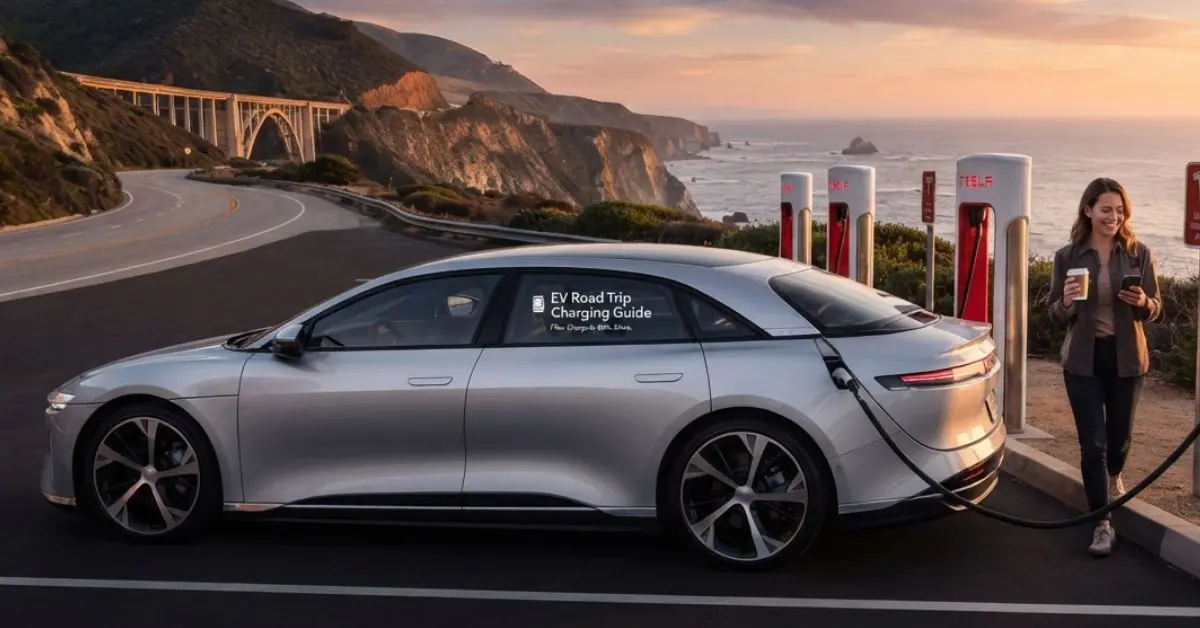
Road-tripping in an EV in 2026 is straightforward with the right preparation. The key principles are: plan charging stops before you leave, charge to 80% and move on, always use your car’s navigation to activate battery preconditioning, and carry a backup charging option. With 248,000+ public charging ports across the U.S. and Tesla Supercharger access available to virtually all NACS-equipped EVs, road trips are genuinely practical for most EV drivers. This complete guide covers everything you need for a successful EV road trip.
Step 1: Plan Your Route and Charging Stops Before You Leave
Use A Better Routeplanner (ABRP) for EV road trip planning — it is purpose-built for this exact use case. Enter your specific EV model, current battery level, and destination. ABRP calculates exactly where to stop, which network to use, how long to charge, and what SoC to leave each station at — factoring in your car’s real charging curve, elevation changes, and weather. It is significantly more accurate than generic map apps for EV trip planning. The free tier covers most needs; premium at $3/month adds live traffic integration.
The 80% Rule: Stop Charging Here and Drive On
The most important road trip charging insight is the 80% rule: stop charging at 80% and continue driving. Above 80% SoC, DC fast charging slows dramatically — going from 80–100% often takes as long as the entire preceding 10–80% session. On a multi-stop road trip, making more frequent 10–80% stops is almost always faster than waiting for 100% at each stop. The one exception: the final charging stop before a long stretch with no chargers — charge to 90–100% if the next segment requires it.
EV Road Trip Charging: Step-by-Step
- Before leaving: Set your EV to 100% for the start of the trip (if NMC) — the only time you should charge to 100% daily. Set the charge to complete just before departure time
- On the road: Enter your first charging stop in your car’s built-in navigation — this triggers battery preconditioning so you arrive ready for full charging speed
- At the charger: Plug in immediately on arrival — the preconditioned battery starts charging at peak rate. Go use the restroom, grab food or coffee
- At 80% SoC: Unplug and drive to your next destination — do not wait for 100% unless range requires it
- Repeat: Enter the next charging stop in navigation before you leave the current station — preconditioning begins immediately for the next stop
Which Charging Network to Use on Road Trips
| Network | Best For | Coverage | Reliability |
|---|---|---|---|
| Tesla Supercharger | All NACS vehicles — primary choice | Excellent — 3,088 US stations | Excellent ⭐⭐⭐⭐⭐ |
| Electrify America | 800V EVs wanting 350 kW; backup for all | Good — all 50 states | Good ⭐⭐⭐⭐ |
| IONNA | 150–400 kW sessions; newer stations | Growing rapidly | Very good ⭐⭐⭐⭐½ |
| EVgo | Urban fast charging; backup on trips | Urban focus | Good ⭐⭐⭐⭐ |
Essential Road Trip Charging Preparation
- Download PlugShare, ABRP, and your network’s app before leaving: You want these ready offline — do not rely on setting them up in a car park with poor reception
- Know your car’s DC fast-charging acceptance rate: If your EV accepts 150 kW, a 350 kW station delivers only 150 kW to your car — plan charging times accordingly, not by the station’s rated maximum
- Have a backup charger: Keep the Level 1 EVSE cable that came with your car in the boot — in an extreme situation, any 120V outlet (hotel, campground, friend’s house) adds 3–5 miles per hour
- Sign up for network accounts before leaving: Tesla app, Electrify America Pass+, EVgo — creating accounts with saved payment at home is much easier than in a car park
- Carry adapters if needed: CCS-to-NACS adapter for Supercharger access on CCS vehicles; J1772-to-NACS adapter included with most NACS EVs for legacy Level 2 stations
How Much Does an EV Road Trip Cost?
DC fast charging at $0.35–$0.55/kWh costs approximately $0.10–$0.16 per mile — slightly cheaper than or comparable to gas. A 500-mile road trip costing approximately $28–$42 in DC fast charging compares to approximately $65 in gas for a 30 mpg car at $3.92/gallon. EV road trips are cheaper than gas on most routes — but not as dramatically cheaper as home charging vs gas ($0.05/mile vs $0.13/mile). Plan for DC fast charging costs at 2–3x your home charging rate per mile.
Conclusion
EV road trips in 2026 are practical and increasingly enjoyable — the charging stops that felt like friction in 2021 now align naturally with meal breaks, coffee stops, and rest areas. ABRP for planning, Tesla Supercharger as the primary network, battery preconditioning via navigation, the 80% rule, and a PlugShare backup check are the five habits that make every EV road trip smooth. The total cost is usually less than an equivalent gas trip — and you never worry about running out of charge when you’ve planned your stops in advance.
