
How Does Workplace EV Charging Work?

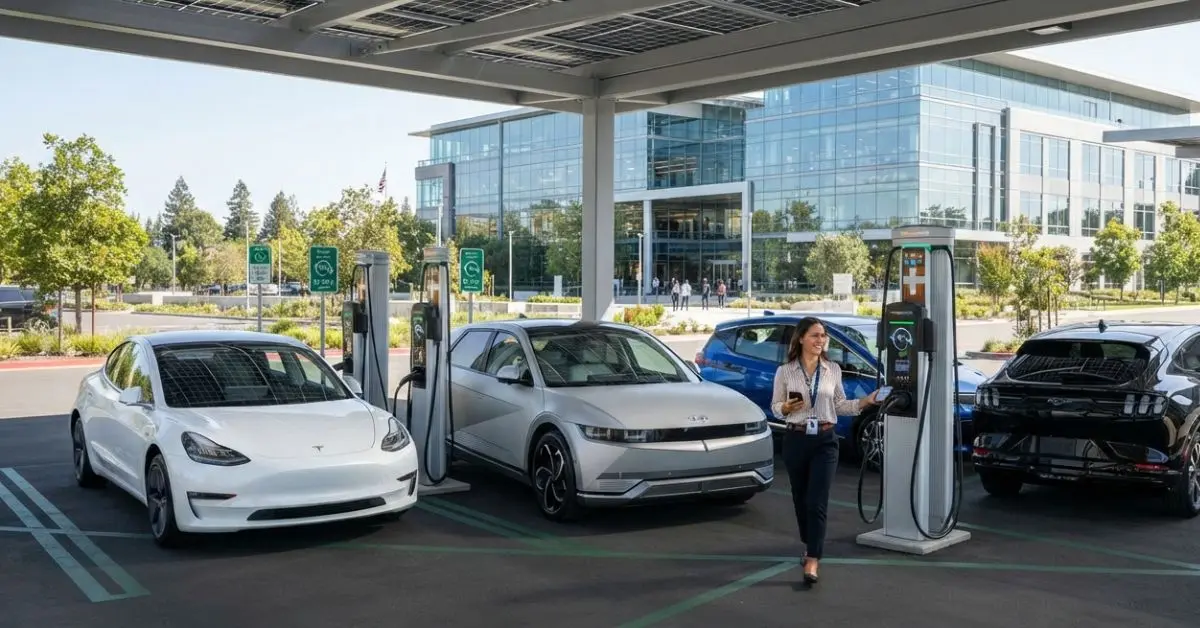
Workplace EV charging provides employees with Level 2 charging during the workday — typically adding 150–250 miles of range during an 8-hour shift. It works through installed Level 2 charging stations in the employer’s parking lot or structure, managed through a networked charging platform like ChargePoint, Blink, or IONNA. Most workplace charging is free for employees or offered at a subsidised rate. For many EV owners — particularly apartment dwellers without home charging — workplace charging is the primary daily charging method. Here is how it works in practice.
How Workplace EV Charging Works: The Basics
Workplace EV charging is fundamentally the same as public Level 2 charging — a 240V station adds 15–35 miles of range per hour. The difference is access control and payment. Workplace chargers are typically restricted to employees via RFID badge or an employer-issued charging card — preventing the general public from using company-installed chargers. Most employer-managed systems use a networked charger platform (ChargePoint for Business, Blink Commercial, or IONNA) that tracks usage, manages access, and reports energy consumption for tax and sustainability purposes.
Typical Workplace Charging Setup
| Specification | Typical Workplace Installation |
|---|---|
| Charger type | Level 2 (7.2–11.5 kW most common) |
| Miles added per 8-hour shift | 150–250 miles (depending on charger power) |
| Number of stations | Varies — 2–50+ stalls depending on company size |
| Access control | Employee RFID card, charger app, or licence plate recognition |
| Cost to employee | Often free; sometimes subsidised (~$0.05–$0.15/kWh) |
| Management platform | ChargePoint for Business, Blink Commercial, IONNA, Greenlots |
| Installation cost (employer) | $1,500–$5,000 per station (hardware + installation) |
| Federal tax incentive (employer) | 30% Alternative Fuel Vehicle Refueling Property Credit |
Who Pays for Workplace EV Charging?
In most cases, the employer pays for the electricity — offering free charging as an employee benefit. Some larger employers implement a subsidised model where employees pay a reduced rate (typically $0.05–$0.15/kWh vs the $0.17–$0.19 national average) to recover a portion of electricity costs. A small number of employers pass the full electricity cost to employees through networked billing. Free workplace charging is the most common model for employers who install chargers as a benefit — it costs approximately $15–$30 per month per employee in electricity at typical usage rates.
The Business Case for Employers
- Employee recruitment and retention: EV charging is a valued benefit — surveys show EV-owning employees rate workplace charging among the most valued perks, comparable to gym access or subsidised parking
- 30% federal tax credit: The Alternative Fuel Vehicle Refueling Property Credit covers 30% of hardware and installation costs (up to $100,000 per location through the Inflation Reduction Act) — reducing the real cost significantly
- ESG and sustainability goals: Workplace charging enables employee EV adoption, reducing the company’s Scope 3 emissions from employee commuting — relevant to corporate sustainability reporting
- Low cost per employee: At 15 kWh per 8-hour workday (a typical daily charge), electricity cost per employee is approximately $2.55/day at $0.17/kWh — less than a cup of coffee per day per employee
How Employees Use Workplace Charging
Most workplace charging systems use a straightforward process. Employees register their vehicle and payment method (or receive a free access code) through the employer’s charging platform. On arrival, they park in an EV-designated stall and tap their RFID card or use the network’s app to start the session. The car charges throughout the workday — employees are often notified via app when their car reaches a set SoC so others can use the stall. Many companies implement a charging etiquette policy where employees move cars once charged to free stalls for colleagues.
Conclusion
Workplace EV charging adds 150–250 miles per shift — enough to cover most employees’ full weekly commuting needs from a single daily workplace top-up. For employees without home charging access (apartment dwellers), workplace charging can entirely replace home charging as the primary daily method. For employers, the 30% federal tax credit reduces installation costs significantly, and the electricity cost is minimal relative to the recruitment and retention benefit. Workplace EV charging is one of the fastest-growing segments of commercial EV infrastructure in 2026 — driven by both employee demand and employer ESG commitments.
