
What Are EV Charging Rights for Renters?

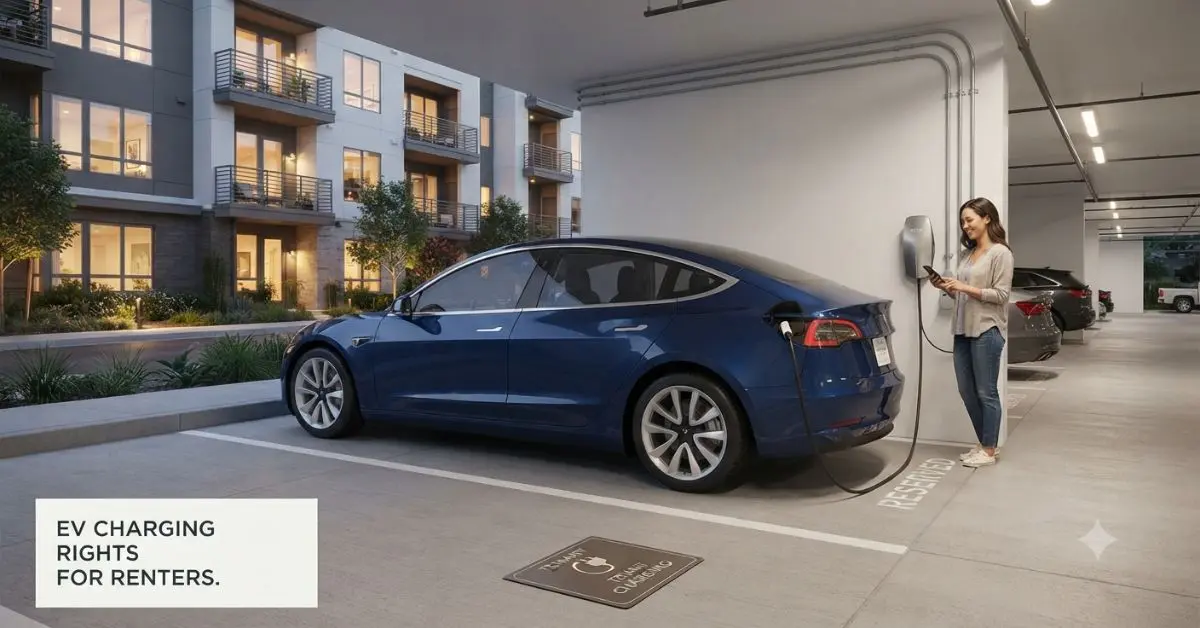
EV charging rights for renters vary significantly by state — but the trend is strongly toward expanding tenant protections. As of 2026, over 14 U.S. states have laws giving tenants the right to install EV chargers at their personal parking space, with landlords limited in their ability to refuse. Federal policy and building codes are also increasingly requiring EV-ready infrastructure in new multi-family construction. Here is a complete guide to what EV charging rights renters have in 2026.
The Core Tenant Right: What It Typically Covers
In protected states, the core right is to install a Level 1 or Level 2 EV charger at a tenant’s dedicated parking space, subject to reasonable conditions. The tenant covers all costs — equipment, licensed installation, permits, insurance, and restoration on move-out. The landlord cannot profit from the installation or impose conditions that effectively prevent the tenant from exercising the right.
State EV Charging Tenant Rights: 2026 Overview
| State | Tenant Right? | Strength |
|---|---|---|
| California (Civil Code 1947.6) | ✅ Yes | Strong — cannot unreasonably refuse |
| Colorado (HB 21-1165) | ✅ Yes | Strong — explicit right |
| Florida (§ 83.682) | ✅ Yes | Moderate — cannot unreasonably withhold |
| Hawaii (HRS § 196-7.5) | ✅ Yes | Strong — cannot prohibit |
| Maryland, Massachusetts, New Jersey | ✅ Yes | Moderate |
| Oregon (ORS 90.730) | ✅ Yes | Strong |
| Washington (RCW 59.18.615) | ✅ Yes | Strong — cannot prohibit |
| Texas, Georgia, most others | ❌ No specific law | Negotiation required |
Federal EV-Ready Building Requirements
The National Electric Code (NEC) 2023 — adopted by many states — requires EV-capable conduit in new parking facilities and multi-family housing. New apartment buildings are being built pre-wired, reducing future installation costs from $3,000–$5,000 per space to approximately $500–$800. The Infrastructure Investment and Jobs Act (IIJA) funds EV charging at multi-family buildings through state energy offices.
How to Exercise Your EV Charging Rights
- Research your state law at afdc.energy.gov/laws/state — the Department of Energy’s state EV policy database is the most reliable source
- Submit a formal written request — email creates a documented record; cite the specific statute name and number
- Offer to cover all costs — installation, permits, insurance, and restoration removes every landlord objection
- Propose a professional installation plan — a pre-obtained electrician’s quote shows the landlord exactly what will happen
- If refused illegally — contact your state attorney general’s consumer protection office; illegal refusal may entitle you to damages and fee recovery
What Landlords Can and Cannot Do
In protected states, landlords can require a licensed electrician, permits, proof of insurance, and installation only at the tenant’s dedicated spot. They cannot outright refuse without engaging the process, charge excessive unrelated fees, or unreasonably delay approval. The process gives landlords reasonable control over safety and quality while ensuring tenant access to EV charging.
Conclusion
EV charging rights for renters are strong and growing — 14+ states now protect the right to install chargers at personal parking spaces. Federal NEC 2023 EV-ready requirements are making new apartment parking increasingly pre-wired. For renters in protected states: written request citing the state law, professional installation offer, and documented restoration commitment is all you need. For renters in unprotected states, a commercial proposal emphasising property value improvement is the most effective approach.
