
How to Charge an EV If You Live in an Apartment

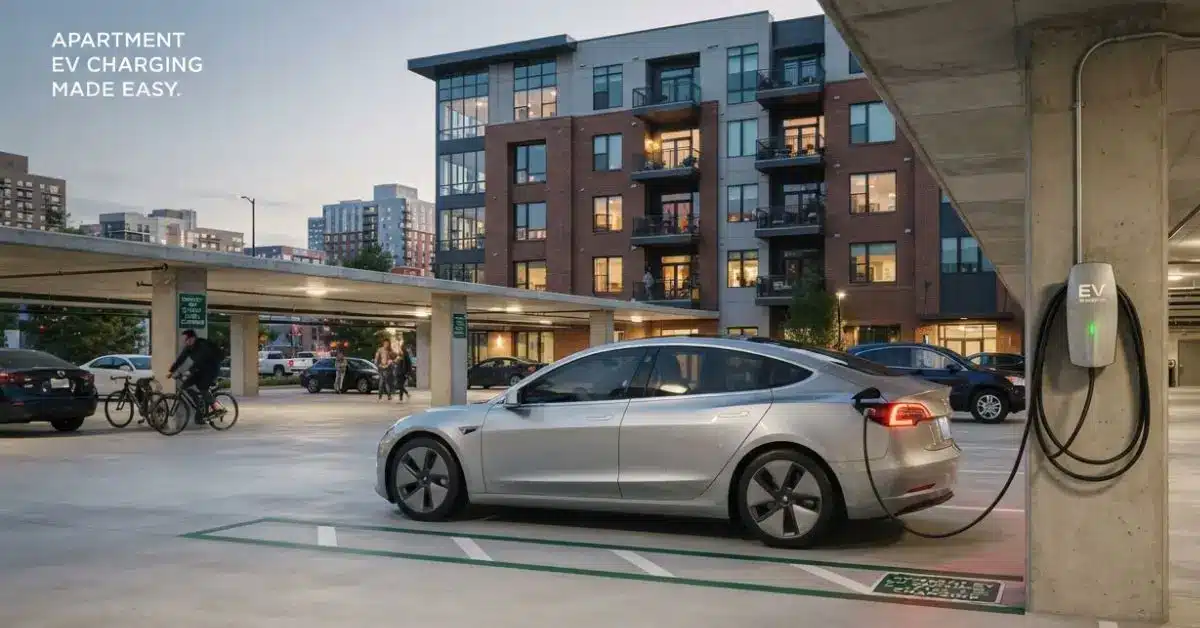
Charging an EV without a home garage is very manageable in 2026 — using a combination of outdoor outlet Level 1 charging, public Level 2 destination charging, workplace charging, and DC fast charging for top-ups. Approximately 30–40% of U.S. EV owners live in apartments or multi-unit dwellings — making apartment EV charging one of the most important practical questions for new EV buyers. Here are every solution available to apartment EV drivers.
Apartment EV Charging Options: Overview
| Option | Speed | Cost | Availability |
|---|---|---|---|
| Parking lot outlet (Level 1) | 3–5 miles/hour | ~$10–$15/full charge (tenant pays) | Some apartment buildings |
| Building-installed Level 2 | 15–35 miles/hour | $0.25–$0.50/kWh or included in rent | Growing — request from landlord |
| Workplace Level 2 (free) | 20–30 miles/hour | Often free | Depends on employer |
| Public Level 2 (retail, hotels) | 20–30 miles/hour | $0–$0.40/kWh | Widely available |
| DC Fast Charging | 100–300 miles in 20–40 min | $0.35–$0.60/kWh | Urban areas well-covered |
| Blink / ChargePoint residential EV charging | Level 2 | Varies | Some apartment complexes |
Option 1: Ask Your Building for EV Charging
The most impactful step an apartment EV owner can take is formally requesting EV charging installation from their property manager or landlord. Many landlords are receptive — EV charging has become a sought-after amenity that improves property value and tenant retention. In California, Colorado, and several other states, landlords are legally required to permit EV charger installation upon request (see the section on EV charging rights for renters). Even without legal requirements, presenting a business case — that EV charging infrastructure increases property value and attracts desirable long-term tenants — often succeeds.
Option 2: Use Your Parking Spot’s Existing Outlet
Many apartment parking spots have an existing 120V outlet — originally installed for engine block heaters in cold climates. If your spot has one, Level 1 charging is available immediately using the portable EVSE cable that came with your EV. Adding 3–5 miles per hour, Level 1 adds approximately 40–50 miles overnight — enough for many urban commuters who drive under 30–40 miles daily. If your spot doesn’t have an outlet but nearby spots do, asking the building manager to permit use of an existing outlet is often a low-cost win.
Option 3: Charge at Work
Workplace EV charging is increasingly common and is often free. A Level 2 charger running for 8 hours at work adds approximately 170–250 miles — enough to cover most weeks of urban commuting without any home charging at all. If your employer does not currently offer EV charging, request it — present the argument that it is a valued employee benefit that costs approximately $500–$1,500 to install per station and dramatically helps EV-owning employees. Many employers have sustainability goals that align with adding EV infrastructure.
Option 4: Build a Public Charging Routine
Urban apartment EV owners increasingly treat public Level 2 chargers as their “home charger equivalent” — stopping at grocery stores (Whole Foods, Costco), shopping centres, and destination chargers for regular top-ups. The key is integrating charging into activities you would do anyway: groceries, gym visits, cinema, library. A 2-hour Level 2 charge during a weekly grocery run adds approximately 45–60 miles — enough to supplement weekday workplace charging into a full weekly charging solution without any home charging.
Option 5: Use DC Fast Charging Strategically
For apartment dwellers without regular Level 2 access, DC fast charging once or twice per week covers most driving needs. A 20–30-minute DC fast session adds 100–200 miles — enough for most people’s weekly driving covered in a single stop. At $0.35–$0.55/kWh, weekly DC fast charging costs approximately $15–$30 — more expensive than home Level 2 charging but still significantly cheaper than gas. Urban areas in 2026 have extensive DC fast coverage through Tesla Supercharger (open to all NACS EVs), EVgo, and ChargePoint Express stations.
Best EVs for Apartment Dwellers
- LFP battery EVs (Tesla Standard Range, Chevy Equinox EV SR, BYD models): LFP supports daily 100% charging — ideal for apartment dwellers who may charge whenever Level 2 access is available, without worrying about degradation from irregular charging patterns
- Long-range EVs: A 300+ mile range EV requires less frequent charging than a 200-mile EV — more flexibility to charge opportunistically rather than daily
- Fast-charging EVs (Hyundai Ioniq 5, Kia EV6, Tesla Model 3/Y): Faster DC charging means shorter stops at public fast chargers — less time investment per charging session for apartment dwellers relying on public fast charging
Conclusion
Living in an apartment without a home charger does not prevent practical EV ownership in 2026. The most effective strategies are: requesting building-installed charging from your landlord (often successful), charging free at work, building a public Level 2 routine around your regular errands, and using DC fast charging for weekly top-ups. Apartment EV ownership requires more intentionality than garage home charging — but with the right habits and the right EV, it is genuinely workable for most urban drivers covering under 1,000 miles per month.
