
What to Do If You Run Out of Charge on the Road

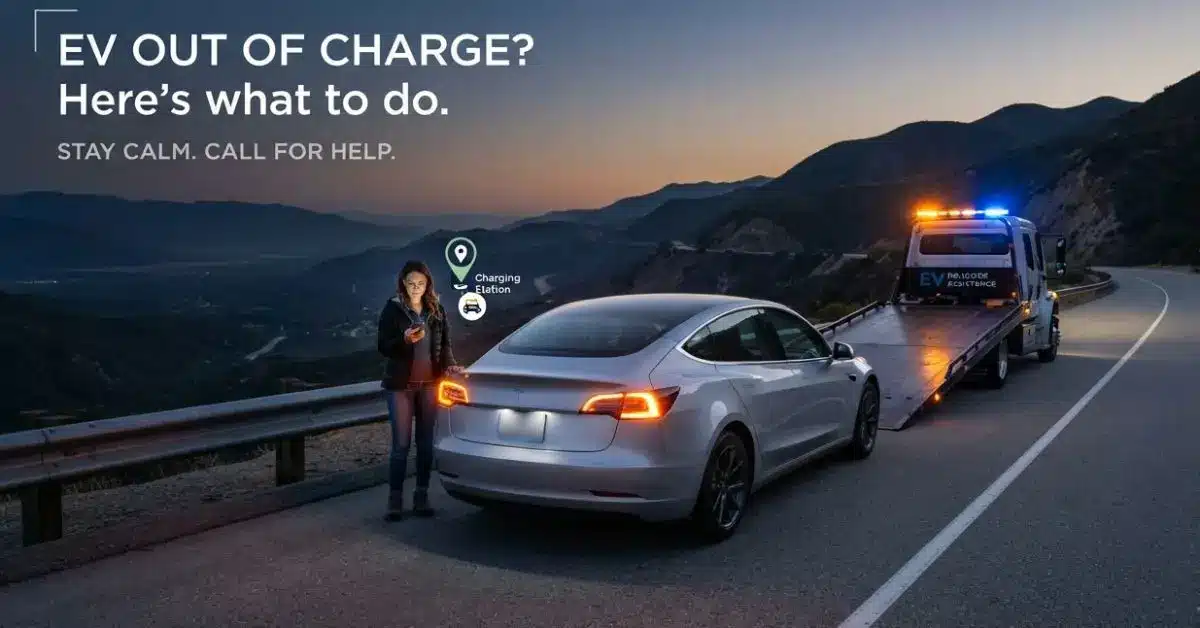
If you run out of charge in an EV, your first step is to safely pull off the road, turn on hazard lights, and call roadside assistance. Unlike running out of gas, an EV that reaches 0% cannot be quickly topped up from a portable container — you need either a mobile charging unit, a flatbed tow to a nearby charger, or in some cases a Level 1 connection to add enough range to reach a charging station. Running completely out of charge is rare with proper planning — but here is exactly what to do if it happens.
Immediate Steps When Your EV Runs Out of Charge
- Step 1 — Stay calm and pull over safely: EVs give multiple range warnings before reaching 0% — you will have time to safely exit traffic. Activate hazard lights immediately when pulling over
- Step 2 — Call roadside assistance: Your car manufacturer’s roadside assistance number is in the owner’s manual and usually accessible through the car’s infotainment touchscreen. AAA, your car insurance roadside programme, and most EV brands include mobile charging or flatbed towing as standard coverage
- Step 3 — Identify the nearest charger: Open PlugShare or Google Maps while waiting — knowing the nearest charger’s location helps the roadside assistance team plan the fastest solution
- Step 4 — Unlock the charging port: Make the car accessible for the roadside assistance team before they arrive — confirm the charging port cover can be opened (some open via the touchscreen or key fob even with a depleted battery through the 12V auxiliary system)
What Roadside Assistance Can Do
| Option | What It Provides | Time to Help | Availability |
|---|---|---|---|
| Mobile Level 2 charging unit | Adds 10–20 miles in 30–60 min from a mobile generator | 30–90 min arrival | Some AAA regions, some manufacturer roadside teams |
| Flatbed tow to charger | Transports car to nearest charger | 30–90 min arrival | Most roadside assistance providers |
| Tesla Roadside Assistance | Range Assistance service provides mobile charge in some areas | Varies by location | Tesla owners only; not universal |
| Police / highway patrol | Can help keep you safe while waiting; cannot charge your EV | Minutes | Always available |
The EV “Reserve” Battery: Not Truly Zero
Most EVs maintain a small hidden reserve below the displayed 0% — typically 3–8% of actual battery capacity. When the display shows 0% range remaining, you may have 5–20 miles of actual remaining range depending on your EV model and conditions. Tesla keeps approximately 3–5 miles in reserve below 0 miles displayed. Hyundai Ioniq 5 keeps approximately 5–8% reserve. This buffer is specifically to help you limp to a charger rather than stopping immediately at the “0 miles” warning. Drive slowly, avoid hills, turn off climate control, and use this reserve to reach safety or a charging point.
Can You Push an EV or Put It in Neutral?
Most EVs cannot be safely pushed or rolled in neutral with a fully depleted battery — the electric parking brake and steering may not function without 12V power. Some EVs allow a neutral mode for towing, but this varies by model and requires specific procedures in the owner’s manual. Never attempt to push an EV onto a flatbed without first confirming the correct procedure with your roadside assistance provider and owner’s manual. Most EVs specify they must be transported on a flatbed with all four wheels off the ground — not tow-dolly or towing with two wheels on the road.
How to Prevent Running Out of Charge
- Never plan to arrive at a charger with less than 10–15% SoC: Always leave a comfortable buffer — range estimates become less predictable at very low SoC, especially in cold weather or at highway speeds
- Use ABRP for road trips: A Better Routeplanner accounts for real-world efficiency at your specific speed, weather, and elevation — far more accurate than the car’s built-in range estimate for long journeys
- Set a personal low-SoC alert: Most EV apps allow alerts at specific battery levels — set an alert at 20% SoC to prompt you to start looking for a charger
- Slow down when range gets low: Aerodynamic drag drops dramatically at lower speeds — slowing from 75 mph to 60 mph typically increases remaining range by 20–25%
Conclusion
Running out of charge in an EV is rare — every EV provides extensive low-battery warnings well before reaching 0%. If it does happen, pull over safely, activate hazards, call roadside assistance (flatbed to a charger is the most reliable solution), and use PlugShare to identify the nearest charging station for the tow destination. The most important prevention is planning: use ABRP for road trips, never plan to arrive at a charger with less than 10% buffer, and treat the 15% SoC warning as your cue to find the next charger — not a suggestion to push on.
