
Federal Tax Credit for EV Home Charger Installation

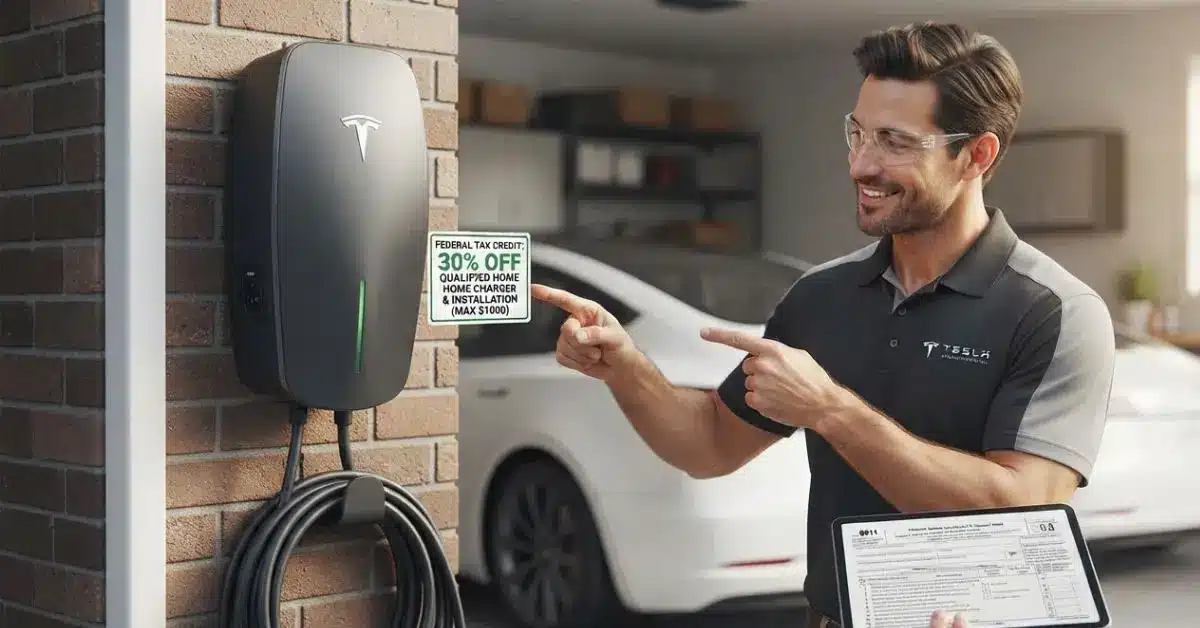
The federal government gives a 30% tax credit for home EV charger installation. This credit covers equipment and installation costs up to $1,000 for homes. The official name is the Alternative Fuel Vehicle Refueling Property Credit, or IRS Form 8911.
The Inflation Reduction Act extended this program. For a normal home charger costing $800 to $1,600, the credit saves you $240 to $480 on your taxes. Many states also give extra rebates on top of this federal credit.
See exactly what your state offers on top of this in our guide to state rebates for home EV charger installation.
Federal EV Home Charger Tax Credit: Key Details
| Feature | Detail |
|---|---|
| Credit name | Alternative Fuel Vehicle Refuelling Property Credit |
| IRS form | Form 8911 |
| Credit percentage | 30% of equipment + installation costs |
| Maximum credit (residential) | $1,000 |
| Maximum credit (commercial) | $100,000 per location |
| Expiration date | December 31, 2032 (extended by IRA) |
| Income limit? | No — available regardless of income |
| New vs used property? | New or newly installed equipment only |
| Credit type | Non-refundable — reduces tax liability only |
| Location requirement | Low-income community or non-urban census tract required (NEW for 2023+) |
Who Qualifies for the Federal EV Charger Tax Credit?
The Inflation Reduction Act requires a charger to be located in a specific census tract to qualify for the 30% credit. These tracts must be low-income communities or non-urban areas.
This rule limits who gets the credit. Chargers in suburban or urban non-low-income areas miss out on the federal credit.
You should use the IRS census tract lookup tool on irs.gov/form8911 or ask a tax expert to confirm your address qualifies before you count on the credit.
What Costs Qualify for the 30% Credit
Eligible Expenses
The following costs generally qualify for the federal tax credit:
- EV charger hardware purchase
- Licensed electrician labor
- Electrical wiring
- Conduit
- Circuit breaker
- Outlet installation
- Permit fees
- Electrical panel upgrade if it is directly required for the charger installation
Expenses That Do Not Qualify
The following costs are not eligible:
- Electrical panel upgrades completed for unrelated projects
- Driveway or garage remodelling
- Landscaping work
- Existing wiring that did not require upgrading for charger installation
How the Credit Is Calculated
Add together all qualifying equipment and installation costs. Multiply the total by 30%. You can claim that amount as a federal tax credit, up to a maximum of $1,000, by filing IRS Form 8911 with your federal tax return.
State and Utility Rebates: Additional Savings
Many states, utility companies, and local energy programs offer rebates that can be combined with the federal tax credit. These incentives are separate from the federal program and may still be available even if your location does not qualify for the federal credit.
Some examples include:
- California utility EV charger rebates ranging from $500 to $1,000
- New York State Energy Research and Development Authority (NYSERDA) charging incentives
- Utility rebates from Pacific Gas & Electric
- Xcel Energy programs
- Duke Energy EV charging incentives
- Other local utility rebate programs
For the latest incentives available in your area, check the Database of State Incentives for Renewables and Efficiency (DSIRE).
Once your charger is installed, good daily habits help protect your investment — see our guide on best EV charging habits to extend battery life.
How to Claim the Federal Credit
Save All Installation Documents
Keep receipts for the charger, electrician labour, permit fees, electrical materials, and any related installation expenses. You will need these records when completing your tax return.
Verify Your Census Tract
Before claiming the credit, confirm that your installation address is located within an eligible census tract using the IRS lookup tool.
Complete IRS Form 8911
Enter your total qualifying expenses on IRS Form 8911, calculate your 30% credit, and transfer the final amount to your federal tax return as instructed.
Get Professional Tax Advice if Needed
The updated eligibility rules introduced in 2023 can be confusing. If you are unsure whether your installation qualifies, a qualified tax professional can help confirm your eligibility and correctly complete Form 8911.
Conclusion
The federal 30% tax credit via Form 8911 saves up to $1,000 on residential electric vehicle charger installation costs. Specific location rules limit eligibility for many suburban homeowners, so you must verify your address before you count on this money.
State programs and utility rebates often cover the financial gap for addresses that miss out on the federal discount. For qualifying homes, combining the federal credit and local rebates cuts a $1,200 installation cost down to under $500. This makes Level 2 home charging much cheaper and easier to afford.
Charging multiple large loads at home? See our guide on what dynamic load management is in EV charging.
