AC vs DC Charging: What’s the Difference in EVs?

Most EV owners use AC and DC charging without knowing how they differ. Understanding how each works helps you charge faster, save money, and protect your battery.
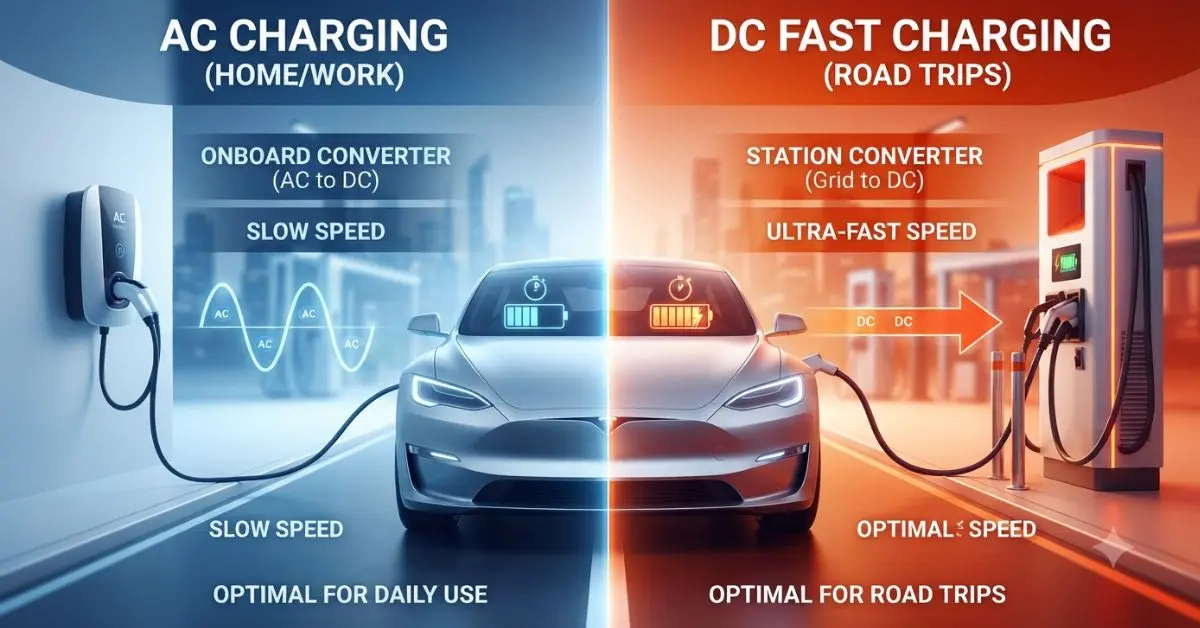
AC and DC charging are the two fundamental types of electrical current used to charge electric cars — and understanding the difference explains why some chargers are fast and others are slow. In short: AC charging uses your car’s onboard charger and is slower; DC fast charging bypasses it and is dramatically faster. Here is everything you need to know about AC vs DC charging in EVs.
AC vs DC Charging: Quick Comparison
| Feature | AC Charging | DC Fast Charging |
|---|---|---|
| Current type | Alternating Current (AC) | Direct Current (DC) |
| Conversion happens | Inside the EV (onboard charger) | Inside the charging station |
| Speed | Slow to moderate | Fast to ultra-fast |
| Power range | 1.4 kW – 22 kW | 50 kW – 473 kW |
| Miles per hour | 3–35 miles/hour | Up to 350+ miles in 20–30 min |
| Typical use | Home, workplace, destination | Highway, road trips |
| Connectors (US) | J1772, NACS (AC) | CCS1, NACS (DC), CHAdeMO |
What Is AC Charging?
Your home and most public charging stations use Alternating Current (AC). AC electricity flows back and forth 60 times every second. Electric vehicle batteries only store Direct Current (DC). Because of this, the car must convert AC power to DC before it reaches the battery.
This conversion happens inside the vehicle through the onboard charger (OBC). The onboard charger’s power limit decides the speed of your AC charging. A car with an 11 kW onboard charger only accepts 11 kW of power, even if the charging station offers more. Most home wallboxes provide 7.2–11.5 kW, and the car takes only what its onboard charger can handle.
Common Onboard Charger Capacities
| EV Model | Onboard AC Charger | Level 2 Charging Speed |
|---|---|---|
| Tesla Model 3 Long Range | 11.5 kW | ~35 miles/hour |
| Hyundai Ioniq 5 | 11 kW | ~32 miles/hour |
| Renault Scenic E-Tech | 22 kW | ~55 miles/hour |
| Ford Mustang Mach-E | 10.5 kW | ~30 miles/hour |
| VW ID.4 | 11 kW | ~32 miles/hour |
| Toyota bZ4X | 6.6 kW | ~20 miles/hour |
Where and When to Use AC Charging
Home Level 1 Charging (1.4–1.9 kW AC)
Plugs into a standard 120V outlet and uses the car’s onboard charger to convert AC to DC at the slowest charging rate.
Home Level 2 Charging (7–11.5 kW AC)
Uses a wallbox on a 240V circuit. The onboard charger converts AC to DC, making it the most common option for overnight home charging.
Public Level 2 Charging (7–22 kW AC)
Found at shopping centers, hotels, and workplaces. It is ideal for adding about 25–75 miles of range during a 1–3-hour stop.
Three-Phase AC Charging (11–22 kW)
More common in Europe, where some homes and public chargers provide three-phase power. Certain EVs, such as the Renault Scenic and Smart #3 Premium, can accept up to 22 kW AC charging.
What Is DC Fast Charging?
Direct Current (DC) flows in only one direction. EV batteries store energy in this same way. DC fast-charging stations convert AC power into DC power before it enters the car. This process uses powerful equipment inside the station. This skips the car’s slower built-in charger. It allows much more power to flow straight into the battery.
This method makes charging much faster. A 150 kW DC fast charger delivers about 10 times more power than an 11 kW Level 2 AC charger. Most EVs reach an 80% charge from 10% in 20 to 45 minutes. The charging speed now depends on the car’s maximum DC acceptance rate, which you can find in the vehicle’s spec sheet.
Why Do EV Batteries Need DC?
Lithium-ion cells are the building blocks of every EV battery. These cells store and release energy only as Direct Current (DC). Electrons flow from the negative terminal through the circuit to the positive terminal in one direction.
Batteries cannot store Alternating Current (AC). You must convert AC into DC first. This is why all battery-powered devices, such as phones, laptops, and EVs, require a conversion step when charging from AC wall outlets.
DC Where and When to Use DC Fast Charging
Highway DC Fast Chargers (50–350 kW)
Networks such as Tesla Superchargers, Electrify America, EVgo, IONNA, and ChargePoint Express can add around 100–250+ miles of range in 20–40 minutes.
Ultra-Fast Chargers (350–473 kW)
Designed for 800V EVs like the Hyundai Ioniq 5, Kia EV6, and XPENG G6, these chargers deliver the fastest charging speeds available today.
Tesla Superchargers (V3 and V4)
Tesla V3 Superchargers provide up to 250 kW, while V4 stations support 250+ kW. They are available to all NACS-equipped vehicles in North America without an adapter.
Conclusion
AC charging uses your car’s internal converter. This method is slower but better for your battery during daily use. DC fast charging skips the internal converter and sends power directly to the battery. This way is much faster, but you should save it for road trips.
For most owners, the best strategy is to use AC Level 2 charging at home every night. You should use DC fast charging only on road trips to quickly add range. Understanding these differences helps you plan better, save money, and keep your battery healthy for longer.
FAQs
Can You Use Both AC and DC on the Same EV?
Every modern electric vehicle supports both AC and DC charging. The NACS port and the CCS1 combo port use the same opening for both types of power. The car automatically detects the type of signal coming in and sends the power where it needs to go. You do not need to switch modes because the car handles everything for you.
Does AC or DC Charging Damage the Battery More?
AC charging is the best option for daily use because it puts less stress on the battery. DC fast charging creates more heat, so it is best used for road trips or when you need a quick charge. Modern EVs use battery cooling systems to reduce wear during fast charging.
Is DC fast charging safe for everyday use?
Yes, DC fast charging is safe, but it is best used for quick charging during long trips. For daily charging, AC Level 2 is the better choice for long-term battery health.
