
Why Does BMS Slow Down Charging at High SOC?

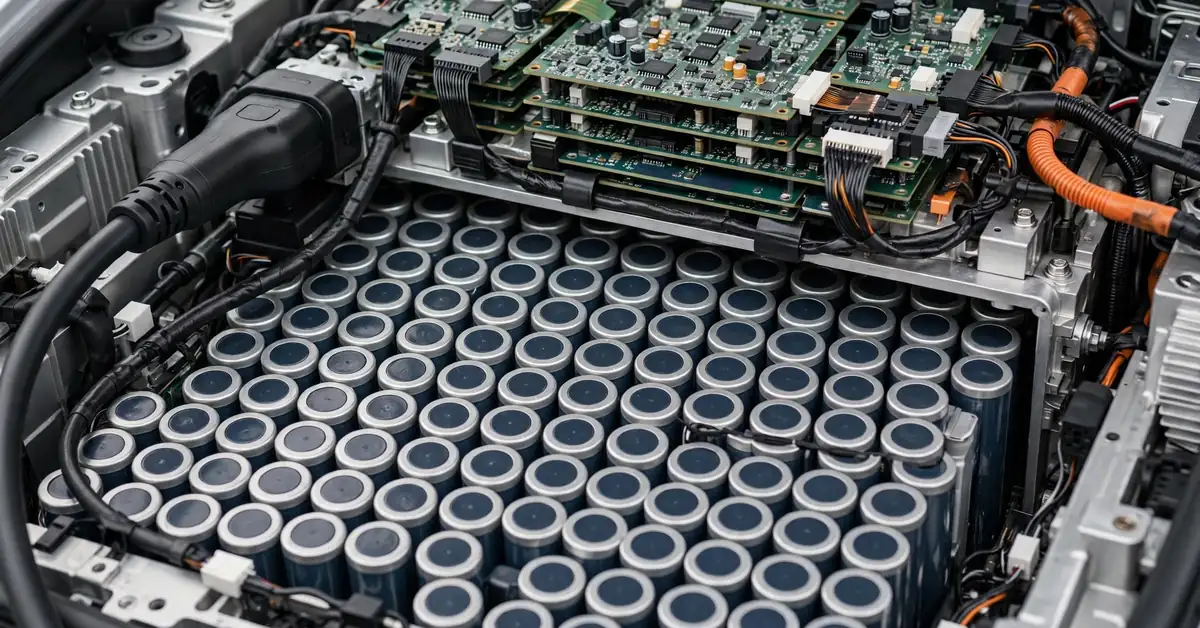
Your charge rate falls off a cliff near full, and it feels like something is broken. It isn’t — your battery’s guard is doing it on purpose. Here’s why, in short, then in full.
Because a nearly-full cell is a fragile cell. As charge climbs, each cell’s voltage approaches its hard ceiling (4.20 V for nickel-based cells, 3.65 V for LFP), so the BMS switches from constant current to constant voltage and the current tapers away. Two more brakes stack on top: pushing high current into full cells plates metallic lithium onto the anode, and the final percent is spent balancing cells against each other. The slowdown is the protection working — which is why fast charging is always quoted from 10% to 80%.
- The ceiling: 4.20 V per cell (nickel chemistries), 3.65 V (LFP)
- The shape: constant current first, then a long constant-voltage taper
- The proof: a Model Y peaks at 250 kW but averages 124 kW across 10–80%
The voltage ceiling: why the taper is built into the chemistry
Lithium-ion charging is a voltage-limited process: the charger may push hard while the cells are empty, but as each cell nears its maximum voltage, the only safe way to keep filling it is to ease the current down.
Battery University’s charging guide describes the standard profile every EV follows: a constant-current stage that does the bulk of the work, then a saturation (constant-voltage) stage in which current decays until it reaches roughly 3–5% of the cell’s rated current — the definition of full. Nickel-based cells (NMC, NCA and their kin) charge to 4.20 V per cell, with a tolerance of just ±50 mV; LFP cells top out lower, at 3.65 V per cell. There is no slack in those numbers: hold a 4.20 V cell above its ceiling for long and the same source describes metallic lithium plating, gas generation and rising internal pressure.
Tesla’s owner’s manual states the outcome in plain owner language: the charge rate is decreased when the battery “is too cold, the Battery’s charge is nearly full, and when the Battery conditions change with usage and age” — and, in its charging instructions, “typically, a lower state of charge results in faster charging.” The taper is not a defect in your car or the charger. It is the ceiling, arriving on schedule.
The second brake: lithium plating
Even before the ceiling bites, high current into a nearly-full cell risks depositing metallic lithium on the anode instead of storing it between the graphite layers — and plated lithium is lost capacity at best.
Battery University’s fast-charging guide puts the threshold plainly: charge current should be lowered when the pack reaches 70–80% state of charge, because lithium deposition forms whenever the charge rate exceeds the rate at which lithium can intercalate into the negative electrode — which happens when charging too fast, at too low a temperature, or at too high a state of charge. In extreme cases the deposits can grow into a short circuit. Cold multiplies the risk: below 5 °C the charge current should be reduced, and at freezing temperatures charging is not permitted at all in the guide’s terms, because diffusion in the anode slows to a crawl. Our dedicated explainer covers how lithium plating forms and why it is permanent.
So the BMS is managing two limits at once in the top half of the gauge: a voltage it must not cross, and an anode that accepts lithium more slowly the fuller and colder it gets. Both point the same way — down.
The third brake: balancing at the top
The last few percent are also when the pack’s cells are brought into line with each other — a slow, deliberate process that stretches the final phase.
No two cells age identically, so after months of use the pack’s cells sit at slightly different states of charge. Battery University’s balancing guide describes the standard cure: passive balancing bleeds the highest cells down through resistors during charging, in the 70–80% state-of-charge region, so that all cells arrive at full together. It calls the finishing step “an equalizing charge — a charge on top of a charge.”
Tesla’s manual gives owners the visible symptom: when charging to 100%, “the vehicle may continue to charge with low power when charging is displayed as complete. This is expected because the vehicle prioritizes making sure the cells are balanced.” If your car has ever sat at a charger sipping a few kilowatts after announcing it was done, that was balancing — the BMS spending time, not malfunctioning.

What the taper looks like on real cars
The cleanest measure of the taper is the gap between a car’s headline peak charging power and what it actually averages between 10% and 80% — EV Database publishes both.
| Car | Peak DC power | Average, 10–80% | 10–80% time |
|---|---|---|---|
| Hyundai IONIQ 5 (84 kWh, 800 V) | 263 kW | 196 kW | 18 min |
| Tesla Model Y Long Range (400 V) | 250 kW | 124 kW | 27 min |
| Ford Mustang Mach-E ER (400 V) | 150 kW | 105 kW | 37 min |
Read the Model Y row carefully: the car that advertises 250 kW delivers barely half of that averaged across the standard fast-charge window — and the average only falls further beyond 80%, which is exactly why manufacturers quote times to 80% and not to 100%. The IONIQ 5’s 800-volt system holds its curve flatter (196 of 263 kW), which is engineering, not magic: a higher-voltage pack reaches the same power at lower current, and lower current is what the top of charge restricts. A note on honesty: per-percent curve points (the exact kW at 63% or 87%) are not published in text form by EV Database, so this page uses the peak-versus-average gap — the taper you can verify — rather than invented curve readings. How the two charging types differ in this behaviour is covered in our AC vs DC charging comparison.
What to do with this knowledge
Treat 80% as the finish line on a road trip, size your daily limit by chemistry, and let the car finish its balancing when it asks for a full charge.
On DC fast chargers, the arithmetic is brutal: the 80–100% stretch can take as long as the 10–80% stretch that delivered three times the energy. Ford tells its owners the same thing in its own guidance — charging to 80% on a fast charger “minimizes your time charging and reduces battery capacity degradation”, noting that rates slow between 80% and 100%. Unplug at 80%, drive, and charge again lower down the curve where the car is fast.
At home the limits differ by chemistry. Tesla advises keeping the daily limit at about 80% where the car recommends it, and avoiding leaving the battery sitting at or near 0% or 100%. Ford sets its nickel-chemistry cars at 90% for home charging, reserving 100% for long trips. LFP is the exception that proves the rule: Ford instructs LFP owners to charge to 100% at least once a month, because the chemistry’s flat voltage curve leaves the BMS estimating charge rather than measuring it — the full charge is what recalibrates the estimate. Heat is the other taper trigger worth knowing: a hot pack slows charging for the same protective reasons, which is how the BMS manages cooling in hot weather.

Normal taper or a real problem?
Slowing above 70–80% is normal on every EV. Slowing while the pack is low and warm is not — that pattern has other causes.
Healthy taper has a signature: strong power when the battery is low, a progressive fall as it fills, and the steepest drop after 80%. Suspect something else when a warm car at 20% will not take power it used to take (charger-side limits, a hot or cold pack, or a fault), when one car at a bank of chargers is slow while its neighbours are not (try another stall before blaming the car), or when charging stops outright rather than tapering. Age plays a role too — Tesla’s manual lists changing battery condition with usage and age among its reasons for a reduced rate — but age moves the whole curve gently; it does not switch the taper on at low charge.
Frequently asked questions
Why does my EV charge so slowly after 80%?
Because all three brakes stack there: cells are at their voltage ceiling so current must taper (constant-voltage stage), the anode’s acceptance is at its lowest so plating risk caps the current, and the BMS is balancing cells. It is the designed behaviour — Ford’s own guidance notes rates slow between 80% and 100%.
At what percentage does charging start to slow down?
The decline is progressive, but the steep part usually begins around 70–80%: Battery University advises lowering charge current at 70–80% state of charge, and passive balancing also works in that region. Some cars hold a flat curve longer (800 V models especially) — the peak-versus-average table above shows the difference.
Does AC home charging slow down near full too?
Yes — the same voltage ceiling applies, so the final percent trickles in on AC as well. It is simply less noticeable: at home-charging power the current is far below the pack’s limits for most of the curve, so the taper occupies a smaller share of the session, and the session usually runs overnight anyway.
Is it bad to charge to 100%?
Occasionally, no — the BMS protects the pack throughout, and a full charge before a long trip is what 100% is for. Habitually sitting at 100% is what makers advise against (Tesla: avoid leaving the battery at or near 100% for long periods). LFP cars are the exception: they should see 100% regularly (Ford says at least monthly) so the charge estimate stays accurate.
Why does my car keep charging after it says 100%?
Balancing. Tesla’s manual explains it directly: at 100% the car may continue charging at low power after showing complete, because it prioritises balancing the cells. Leave it plugged in; it stops when the cells agree.
Conclusion
The BMS slows charging at high state of charge because everything it exists to prevent gets easier to cause as the pack fills: a voltage ceiling measured in hundredths of a volt, an anode that plates lithium when lithium arrives faster than it can be stored, and a few hundred cells that must be walked to the line together. The taper is not the charger failing you or the battery tiring — it is the cheapest insurance in the car, paid in minutes. Charge to 80% when you are travelling, follow your chemistry’s daily limit at home, and let it finish the slow part when a full pack is genuinely the plan.
Quick view: Why it slows — voltage ceiling (4.20 V/cell; LFP 3.65 V) forces a constant-voltage taper; plating risk caps current from ~70–80%; balancing stretches the finish. Proof — Model Y: 250 kW peak, 124 kW average 10–80% (EV Database). Practice — road-trip to 80%; daily 80–90% (nickel) per maker guidance; LFP to 100% at least monthly.
