
How Does BMS Control Battery Cooling in Hot Weather?

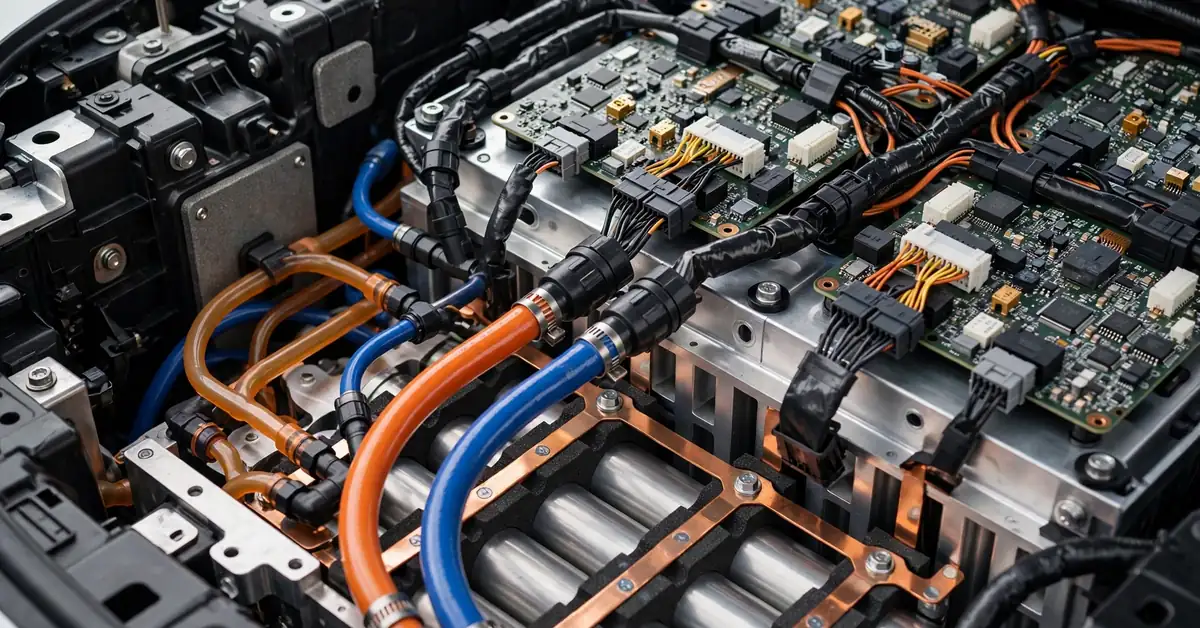
On a hot day, your EV’s battery is fighting heat from two directions at once: the weather soaking in from outside, and the heat the pack generates itself every time current flows. The battery management system (BMS) is the referee in that fight — it watches the pack’s temperature constantly, decides when cooling starts, and takes power away if cooling starts to lose.
The BMS reads temperatures from sensors spread across the battery modules. When the pack crosses a set threshold, it starts the coolant pump and radiator fans; in serious heat or during fast charging it also brings in the car’s refrigerant circuit to chill the coolant below the outside air temperature. If the pack still keeps heating up, the BMS slows charging and limits power until temperatures fall back into the safe zone.
Why hot weather puts extra pressure on the pack
A parked EV starts the day warm, and every drive and charge adds heat the pack then has to get rid of.
Where does the heat inside a battery come from?
Some of it is simply the weather: a pack sitting in a car in the sun soaks up ambient heat for hours before you even drive. The rest is made inside the cells. Whenever current flows — accelerating, climbing, fast charging — electrical resistance in the cells turns part of that energy into heat. Battery University describes this plainly: a lithium-ion battery performs well at elevated temperatures, but prolonged exposure to heat shortens its life, and capacity loss at high temperature rises the fuller the battery is charged.
Why do some cells suffer more than others?
Cells in the middle of the pack are insulated by their neighbours and shed heat slowly, while cells at the edges cool more easily. That spread is why a single average temperature is not enough: the BMS tracks the warmest areas it can sense, because the hottest cell is the one ageing fastest and the one that sets the safety limit for the whole pack.
The temperatures that matter
Every cooling decision the BMS makes is really a comparison against a small set of temperature limits.
Battery University publishes the working ranges for lithium-ion cells, and they explain most of what the car does next. Charging is permitted from 0°C to 45°C (32–113°F), fast charging from 5°C to 45°C (41–113°F), and discharging across a wider −20°C to 60°C (−4–140°F). Inside those hard limits, packs are calibrated to do their best work in a much narrower comfort zone, roughly 20–30°C (68–86°F) — which is why cooling starts working long before anything is in danger.
| Situation | Temperature | What it means |
|---|---|---|
| Comfort zone | ~20–30°C (68–86°F) | Where the pack gives its best mix of power, charging speed and life |
| Charging range | 0–45°C (32–113°F) | Outside this, the BMS will not charge normally |
| Fast-charging range | 5–45°C (41–113°F) | Full DC charging speeds live inside this window |
| Discharge range | −20–60°C (−4–140°F) | The widest limit — driving is allowed far beyond the comfort zone |
| Parked full in heat | 40°C (104°F) at 100% charge | A year stored like this leaves ~65% recoverable capacity (Battery University) |
The last row is the one worth remembering. In Battery University’s storage tests, a lithium-ion battery kept at 40°C and 100% charge for a year kept only about 65% of its recoverable capacity, against 80% at a mild 25°C. Heat on its own is bad; heat plus a full battery is the worst combination the tests found.
How the BMS decides when to start cooling
The BMS never guesses — it reads temperatures directly, several times a second, and acts on thresholds set by the manufacturer.
What sensors does the BMS read?
This loop — sense the pack, compare it with the limits, act before heat builds — is battery temperature regulation, and it runs the whole time the car is awake. Temperature sensors (usually NTC thermistors) sit on or between modules across the pack, backed up by sensors in the coolant going in and coming out. Comparing coolant in and out tells the BMS how much heat the loop is actually removing, while the spread between the hottest and coolest sensors tells it whether one area needs attention. It also knows the outside air temperature, which decides which cooling tools are worth using.
Why does cooling not switch off at the same temperature it switched on?
Thresholds come in pairs. Cooling starts when the pack crosses the upper set point, then keeps running until the pack falls a few degrees below it. That deliberate gap (engineers call it hysteresis) stops the pump and fans from chattering on and off every few seconds, and it means cooling responds smoothly rather than in bursts.
What the BMS actually controls
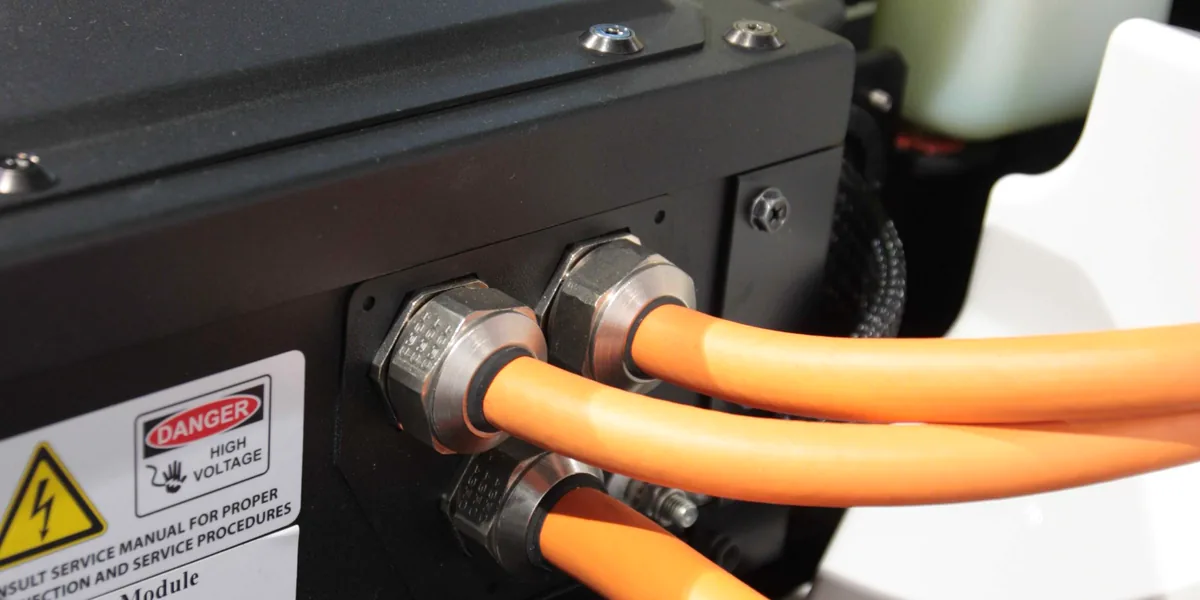
Cooling hardware does nothing on its own — every pump, valve, fan and compressor in the system takes its orders from the BMS.
Liquid cooling loops and cold plates
Most modern EVs circulate a water-glycol coolant through flat cold plates bonded to the modules, or through channels built into the pack floor. The BMS varies the pump speed to match the heat load: a gentle circulation for a mild cruise, full flow for a fast charge in summer. Implementations differ by maker — how GM’s Ultium BMS manages its pack is one approach, CATL’s BMS technology another, and the system Nissan uses in the Leaf a third.

The refrigerant chiller: cooling below the outside temperature
A radiator can only cool the coolant down to the temperature of the air passing through it. On a 38°C (100°F) day that is not enough, so most EVs can route the coolant through a chiller linked to the air-conditioning refrigerant circuit. The BMS brings the chiller in when ambient air stops being a useful heat sink — typically in high heat or under fast-charging loads — and it is the reason an EV can hold its pack near the comfort zone on days when the air itself is hotter than that zone.
Fans and air cooling
Radiator fans are the cheapest tool and always the first step: if the outside air is cool enough, the BMS simply opens the path to the radiator and runs the fans, using very little energy. Direct air cooling of the pack itself — no liquid loop at all — is the simplest and weakest option and survives mainly on smaller, cheaper designs. The standard sequence is therefore passive first, active when needed: fans and radiator while they can cope, pump and chiller when they cannot.
Cooling that starts before you plug in: preconditioning
On a hot day the smartest cooling happens before the charger, not at it — the car cools the pack down on the way there.
Fast charging pushes the largest currents the pack ever sees, so arriving at a DC charger with a heat-soaked battery guarantees a slow session: the BMS will protect the pack by cutting the rate. Cars therefore precondition — actively bringing the battery toward its ideal temperature while you drive to the charger. Tesla’s manual describes it directly: navigate to a Supercharger with Trip Planner and the car prepares the battery automatically; in extreme heat the preconditioning message may not even appear on screen, but the preparation still happens. Tesla recommends starting that navigation 30–45 minutes before arrival so the battery reaches the charger at the right temperature.
When cooling is not enough: throttling and derating
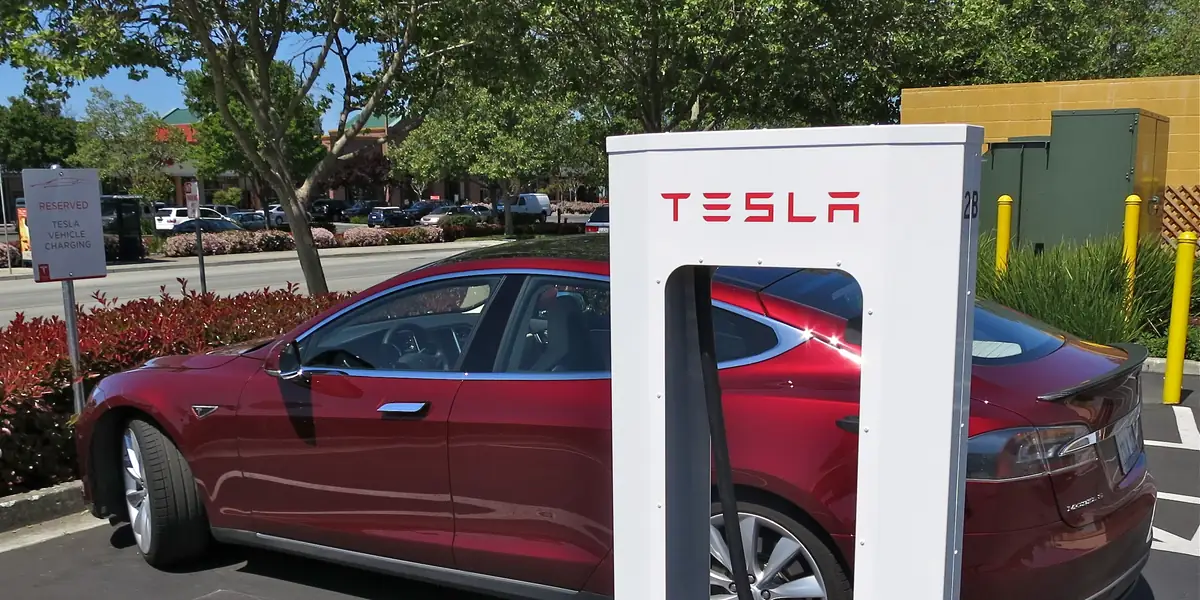
If temperatures keep climbing despite full cooling, the BMS stops asking and starts rationing — first the charging speed, then the power.
The ladder is deliberate. First, DC fast-charging rates are trimmed, because charging is the biggest heat source the BMS can switch off. If that is not enough, discharge is limited too: acceleration feels flatter and top power falls. Beyond that come dashboard warnings, and at the true safety limits the car will shut the system down rather than let a cell approach thermal runaway. None of this is a fault. It is the BMS spending performance to buy temperature — and on a hot day, a charge that slows down midway is usually this ladder working exactly as designed.
What heat actually costs: range and battery life
Heat costs you twice — a little range today, and a little battery life every year.
For range, the effect is real but modest. Recurrent’s analysis of 29,716 EVs found range barely dips until about 90°F (32°C), where cars shed roughly 5% of their range, mostly to air conditioning for the cabin and the battery; its data table puts the loss at roughly 13–15% at 100°F (38°C). For battery life, the bill arrives slowly. Geotab’s analysis of more than 22,700 EVs found batteries degrade at about 2.3% per year on average, and that vehicles in hot climates degrade about 0.4 percentage points faster per year than those in mild ones. Heat is not the whole story of how long EV batteries last, but it is a steady, measurable part of it.
What you can do in a heatwave
You cannot reprogram the BMS, but you can decide how hard it has to work.
- Park in shade or a garage when you can — a pack that starts cooler needs less cooling all day.
- Stay plugged in during extreme heat, with the charge limit around 80%: Recurrent advises keeping at least 50% charge, or better, staying plugged in at an 80% limit, because a parked EV uses energy to look after its battery.
- Charge in the cooler hours — early morning or overnight — rather than at midday.
- Precondition while plugged in before a trip, so the grid pays for the cooling instead of the battery.
- Let a hot car rest a few minutes after a hard drive before fast charging, instead of plugging in the second you stop.
- Avoid leaving the car parked at 100% charge in serious heat — Battery University’s storage tests mark full charge plus high temperature as the fastest route to permanent capacity loss.
Frequently asked questions
What temperature is too hot for an EV battery?
For charging, Battery University puts the normal window at 0–45°C (32–113°F), with fast charging at 5–45°C. The pack can discharge up to 60°C (140°F), but living there is not the same as visiting: sustained heat well inside the legal limits still accelerates ageing. Tesla’s manual gives a simple outer fence — avoid exposing the car to ambient temperatures above 140°F (60°C) for more than 24 hours at a time.
How do EVs cool their batteries?
Most use a liquid loop: coolant pumped through cold plates under or between the modules, shedding heat through a radiator, with the air-conditioning refrigerant circuit chilling the coolant further when the weather is too hot for the radiator alone. The BMS controls the whole sequence — sensors, thresholds, pump speed, fans and chiller. (Cold weather is the mirror problem; here is how cold weather affects EV batteries.)
Does an EV cool its battery while parked?
It can. Recurrent notes that even parked and unplugged, an EV uses battery power to keep its battery cool — one reason they advise staying plugged in during heatwaves, so that energy comes from the wall instead of the pack. How aggressively a car does this varies by model, and it is separate from cabin features such as Tesla’s Cabin Overheat Protection, which cools the cabin, not the battery.
How can I keep my EV battery cool in summer?
Shade, an 80% charge limit while parked, charging in cooler hours, preconditioning while plugged in, and a short rest before fast charging after a hard drive. None of these need any setting inside the battery — they simply reduce the heat the BMS has to remove.
Does hot weather permanently damage an EV battery?
Heat accelerates the chemical wear that permanently costs capacity — that part is permanent. The size of the effect is modest, though: Geotab measured hot-climate cars degrading about 0.4 percentage points per year faster than mild-climate cars. Occasional hot days are not a problem; living at high temperature, especially parked fully charged, is what adds up.
Conclusion
The BMS handles hot weather the way a good manager handles a crisis: measure constantly, act early, and sacrifice performance before safety.
Sensors find the heat, thresholds start the cooling, the liquid loop and chiller remove what the radiator cannot, and throttling steps in when physics wins anyway. Your part is smaller but real: shade, sensible charge limits and cooler charging hours mean the system spends its effort on driving, not on surviving the car park.
