
How Does BMS Manage Battery Heating in Cold Weather?

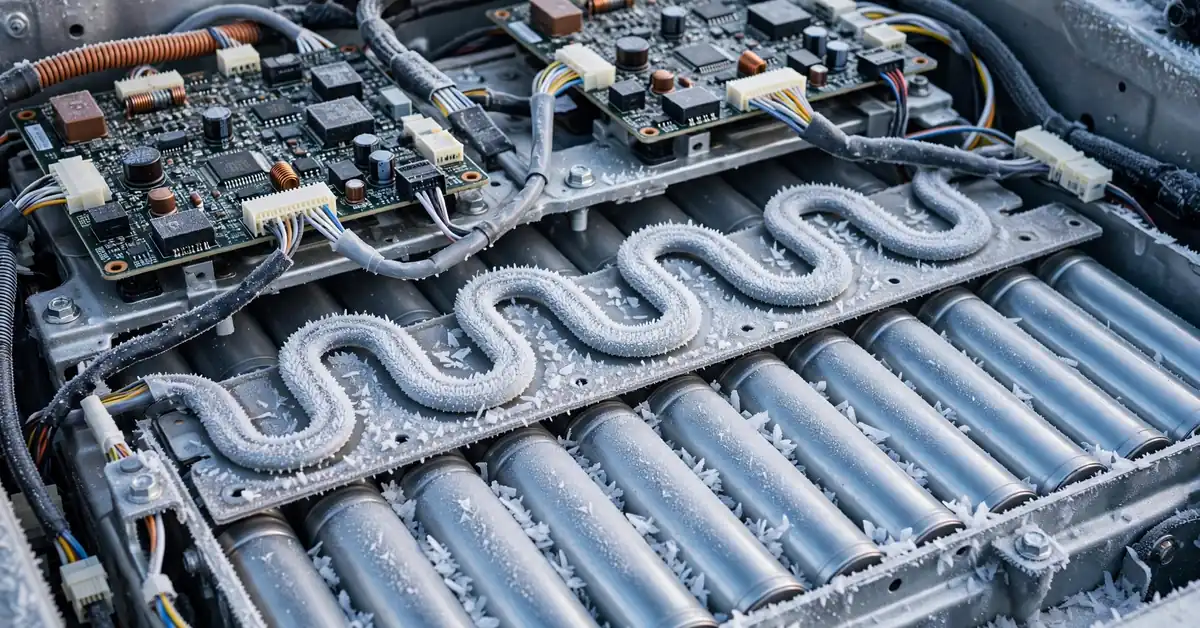
A BMS manages battery heating in cold weather by monitoring the pack’s minimum cell temperature and activating resistive heaters, a heat pump, or redirected motor waste heat once temperature drops below a safe threshold, restoring performance and enabling safe charging. Without this active response, a cold pack would deliver less power and risk permanent damage if charged too aggressively.
Why Cold Batteries Need Active Intervention
Cold slows the chemical reactions inside lithium-ion cells, raising internal resistance and reducing how much energy the pack can deliver. Charging a cold battery carries an even more serious risk: lithium plating, where metallic lithium deposits on the anode instead of properly intercalating, which can permanently reduce capacity or create internal short-circuit risk over time. Heating exists specifically to avoid both problems.
How the BMS Decides When to Heat the Pack
The BMS continuously tracks the coldest point in the pack, not just an average temperature, since that minimum reading determines the safe charge and discharge limits. Once that minimum drops below a defined threshold, commonly cited examples fall around 32-40°F (0-4°C) depending on the vehicle, the BMS activates heating to bring the pack back into a usable range.
What Hardware the BMS Commands for Heating
Resistive PTC Heaters
Many EVs use PTC (positive temperature coefficient) heating elements integrated into the coolant loop, which the BMS activates to warm the coolant, which in turn transfers heat to the battery through cold plates or channels.
Heat Pumps
More efficient than simple resistive heating, heat pumps extract ambient heat and concentrate it into the coolant loop, and the BMS coordinates their use alongside cabin heating demands in many modern EV designs.
Motor Waste Heat
Some architectures redirect heat generated by the motor and inverter during driving into the battery thermal loop, with the BMS controlling valves and pumps to route that otherwise-wasted heat productively rather than relying solely on dedicated heaters.
Managing Charging Restrictions During Warm-Up
Below freezing, most BMS designs restrict charging significantly or block it entirely, since the risk of lithium plating is highest at very low temperatures. As the pack warms past specific thresholds, sometimes 32°F to allow charging and regenerative braking, and higher thresholds for progressively faster charging rates, the BMS incrementally lifts those restrictions.
The Self-Warming Effect of Driving
Simply driving generates heat from the battery’s own internal resistance under load, gradually warming the pack even without dedicated heating. The BMS factors this into its overall thermal strategy, sometimes tolerating a temporarily colder pack at the start of a drive knowing that normal use will help raise the temperature naturally.
Why Cold Weather Heating Also Reduces Range
Heating the battery consumes energy that would otherwise go toward driving, which is one of several reasons EV range commonly drops in winter, alongside the reduced electrochemical efficiency of cold cells themselves and cabin heating demand.
| Temperature Zone | Typical BMS Response |
|---|---|
| Below freezing | Charging restricted or blocked; heating activated |
| Near freezing to ~40°F | Limited charging/regen allowed; active heating continues |
| Above minimum control temperature | Normal charging and discharging resumes |
Conclusion
A BMS manages battery heating in cold weather by tracking the pack’s coldest point and activating PTC heaters, heat pumps, or redirected motor heat once temperature drops below safe operating thresholds. This active management protects against lithium plating during charging and restores usable power for driving, at the cost of some additional energy use, which is why winter range typically runs lower than in mild conditions.
FAQs
Why does my EV charge so slowly in winter?
A cold battery has restricted charge current limits to prevent lithium plating, and the BMS gradually lifts those limits as the pack warms.
Does the BMS heat the battery even when the car is parked?
In some designs, yes, particularly if preconditioning is scheduled or the car detects extremely cold ambient temperatures, though this uses some stored energy.
Can driving alone warm up a cold battery enough?
To some degree, since internal resistance generates heat under load, but dedicated heating is still typically needed for safe charging in genuinely cold conditions.
