
EV Charging Levels Explained: Level 1 vs Level 2 vs Level 3

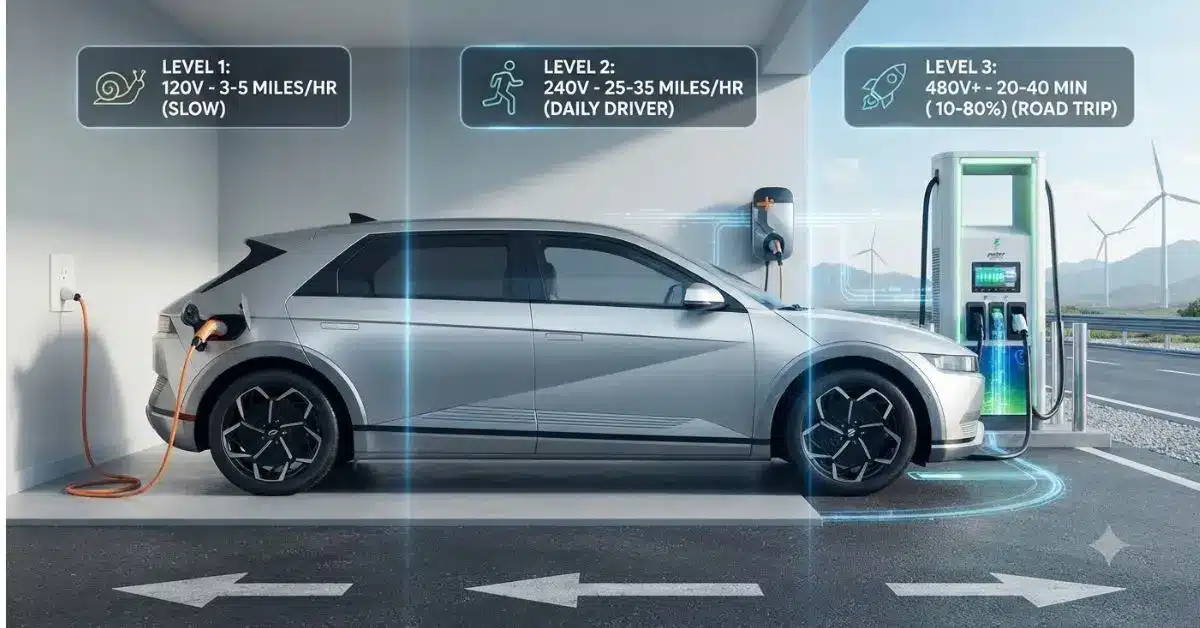
A charger that takes hours at home can become a 20-minute stop on a road trip. Here’s how Level 1, Level 2, and Level 3 charging compare.
EV charging levels indicate how quickly a charger delivers power to your car’s battery. There are three levels — Level 1 (120V), Level 2 (240V), and Level 3 DC Fast Charging — each with different speeds, equipment, and costs. Understanding the differences helps you choose the right charger for home, plan road trips, and avoid being stranded with a slow charger when you need a fast one. Here is a complete breakdown of EV charging levels for 2026.
EV Charging Levels at a Glance
| Feature | Level 1 | Level 2 | Level 3 (DC Fast) |
|---|---|---|---|
| Voltage | 120V AC | 240V AC | 480V+ DC |
| Power output | 1.4–1.9 kW | 3.3–19.2 kW | 50–350+ kW |
| Miles added per hour | 3–5 miles | 15–35 miles | 100–350+ miles in 20–45 min total |
| Full charge time (75 kWh) | 40–60 hours | 6–12 hours | 20–45 minutes (10–80%) |
| Equipment needed | Standard outlet + EVSE cord | 240V outlet + wallbox | Installed DC station |
| Typical location | Home | Home/public | Highway / commercial sites |
| Cost per session | ~$10–$15 (home rate) | ~$10–$15 (home rate) | $10–$40 (per session) |
Level 1 Charging (120V): The Slow but Free Option
Level 1 charging uses a standard 120V household outlet. You use this same type of outlet for lamps or phone chargers. Every EV comes with a Level 1 cable, known as an EVSE.
You simply plug one end into the wall outlet and the other into your car. You do not need any installation, but this charging method is slow.
At 1.4–1.9 kW, Level 1 adds approximately 3–5 miles of range per hour. A full charge for a 75 kWh EV takes 40–60 hours. In practice, most Level 1 users charge overnight and add 30–50 miles — enough for short daily commutes. Level 1 is best for plug-in hybrids (PHEVs) with small batteries or EV drivers who commute less than 30 miles daily.
Who Should Use Level 1 Charging?
- PHEV owners with 10–40-mile electric range batteries — Level 1 fills most PHEVs in 2–5 hours
- EV owners who drive under 30 miles per day and can charge overnight without needing a full charge every morning
- Renters or apartment dwellers who cannot install a wallbox but have outdoor outlet access
Level 2 Charging (240V): The Daily Driver’s Best Friend
Level 2 charging uses a 240V circuit. This is the same power level as a clothes dryer or an electric oven. At home, you need a dedicated circuit and a wallbox, also called an EVSE or home EV charger.
In public, you will see Level 2 chargers as stands with cables in parking lots. This method is the most common way to charge. It accounts for about 80% of all electric vehicle charging in the U.S.
Chargers deliver between 3.3 kW and 19.2 kW of power. The exact amount depends on your charger and your car’s onboard charger capacity. Most home wallboxes provide 7.2–11.5 kW, which adds 25–35 miles of range every hour.
A typical 75 kWh EV fills from 20% to 100% capacity in about 7 to 9 hours overnight. Level 2 charging is the best choice for almost every EV owner who can install a home wallbox.
Level 2 Installation Cost
- Wallbox unit cost: $200–$800 (brands like ChargePoint, Grizzl-E, Emporia, JuiceBox)
- Electrician installation: $200–$800 (more if panel upgrade is needed — can reach $1,500+)
- Federal tax credit: 30% credit (up to $1,000) available until further notice under the Alternative Fuel Vehicle Refueling Property Credit (Form 8911)
- State and utility rebates: Many utilities offer $100–$500 rebates on wallbox installation — check your local utility’s website
Level 3 Charging (DC Fast Charging): Road Trip Power
Level 3 charging, also known as DC Fast Charging (DCFC), converts AC power to DC before it enters your car. This process bypasses the car’s slower onboard charger, which allows the vehicle to charge much faster.
Power output at these stations ranges from 50 kW at older locations to 350 kW at the newest Electrify America and IONNA stations. Tesla Supercharger V4 stations reach up to 250 kW. Some Zeekr 7X and XPENG G6 models can even accept up to 473 kW at compatible stations.
Most electric vehicles (EVs) charge from 10% to 80% in 20 to 40 minutes at 150–350 kW. Certain 800V vehicles, such as the Hyundai Ioniq 5, Kia EV6, and Porsche Taycan, finish this charge in just 18 to 22 minutes.
Drivers use DC fast charging only for road trips, not for daily home charging. Manufacturers recommend limiting DC fast charging to 1 or 2 times per week to keep your battery healthy over time.
800V vs 400V: Does Voltage Matter?
Yes, 800V electric vehicles charge much faster than 400V systems. Models like the Hyundai Ioniq 5, Ioniq 6, Kia EV6, Kia EV9, Porsche Taycan, and Lucid Air use this 800V technology. Because they use higher voltage, these cars accept 250–350 kW of DC power without overheating.
In contrast, 400V vehicles like the Tesla Model 3, Tesla Model Y, VW ID.4, and BMW i4 reach lower peak speeds of 135–250 kW. An 800V EV adds much more range than a 400V EV when you plug both into the same 350 kW charging station.
Level 2 vs DC Fast Charging: Which Should You Use?
| Scenario | Best Charging Level | Why |
|---|---|---|
| Daily home charging | Level 2 | Slow enough to protect the battery; fills overnight |
| Short commute (under 30 mi/day) | Level 1 or Level 2 | Either works; Level 1 may suffice |
| Road trips over 150 miles | Level 3 DC Fast | Adds 100–200 miles in 20–30 min |
| Quick top-up while shopping | Level 2 (public) | Adds 10–25 miles in 1–2 hours |
| Emergency range (stranded) | Level 3 DC Fast | Fastest way to get back on the road |
Are There Charging Levels Beyond Level 3?
Some manufacturers and industry groups mention charging levels beyond Level 3. The Megawatt Charging System (MCS) is a new standard for electric semi-trucks. It delivers up to 3.75 MW (3,750 kW) for commercial vehicles. This technology does not apply to passenger electric vehicles.
Some discussions also include wireless or inductive charging as a separate category. Toyota, Genesis, and other companies currently test this technology. It is not yet widely available for consumer vehicles in 2026.
Conclusion
EV charging levels are simple. Level 1 is slow and uses your normal wall outlets. This level works well for Plug-in Hybrid Electric Vehicles (PHEVs) or people who drive very little. Level 2 is the best choice for daily drivers. It uses a home wallbox to add 25-35 miles of range per hour at a low monthly cost.
Level 3 DC fast charging helps you on road trips. These highway stations can charge your battery from 10% to 80% in only 20 to 40 minutes. For most EV owners in 2026, the best strategy combines a Level 2 wallbox at home for daily needs and Level 3 charging for quick stops away from home.
FAQs
What is the difference between Level 1, Level 2, and Level 3 EV charging?
Level 1 uses a standard 120V outlet and charges the slowest. Level 2 uses a 240V circuit and is ideal for daily charging at home or in public. Level 3 DC Fast Charging delivers the fastest charging speeds and is mainly used on highways and long trips.
Is Level 2 charging better than Level 3 for everyday use?
Yes. Level 2 charging is the best option for daily use because it fully charges most EVs overnight and is gentler on the battery than frequent DC fast charging.
Can every electric vehicle use all three charging levels?
Most EVs can use Level 1 and Level 2 charging. Many modern EVs also support Level 3 DC fast charging, but the maximum charging speed depends on the vehicle’s battery, charging system, and connector compatibility.
