
Home Charging vs Supercharging: Real Costs and Best Option for Your EV

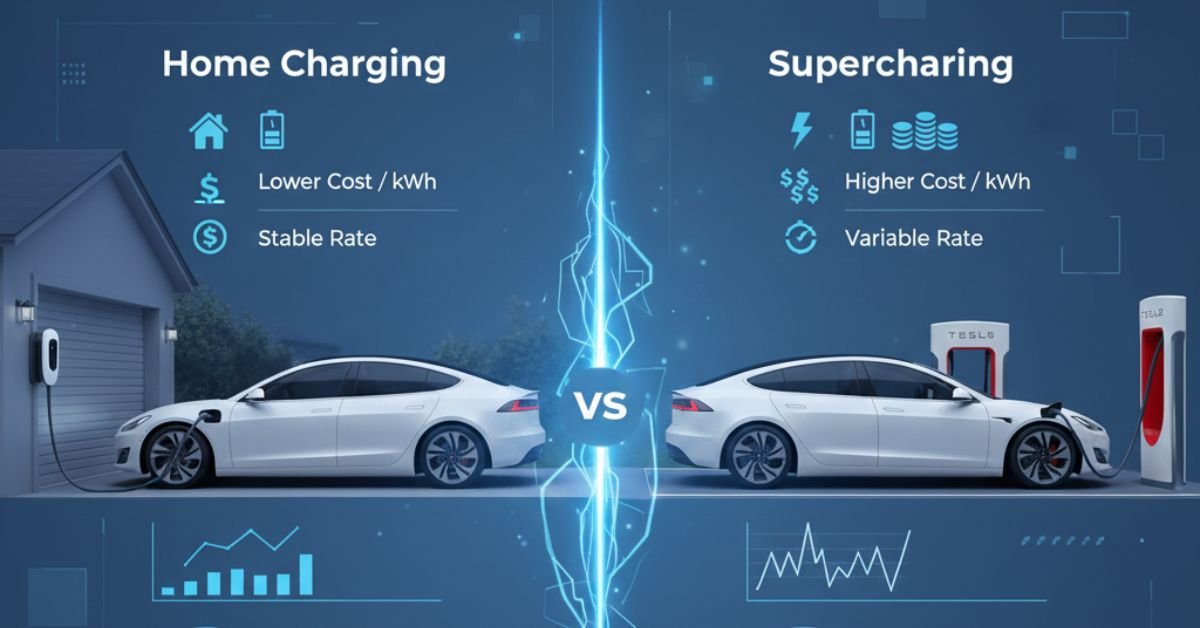
When you buy an electric car (EV), you must decide where to plug it in. Should you use the very fast Supercharger network, or is charging at home better? You want the best choice for cost, ease, and battery health.
The simple answer is this: charging at home for your daily driving is almost always the cheapest and easiest choice. It saves you a lot of money over time. However, Supercharging is a key tool for long trips. It gives you great speed when you must get back on the road fast. We will show you the real cost and practical differences between the two main ways to charge your EV in the United States.
Cost Breakdown: Supercharger vs. Home Charging
The biggest thing in owning an EV is the cost of “fuel.” The difference between Supercharging and home charging is very clear here. In the U.S., the price you pay for electricity changes a lot based on your state, city, and even the time of day.
Understanding the Price Per kWh (National Averages)
The cost of charging is measured in dollars per kilowatt-hour (kWh). Think of the kWh as the “gallon” of electricity.
- Home Charging: The average price for home electricity in the U.S. is around $0.17 per kWh. If you live in a state with low costs, you might pay as little as $0.10 per kWh. If you live in a high-cost state, you could pay $0.30 per kWh or more.
- Supercharging: Supercharger prices are much higher. They are usually $0.25 to $0.50 per kWh. The price often changes based on the time of day and how busy the station is. You pay extra for the speed and ease of fast charging.
On average, Supercharging can cost two to three times more than charging at home. This is the extra cost you pay for speed.
The Hidden Cost Advantage of Off-Peak Home Charging
One of the best ways to save money on your EV is by using Time-of-Use (TOU) electricity plans. Many electric companies offer lower prices during “off-peak” hours, which are usually late at night (10 PM to 6 AM).
For example, your company might charge $0.25 per kWh during the day but only $0.08 per kWh at night. You can set your EV to charge only during these cheap hours. This will greatly lower your yearly charging costs. Superchargers do not offer this choice; you pay the price they set when you plug in.
Cost Per Mile Comparison
We must look at the cost per mile to truly compare the two methods. This helps you see the direct savings compared to a gas car. We will use a common EV distance of 4 miles per kWh.
Charging Method | Average Cost per kWh (U.S.) | Cost to Drive 100 Miles (25 kWh) | Cost to Drive 15,000 Miles/Year |
|---|---|---|---|
Home Charging (Off-Peak) | $0.10 | $2.50 | $375 |
Home Charging (Average) | $0.17 | $4.25 | $637.50 |
Supercharging (Average) | $0.35 | $8.75 | $1,312.50 |
Gasoline Car (30 MPG, $3.50/gal) | N/A | $11.67 | $1,750 |
Supercharging Speed and Convenience
Cost is only one part of the choice. Speed and ease decide how you use your EV every day.
1. Supercharging for Road Trips
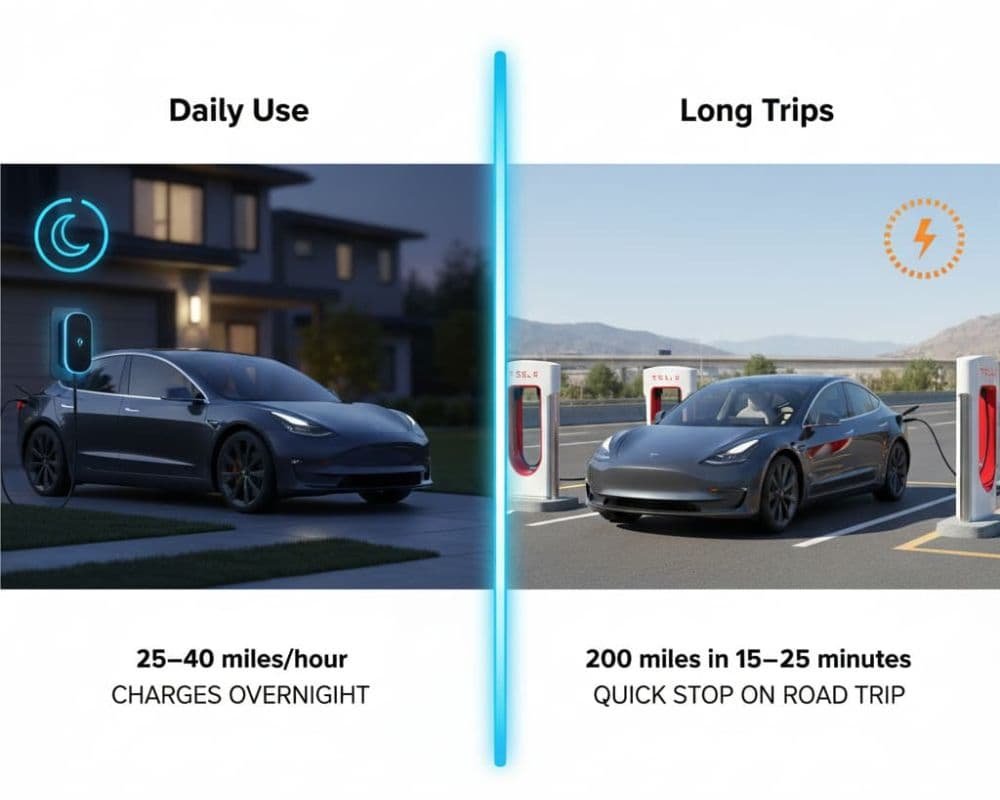
Superchargers are DC Fast Chargers placed along major US highways and in cities, designed specifically for road trips. They charge significantly faster than any home option — fast enough to add meaningful range during a short rest stop. For full Supercharger speed data, V3 vs V4 rates, and model-by-model charging speeds, see our Tesla fast charging guide.
2. Home Charging: The Daily Driver’s Best Friend
Home charging is all about ease and your routine. You plug in when you get home. You wake up to a “full tank” every morning.
- Level 1 Charging: This uses a normal 120V wall plug. It is the slowest choice. It is the lowest cost option per kWh, but impractical for most owners as a primary charging method. It is best for cars that use both gas and electric, or for EV owners who drive very little.
- Level 2 Charging: This uses a 240V plug and a special wall connector. This is the best choice for home charging. It is the most cost-efficient daily charging method for homeowners, typically costing $0.10 to $0.17 per kWh at off-peak night rates. Most EV owners can fully charge overnight, even after driving all day.
Home charging lets you plug in every night. It feels like you never have to think about “getting gas” again. The routine is the convenience.
The Installation Factor: Setting Up Home Charging
The biggest difficulty for home charging is the first setup. It costs money at first, but the long-term savings and convenience are worth it for most homeowners.
1- Initial Costs and Incentives (Tax Credits)
The cost to put in a Level 2 charger can change a lot. It depends on your home’s electrical box and how far the charger is from it.
- Equipment Cost: A Level 2 wall connector usually costs between $400 and $1,000.
- Installation Cost: A professional installation can cost from $800 to $2,000 or more. The price depends on how hard the wiring is.
Federal Tax Credit: The U.S. government often gives a federal tax credit for putting in EV charging equipment. The credit can pay for some of the cost, making your cost lower. Always check with a tax expert for the newest information.
2- Electrical Requirements and Permits
A Level 2 charger needs a special 240-volt circuit. This job is for a licensed electrician.
Actionable Advice: Before you buy an EV, ask an electrician to check your home’s electrical box. They will tell you if you need a bigger box or if you have enough power for a new circuit. Doing this early will stop delays when your EV arrives.
Real-World Scenarios: Making the Smart Choice
Let’s look at how different EV owners should decide between Supercharging and home charging.
Scenario 1: The Daily Commuter
- Profile: Drives 50 miles per day, lives in a house with a garage.
- Recommendation: Home Charging (Level 2). A 50-mile drive needs about 12.5kWh of energy. A Level 2 charger can replace this energy in less than 3 hours, which is easy to do overnight. The money you save from cheap night charging will quickly pay for the installation. Supercharging for daily use would be too expensive and not easy.
Scenario 2: The Weekend Road Tripper
- Profile: Drives 1,000 miles on a long trip once a month.
- Recommendation: A Mix of Both. You should still charge at home for the best cost. But, the long trip needs Supercharging. The speed of a Supercharger on the road is worth the extra cost. You should plan your route to find the most efficient Supercharger stops.
Scenario 3: Apartment Dwellers and Public L2 Options
- Profile: Lives in an apartment building with no place to charge.
- Recommendation: Public Level 2 and Opportunistic Supercharging. This is the hardest choice. You will need to use public Level 2 chargers at work or shopping centers. These are usually cheaper than Superchargers but more costly than home charging. Supercharging becomes something you must do more often, but you should still look for the cheaper public L2 options when you can.
For most EV owners, the best charging plan is to charge at home 90% of the time. Use fast charging only when traveling long distances. The approach is the most cost-effective and battery-friendly.
Conclusion
Home charging is the smartest and most cost-efficient way to power your EV. It keeps your costs low, protects your battery, and gives you a full charge every morning with zero effort. Superchargers are still essential—but mainly for road trips or when you need fast top-ups on the go.
For most drivers in the US, the best strategy is simple: charge at home daily and use fast charging only when you truly need the speed.
This balance gives you the lowest annual charging cost, the most predictable monthly budget, and the smoothest EV ownership experience — with Supercharging ready whenever the open road calls.
