
How Long Does It Take to Charge an Electric Car?

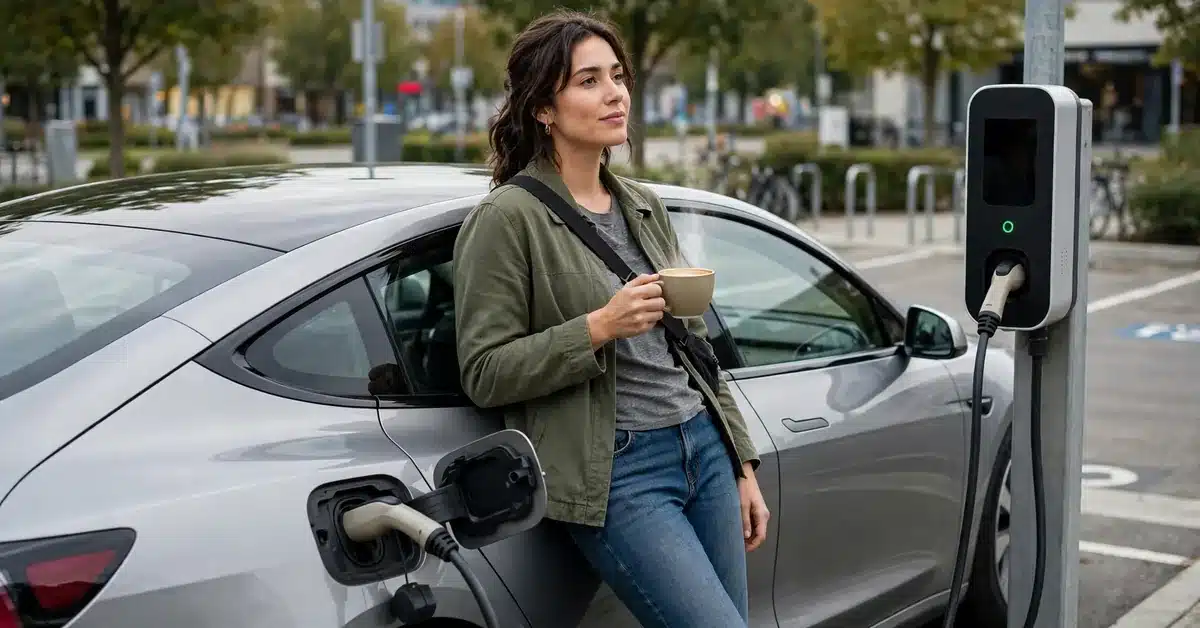
How long it takes to charge an electric car depends on three things: the size of your battery, the power output of your charger, and how much charge your car can accept. A Level 1 home outlet takes 40–60 hours for a full charge. A Level 2 wallbox takes 6–12 hours. A DC fast charger adds 10–80% in just 20–45 minutes. This guide breaks down EV charging times for every method, every battery size, and the most popular models on the market in 2026.
EV Charging Times by Method
| Charging Method | Power | Small EV (40 kWh) | Mid-Size EV (75 kWh) | Large EV (100+ kWh) |
|---|---|---|---|---|
| Level 1 (120V outlet) | 1.4 kW | ~30 hours (full) | ~55 hours (full) | ~75 hours (full) |
| Level 2 (7.2 kW wallbox) | 7.2 kW | ~6 hours (full) | ~11.5 hours (full) | ~16 hours (full) |
| Level 2 (11 kW wallbox) | 11 kW | ~4 hours (full) | ~7.5 hours (full) | ~10.5 hours (full) |
| Level 2 (19.2 kW max) | 19.2 kW | ~2.5 hours (full) | ~4.5 hours (full) | ~6 hours (full) |
| DC Fast (50 kW) | 50 kW | ~45 min (10–80%) | ~65 min (10–80%) | ~90 min (10–80%) |
| DC Fast (150 kW) | 150 kW | ~20 min (10–80%) | ~28 min (10–80%) | ~35 min (10–80%) |
| DC Fast (250 kW) | 250 kW | ~10 min (10–80%) | ~18 min (10–80%) | ~25 min (10–80%) |
| Ultra-Fast (350 kW) | 350 kW | ~8 min (10–80%) | ~14 min (10–80%) | ~18 min (10–80%) |
Charging Time Formula
The basic formula for estimating charge time is straightforward. Divide the energy you need to add (in kWh) by the charger’s power output (in kW) to get hours. For example: charging 60 kWh on a 10 kW Level 2 charger takes approximately 6 hours. In practice, charging is not perfectly linear — battery packs slow down as they approach 80% to protect cells — so real-world times are slightly longer.
Charging Time = Energy to Add (kWh) ÷ Charger Power (kW)
Example: If your 80 kWh EV is at 20% (16 kWh) and you want to reach 80% (64 kWh), you need to add 48 kWh. On an 11 kW Level 2 charger: 48 ÷ 11 = approximately 4.4 hours. On a 150 kW DC fast charger: 48 ÷ 150 = approximately 19–22 minutes (accounting for taper).
Real-World Charging Times: Popular EVs in 2026
| EV Model | Battery | Level 2 (11 kW) | DC Fast (10–80%) | Peak DC Rate |
|---|---|---|---|---|
| Tesla Model 3 Long Range | ~75 kWh | ~7.5 hours (full) | ~25 min | 250 kW |
| Tesla Model Y Long Range | ~82 kWh | ~8 hours (full) | ~27 min | 250 kW |
| Hyundai Ioniq 5 LR AWD | 84 kWh | ~8.5 hours (full) | ~18 min | 350 kW |
| Kia EV6 GT | 77.4 kWh | ~7.5 hours (full) | ~18 min | 350 kW |
| Ford F-150 Lightning LR | 131 kWh | ~13.5 hours (full) | ~41 min | 150 kW |
| Chevy Equinox EV LR | ~85 kWh | ~8.5 hours (full) | ~25 min | 150 kW |
| BMW i4 eDrive40 | 83.9 kWh | ~8 hours (full) | ~31 min | 205 kW |
| Mercedes EQS 450+ | 118 kWh | ~11.5 hours (full) | ~31 min | 200 kW |
Why DC Fast Charging Slows Down After 80%
EV batteries do not charge at a constant rate from 0–100%. They charge quickly from 10–80% and then deliberately slow down above 80%. This protects the battery cells from stress caused by high-voltage charging when nearly full. The Battery Management System (BMS) reduces power intake above 80% to prevent overheating and cell damage.
This is why DC fast charging sessions are always quoted as 10–80% rather than 0–100%. Going from 80–100% at a DC fast charger often takes as long as the previous 10–80% session. For road trips, it is almost always faster to stop more frequently and charge to 80% than to wait for a 100% charge at each stop.
Factors That Affect EV Charging Time
- Battery size: Larger batteries take longer to fill — a 131 kWh F-150 Lightning takes much longer than a 40 kWh Chevy Equinox EV Standard Range
- Current state of charge: Charging is fastest from 10–80%; the last 20% slows significantly
- Temperature: Cold batteries charge slowly — below 14°F (-10°C), charging speed can drop 40–70% without preconditioning
- Charger power output: A 50 kW charger cannot deliver 150 kW — the speed is always limited by whichever is lower: the charger’s output or the car’s acceptance rate
- Car’s onboard charger (AC only): A car with a 7.2 kW onboard charger cannot charge faster than 7.2 kW on Level 2, even from an 11 kW wallbox
- Other cars sharing the charger: Some older DC fast charger installations split power between stalls — arriving when another car is already charging may reduce your speed
How to Speed Up EV Charging
- Precondition the battery: Route to a DC charger through your car’s built-in navigation — this warms or cools the battery to ideal charging temperature before you arrive
- Charge from 10–20% to 80%: Avoid charging from 0% (stressful) or above 80% (slow) — the 10–80% window is the sweet spot for speed
- Use the newest charger hardware: Electrify America HPC stations (350 kW) and Tesla V4 Superchargers (250 kW) are significantly faster than older 50–150 kW stations
- Upgrade to a faster home wallbox: Replacing a 7.2 kW unit with an 11.5 kW wallbox cuts overnight charging time by about 35%
How Long to Charge for Daily Use
For most drivers, daily charging is not a “full charge” scenario. If you drive 40 miles per day and your EV gets 4 miles per kWh, you use approximately 10 kWh. On an 11 kW Level 2 charger, replenishing 10 kWh takes under 1 hour. In practice, you plug in at night and wake up with a full battery — regardless of how depleted it was when you arrived home.
Conclusion
EV charging time ranges from 20 minutes on a DC fast charger to over 60 hours on a standard wall outlet — and the right answer depends on your daily mileage and where you charge. For most owners, an 11 kW Level 2 home wallbox fills any EV overnight while they sleep. For road trips, DC fast charging at 150–350 kW adds 100–200 miles in 20–30 minutes — about the length of a coffee break. The key takeaway: unlike gas stations, EV charging happens while you do other things — making the actual time spent “at the charger” far less than the numbers suggest.
