
What Is LFP Battery Chemistry in Electric Cars?

Figures checked against BloombergNEF’s 2025 battery price survey, the IEA Global EV Outlook, Tesla’s Model 3 owner’s manual, Recurrent’s fleet charging data and Sandia National Laboratories’ cycle-life research.
LFP is the chemistry that quietly took over the electric car. In 2025 it accounted for more than half of all EV battery deployment worldwide (IEA figures) — yet most American buyers have never heard its name, because in the US it hides inside a short list of standard-range cars while the headlines follow nickel batteries.
LFP stands for lithium iron phosphate, and it is a genuinely different cathode recipe: no nickel, no cobalt, a lower voltage, a much longer life, and a price low enough to move the entire industry. This guide explains what it is, how it works, where it beats the nickel chemistries and where it loses — and ends with the honest, dated list of US cars that actually use it, because several popular lists (including, until now, this page) get that list wrong.
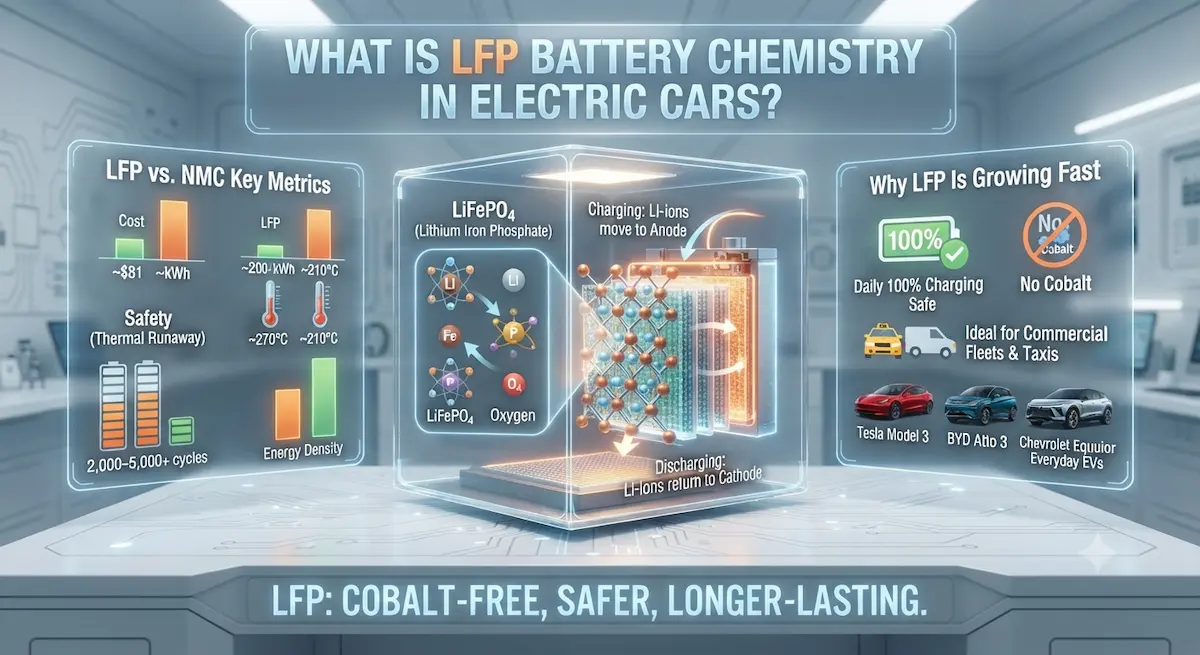
LFP (lithium iron phosphate, LiFePO₄) is a lithium-ion chemistry with an iron-phosphate cathode and no nickel or cobalt. Its cells run at 3.2 volts, store a typical 150–185 Wh/kg, last 2,000–5,000+ charge cycles, and cost about $81/kWh per pack against $128 for NMC (BloombergNEF 2025). In exchange for a heavier pack, owners get the longest-lived, hardest-to-burn and cheapest mainstream EV battery chemistry — the one Tesla tells owners to charge to 100%.
Key figures: 3.2 V per cell · 150–185 Wh/kg typical · 2,000–5,000+ cycles · $81/kWh pack · cobalt-free
What Does LFP Stand For?
LFP stands for lithium iron phosphate — the cathode material, LiFePO₄, gives the chemistry its initials.
Each letter is an ingredient: Lithium, F (iron, from the chemical symbol Fe), and Phosphate. The cathode is built from lithium iron phosphate arranged in an olivine crystal structure — a framework whose strong phosphorus–oxygen bonds will matter a great deal when we reach the safety section. The anode is the same graphite used in almost every lithium-ion cell, so an LFP battery is not a different kind of battery; it is a lithium-ion battery with a different cathode recipe.
Two consequences follow immediately from that recipe. There is no nickel and no cobalt in the cathode — the two expensive, supply-constrained metals that dominate the cost and the ethics debate of nickel chemistries — and the raw materials, iron and phosphate, are among the most abundant industrial commodities on earth. Almost everything else in this guide flows from those two facts and one trade: iron phosphate stores less energy per kilogram than nickel-rich cathodes do.
How Does LFP Battery Chemistry Work?
The same lithium shuttle as every lithium-ion cell — the difference is what the ions climb into and out of.
Charging pulls lithium ions out of the iron-phosphate cathode, through the electrolyte, and lodges them between the layers of the graphite anode; discharging reverses the journey and releases the energy. What changes versus a nickel cell is the cathode’s personality: the olivine framework barely changes shape as lithium leaves and returns, which is a large part of why LFP cells survive so many more cycles — the structure is simply not being wrenched around thousands of times.
What is the electrolyte in an LFP battery?
The same family as in nickel cells — a lithium salt (usually LiPF₆) dissolved in carbonate solvents.
Readers often assume a “different chemistry” means a different liquid inside; it does not. The electrolyte’s job — carrying ions, never electrons — is identical, and the electrons those searchers ask about travel through the external circuit and the copper and aluminium foil current collectors, exactly as in any other lithium-ion cell. The chemistry difference lives in the cathode powder, not the liquid.
Why does the charge gauge drift on LFP cars?
Because LFP’s voltage sits almost flat between roughly 20% and 80% charge, the battery computer cannot read the level from voltage.
On a nickel cell, voltage falls steadily as charge drains, so the gauge has an easy signal. An LFP cell holds nearly the same voltage across most of its range — efficient, but it leaves the battery management system estimating rather than measuring, and the estimate wanders over weeks of partial charging. Remember this section when we reach the charging rule below: the weekly full charge exists to re-anchor that gauge at a known point.
LFP Battery Key Specifications
The five numbers that define the chemistry, side by side with the nickel benchmark.
Specification | LFP | NMC (for comparison) |
|---|---|---|
Nominal cell voltage | 3.2 V | 3.6–3.7 V |
Energy density (cell) | 150–185 Wh/kg typical (newest cells ~205) | 200–260 Wh/kg typical |
Cycle life | 2,000–5,000+ cycles | 1,000–2,500 cycles |
Thermal runaway onset | ~270°C | ~150–210°C, by variant |
Average pack price (BNEF 2025) | $81/kWh | $128/kWh |
Read the table as a personality profile. LFP gives up roughly a quarter of the energy density — which is why an LFP car needs a heavier pack for the same range — and wins nearly everything else: two to three times the cycle life, a thermal-runaway threshold roughly 60–120 degrees higher, and a pack price about 37% lower. Whether that trade suits a given car is a verdict question, and our completed LFP vs NMC comparison works through it factor by factor; this page’s job is the chemistry itself.
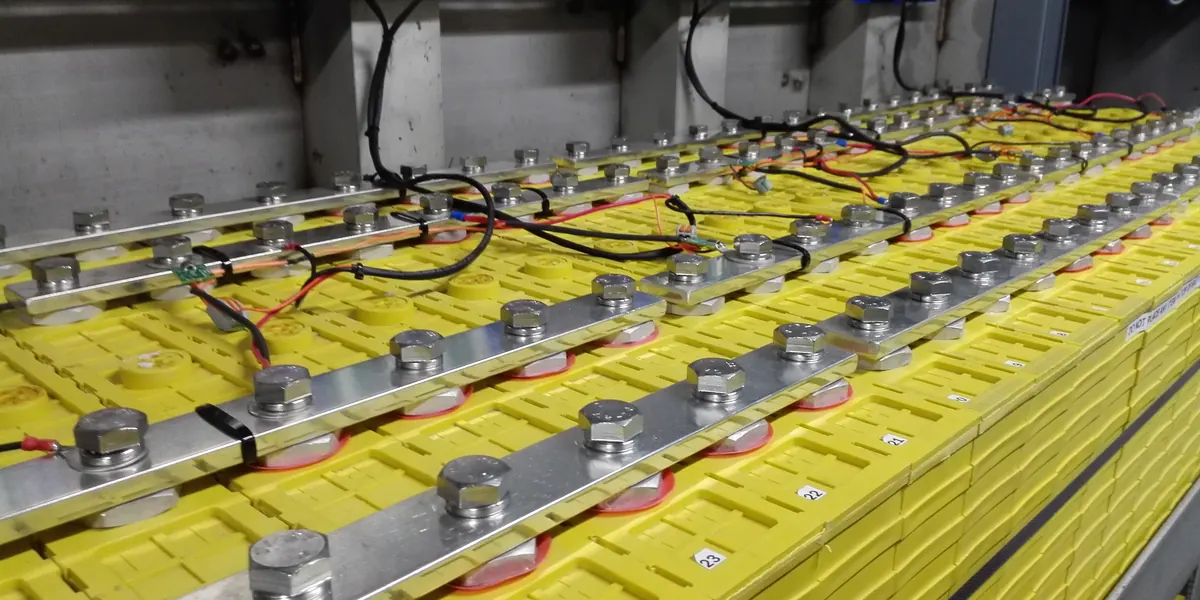
Why Is LFP Considered Safer?
Because its cathode does not feed a fire with its own oxygen — the failure starts later and burns cooler.
Thermal runaway is the event that decides battery safety, and the two families reach it differently. Heat a nickel-oxide cathode far enough and its layered structure breaks down and releases oxygen, which feeds the fire from inside the cell; measured runaway onset for NMC variants sits around 150–210°C. The olivine phosphate in LFP holds its oxygen in those strong phosphorus–oxygen bonds instead, so onset arrives at roughly 270°C, and a failing LFP cell produces far less flammable gas.
The famous demonstration is BYD’s: in its published nail-penetration test at the Blade Battery’s 2020 launch, an LFP Blade cell’s surface reached only 30–60°C with no smoke or fire, while an NMC cell exceeded 500°C and burned. Those are BYD’s own test figures, not an independent lab’s — but the direction matches the independent onset data above. The honesty bound matters just as much: LFP can still catch fire under severe damage, overcharge or extreme heat. It is the safer chemistry, not a fireproof one, and any source that calls it fireproof is overselling.
The Charge-to-100% Rule: What Tesla Actually Tells LFP Owners
Keep the charge limit at 100%, and fully charge at least once a week — that is Tesla’s manual wording, and it is widely misquoted.
For nickel-chemistry cars, the standard advice is to live between 20% and 80% and save full charges for trips. LFP reverses the headline: Tesla’s Model 3 owner’s manual, in its section for lithium iron phosphate cars, recommends that owners keep the charge limit set to 100% even for daily use, and fully charge to 100% at least once per week. Note what it does not say — it never asks for a full charge every single day, the version that circulates on forums (and that this page’s old FAQ repeated). The weekly rhythm is the requirement.
Why the weekly full charge?
Calibration, mostly — it re-anchors the drifting gauge described above, and LFP tolerates full charges far better than nickel chemistries do.
Because the flat voltage curve starves the gauge of signal, a regular trip to a known 100% is how the car keeps its range estimate honest; an LFP car that is never fully charged can start showing surprising range errors. Two honest qualifiers: Tesla’s 2024-and-later North American manuals dropped the written LFP section and instead point owners to the limits the car’s touchscreen itself recommends — follow your car’s screen where it differs — and a 2024 study in the Journal of The Electrochemical Society found that living permanently at very high charge can still cost an LFP cell some life over years. The balanced practice is Tesla’s: limit at 100%, a full charge at least weekly, and no anxiety about it.
LFP in Cold Weather: The Chemistry’s Real Weakness
Every EV loses winter range; LFP’s extra pain is slow charging while the pack is cold.
Start with the honest baseline: Recurrent’s November 2025 analysis of 34 models and more than 30,000 US cars found EVs keep on average about 78% of their maximum range at 32°F and about 70% at 20°F, whatever the chemistry, with heat pumps clawing back roughly a tenth more. Against that baseline, LFP cars typically lose a few points more than nickel-pack cars, worst on short trips where the pack never warms through.
The bigger day-to-day difference is at the plug. Recurrent’s analysis of over 200,000 Tesla Model 3 charging sessions found LFP cars feel the cold DC-charging slowdown more — at 0°F a fast charge averaged roughly 9 minutes longer — which is why Tesla added direct battery heating at Superchargers for these cars. The mitigations are the same ones that help every EV, and they matter more here: precondition the battery while still plugged in, let the car’s navigation prepare the pack before a fast charger, and garage the car when you can. (BYD claims its Blade pack keeps over 90% of capacity discharging at −20°C; that is a manufacturer’s claim, and the fleet data above is the safer guide for US winters.)
The BYD Blade Battery: LFP’s Breakthrough Product
In March 2020 BYD rebuilt the LFP cell into a long blade and deleted the module layer — and LFP’s space problem largely went away.
The Blade Battery, launched by BYD’s FinDreams battery arm on 29 March 2020 and first fitted to the Han EV, stretches a single LFP cell to nearly a metre long and lays the cells directly into the pack — cell-to-pack construction, which BYD says raises space utilisation by over 50% against conventional block-style LFP packs. That packaging gain is what let an LFP car post competitive range figures for the first time: the chemistry’s density disadvantage stayed, but the wasted space around it shrank. How cell-to-pack works mechanically is covered in our cell-to-pack battery design explainer.
The Blade also carried the safety argument — the nail test quoted in the safety section was its launch demonstration — and from April 2021 BYD made it standard across its pure-electric lineup. An RWTH Aachen teardown has since measured a Blade cell at about 160 Wh/kg, squarely in the typical band in the table above. A second-generation Blade with flash charging was unveiled in March 2026; its cathode is widely reported to be the manganese-boosted LMFP discussed below, but BYD has not officially confirmed that, and filings for its first car describe the pack as LFP.
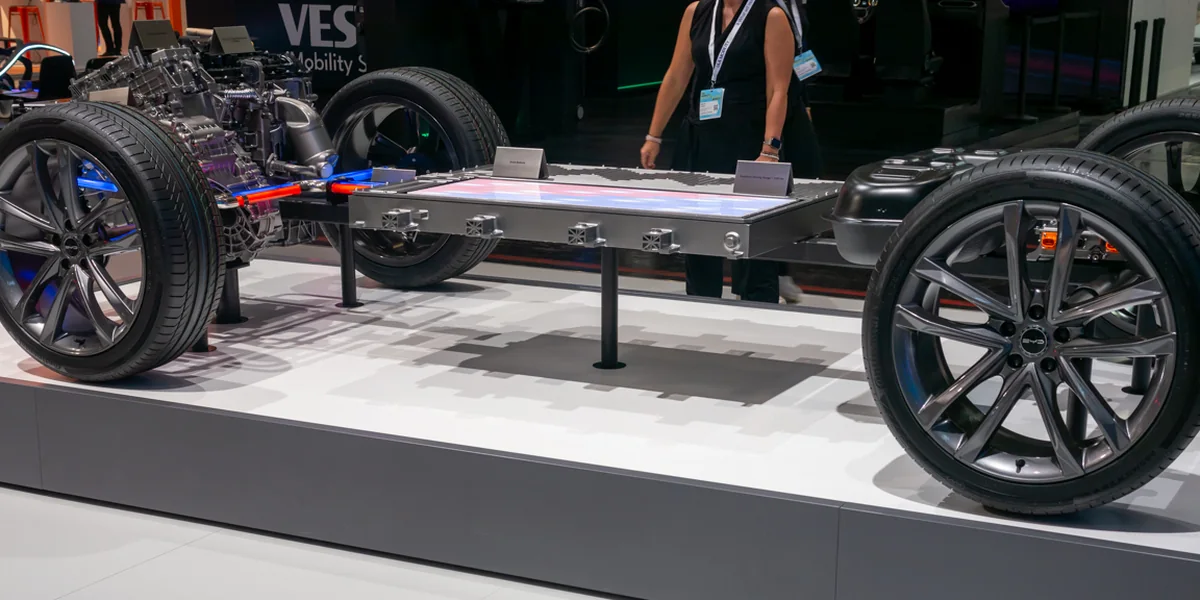
Which EVs Use LFP Batteries?
In the US, a short and specific list — here it is with dates, plus how to check a car you own.
- Ford Mustang Mach-E Standard Range — LFP (CATL cells) since May 2023: 72–73 kWh usable, 250–260 miles EPA in rear-wheel drive. The Extended Range cars remain nickel-chemistry. This is the best-selling LFP car in America, and the one most often missing from lists like this.
- 2027 Chevrolet Bolt — 65 kWh LFP in a cell-to-pack layout, GM’s first US LFP car. (Note what is not on this list: the Equinox EV runs GM’s nickel-based Ultium NCMA pack — several sites, this one included until now, have wrongly listed it as LFP.)
- Rivian R1 Standard (Gen 2) — 92.5 kWh LFP, up to 270 miles EPA-estimated, plus an LFP Rivian Commercial Van for fleets. Rivian’s lineup changes by model year, so check the current configurator before relying on this entry.
- Tesla Model 3 Rear-Wheel Drive, 2022–2024 — the CATL-LFP car (272 miles EPA) that started the US conversation. It was discontinued in October 2024 after tariffs on Chinese-made batteries rose, and as of today no new Tesla sold in the US has an LFP battery — the current Model Y Standard, despite the badge, runs a nickel (NCA) pack.
How do I know if my car has an LFP battery?
Tesla puts it on the car’s screen; Ford hides it in the VIN.
In a Tesla: Controls → Software → Additional Vehicle Information — an LFP car states “High Voltage Battery type: Lithium Iron Phosphate”. In a Mach-E: check the eighth character of the VIN — 4 or 5 indicates the LFP standard-range pack. The answer matters because it changes your charging rule: LFP cars follow the charge-to-100% guidance above; nickel cars follow the 80%-for-daily-use guidance on our NMC chemistry page.
Where Did LFP Come From?
Published in 1997, blocked for a decade by one flaw, and carried to market by Chinese makers while the West chased nickel.
LiFePO₄ was reported as a cathode material in 1997 by Padhi, Nanjundaswamy and John Goodenough’s group at the University of Texas (Goodenough would share the 2019 Nobel Prize for lithium-ion work). The material had a crippling flaw: it barely conducts electricity. The fix that unlocked it — shrinking the particles and carbon-coating them — came from Michel Armand’s circle at Hydro-Québec and the Université de Montréal, with a parallel doping route from MIT’s Yet-Ming Chiang that became A123 Systems.
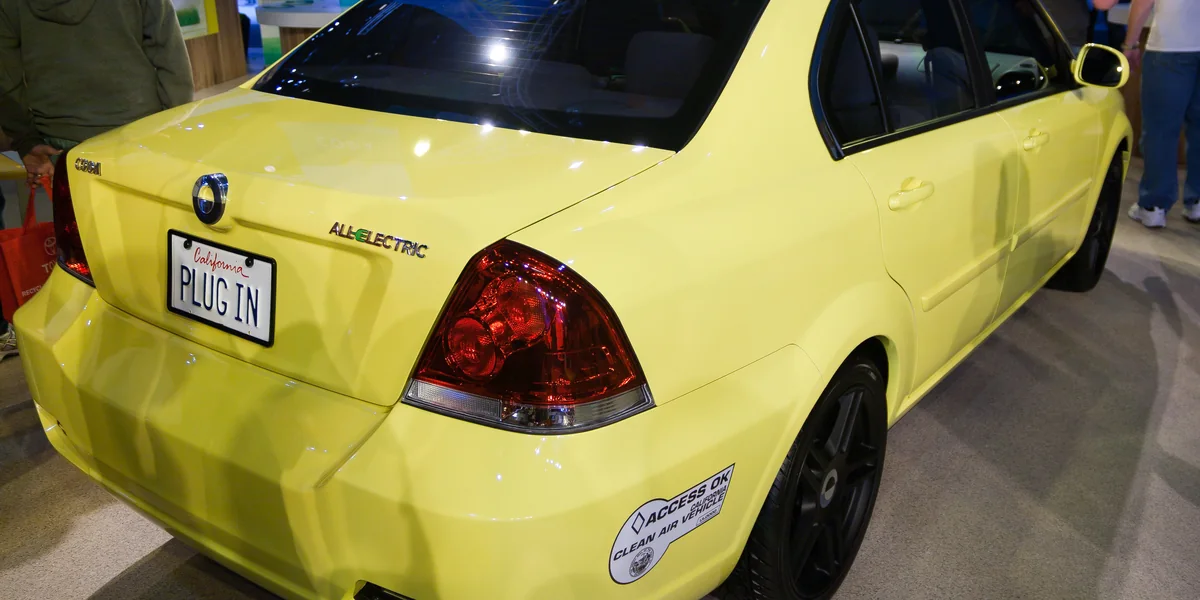
Western carmakers then largely walked away, judging the energy density too low, while Chinese makers — above all BYD, an LFP specialist from its battery days — kept improving it for buses, storage and eventually cars. America’s early taste was small cars like the CODA pictured above. The chemistry’s takeover waited for two things: cell-to-pack packaging (the Blade, above) and the industry’s post-2021 cost shock, which made a cathode of iron and phosphate look very smart indeed.
Why Is LFP Winning?
Cost first, lifespan second, and a supply chain with no nickel or cobalt bottlenecks.
The numbers frame it plainly: BloombergNEF’s 2025 survey puts LFP packs at $81/kWh against $128 for NMC; the IEA counts LFP at nearly 50% of global EV battery deployment in 2024 and over 55% in 2025. But read that as a global figure — the same IEA data puts LFP at only about 5% of North American car battery capacity, because US standard-range lineups are fewer and Chinese-cell tariffs bite. The growth story is real; its American chapter is simply earlier and shorter than the global one, which is exactly why the dated car list above matters more than the headline share.
What Is Next: LMFP
The industry’s answer to LFP’s one weakness is to add manganese — promising, shipping in China, not yet in a US car.
LMFP swaps part of the iron for manganese, lifting the cell voltage toward a claimed ~3.8 V platform and the energy density with it — cathode makers put the theoretical gain at 15–20% over LFP. Gotion’s L600 LMFP cell claims 240 Wh/kg (a company claim, treat it as one); CATL’s M3P is a related manganese-phosphate system that CATL itself says is not plain LMFP. Our LMFP battery chemistry explainer tracks the detail. The honest status for US buyers: no LMFP car is on sale here yet — it is the chemistry to watch, not the one to shop for today.
Frequently Asked Questions
What does LFP stand for?
Lithium iron phosphate — LiFePO₄, the cathode material. The F is iron’s chemical symbol, Fe. On a home battery charger, an “LFP” mode simply means the voltage profile for this chemistry (3.2 V cells, ~3.65 V full) rather than for lead-acid or nickel-based lithium cells.
Is LFP a lithium-ion battery?
Yes. LFP is one family within lithium-ion, alongside NMC and NCA. All of them shuttle lithium ions between a graphite anode and a metal-based cathode; they differ in what that cathode is made of.
Does an LFP battery contain cobalt or nickel?
No — that is one of its defining advantages. The cathode is lithium, iron and phosphate. An LFP pack does still contain lithium (about 0.08 kg per kWh), copper in the anode foil, aluminium, graphite and steel — “cobalt-free” does not mean metal-free.
How long does an LFP battery last?
On cycle life, 2,000–5,000+ full charge cycles is the defensible band — roughly two to three times an NMC pack’s 1,000–2,500. In a car driven typical US miles, the pack’s cycle budget usually outlasts the vehicle around it; calendar aging, not cycling, becomes the limit.
Can an LFP battery catch fire?
Yes, under severe damage, overcharge or extreme heat — but it is substantially harder to push into thermal runaway. Its runaway onset is around 270°C against roughly 150–210°C for NMC variants, and its cathode does not release oxygen to feed a fire. Safer, not fireproof.
Should I charge my LFP car to 100%?
If your car is an LFP model, follow Tesla’s published guidance for its LFP cars: keep the charge limit at 100% and fully charge at least once a week, so the range gauge can recalibrate. Nickel-chemistry cars follow the opposite rule — around 80% for daily use.
Why does my LFP car’s range estimate jump around?
Because LFP’s voltage barely changes between about 20% and 80% charge, the battery computer estimates the level instead of measuring it, and the estimate drifts. A full 100% charge re-anchors it — the practical reason behind the weekly full-charge advice.
Is LFP worse in winter than other batteries?
Somewhat. All EVs keep only about 78% of their maximum range at 32°F and about 70% at 20°F (Recurrent fleet data); LFP cars typically lose a few points more and, more noticeably, DC fast-charge more slowly until the pack warms. Preconditioning while plugged in is the main fix.
Which US cars have LFP batteries today?
The Ford Mustang Mach-E Standard Range (since May 2023), the 2027 Chevrolet Bolt, and Rivian’s standard-range models. The LFP Tesla Model 3 was discontinued in the US in October 2024, and no current US Tesla uses LFP — the full dated list is in the section above.
Conclusion
LFP is what happens when a battery chemistry optimises for cost, lifespan and safety instead of maximum energy — and the market has voted for it at global scale.
Its compromises are real and specific: a heavier pack, a drifting fuel gauge, and slower charging on a frozen morning. Its advantages are equally specific: no cobalt or nickel, two to three times the cycle life, a thermal threshold nickel chemistries cannot match, and a price gap of roughly $2,700 a pack. For the growing list of standard-range cars that carry it in the US, that trade is not a compromise at all — it is the point.
