
What Are the Downsides of NCA Batteries?

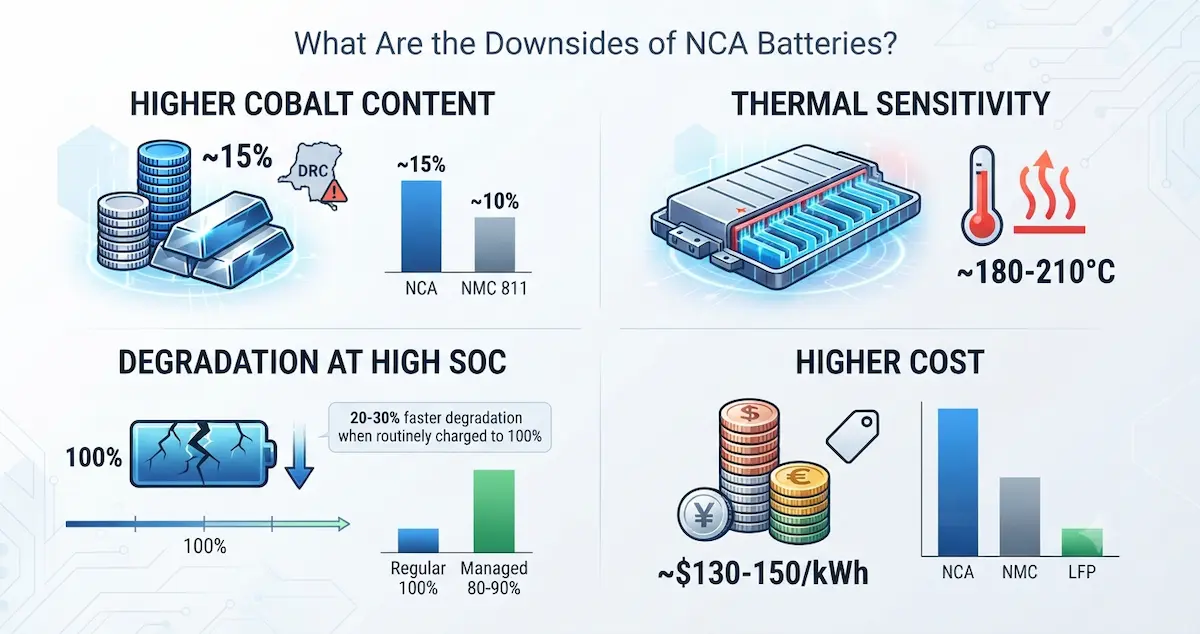
NCA batteries offer outstanding energy density — but they come with four significant downsides: higher cobalt dependence, greater thermal sensitivity, faster degradation at high states of charge, and higher cost than both NMC and LFP. These limitations explain why NCA remains a niche chemistry used primarily by Tesla via Panasonic, while most other automakers have chosen NMC 811 or LFP for their EV batteries.
New to NCA itself? Start with our full explainer on what NCA battery chemistry is in electric vehicles.
Downside 1: Higher Cobalt Content
NCA contains approximately 15% cobalt by cathode metal weight — higher than NMC 811’s ~10%. Cobalt costs $30–40/kg in 2025 (with historical highs above $90,000/metric ton), ~70% comes from the DRC with associated ethical concerns, and its price is highly volatile. While both NCA and NMC depend on cobalt, NCA’s higher cobalt fraction makes it more expensive and more exposed to supply chain disruptions. NMC 811 reduces this exposure; LFP eliminates it entirely.
Downside 2: Thermal Sensitivity
NCA’s thermal runaway onset temperature is approximately 180–210°C — at the lower end of NMC’s range (~200–210°C) and significantly below LFP (~270°C). The aluminum in the cathode provides some structural stabilization, but NCA’s high nickel content (~80–85%) makes it reactive at elevated temperatures. This requires more aggressive liquid cooling than either NMC or LFP to maintain safe operating temperatures during high-power charging and discharging.
Downside 3: Degradation at High State of Charge
NCA degrades significantly faster when regularly held at high states of charge (above 80–90%). Research indicates that NCA batteries degrade approximately 20–30% faster when routinely charged to 100% vs 80–90%. Tesla owners with NCA-equipped vehicles (Model S, Model X, and many US Model 3/Y LR) are advised to set daily charging limits to 80–90% to preserve battery life. This charging discipline is more important for NCA than for standard NMC — and the opposite of LFP guidance.
Downside 4: Higher Cost
NCA cells are more expensive to manufacture than NMC cells at comparable energy density, for two reasons:
- Higher cobalt content increases raw material cost vs NMC 811
- More demanding manufacturing process — NCA cells require strict atmosphere control during synthesis and are more sensitive to moisture during production than NMC
Pack costs for NCA cells are estimated at $130–150/kWh — at the higher end of premium cell chemistry costs, above NMC 811’s ~$128/kWh average and well above LFP’s ~$81/kWh.
See the full head-to-head against NMC’s aluminum-free approach in our guide on NCA vs NMC battery: key differences.
NCA Disadvantages vs Other Chemistries
| Disadvantage | NCA | NMC 811 | LFP |
|---|---|---|---|
| Cobalt content | ~15% (highest) | ~10% | Zero |
| Thermal runaway onset | ~180–210°C (lowest) | ~200–210°C | ~270°C (safest) |
| Daily charge limit | 80–90% | 80–90% | 100% (recommended) |
| Cycle life | 1,000–2,000 (shorter) | 1,000–2,500 | 2,000–5,000+ |
| Cost per kWh | $130–150 (highest) | ~$128 | ~$81 (cheapest) |
| Supplier diversity | Very limited (primarily Panasonic) | Broad (CATL, LG, SK, Samsung) | Broad (CATL, BYD) |
Frequently Asked Questions
What are the downsides of NCA batteries?
NCA’s four main downsides are: higher cobalt content (~15%) vs NMC 811’s ~10%; lower thermal runaway onset (~180–210°C) requiring aggressive liquid cooling; faster degradation when regularly charged above 80–90% SoC; and higher manufacturing cost ($130–150/kWh). Its supply chain is also narrower — primarily dependent on Panasonic as the main manufacturer.
Is NCA battery worse than NMC?
NCA is not categorically “worse” — it has higher energy density than NMC 811. But NCA has more cobalt, slightly lower thermal stability, and narrower supplier diversity. For automakers choosing between NCA and NMC 811 for a new platform, NMC 811’s combination of comparable density, lower cobalt content, and broader supply chain makes it the more practical choice — which explains why virtually every automaker except Tesla has standardized on NMC rather than NCA.
Can NCA batteries be charged to 100%?
Tesla recommends limiting daily NCA charging to 80–90%. Charging to 100% is acceptable before long road trips but should not be a daily habit. NCA degrades 20–30% faster when regularly held at full charge due to the high voltage stress on the cathode structure. This is the same guidance as NMC — the opposite of LFP, which can be charged to 100% daily without significant degradation.
Conclusion
NCA’s exceptional energy density makes it ideal for maximum-range applications — but its higher cobalt content, thermal sensitivity, degradation at high SoC, and cost represent real limitations. These downsides explain why no major automaker beyond Tesla has adopted NCA at scale, and why Tesla itself is transitioning toward NMC (4680 cells) and LFP (Standard Range models). NCA served Tesla well as a range-leadership chemistry — but the broader EV industry found that NMC 811 delivered nearly equivalent range with a more practical balance of cost, cobalt exposure, and manufacturing accessibility.
Curious how NCA compares directly to the safest, cheapest mainstream chemistry? See our range comparison of LFP vs NCA: which has more range.
