
What Is Lithium Manganese Oxide (LMO) Battery Chemistry?

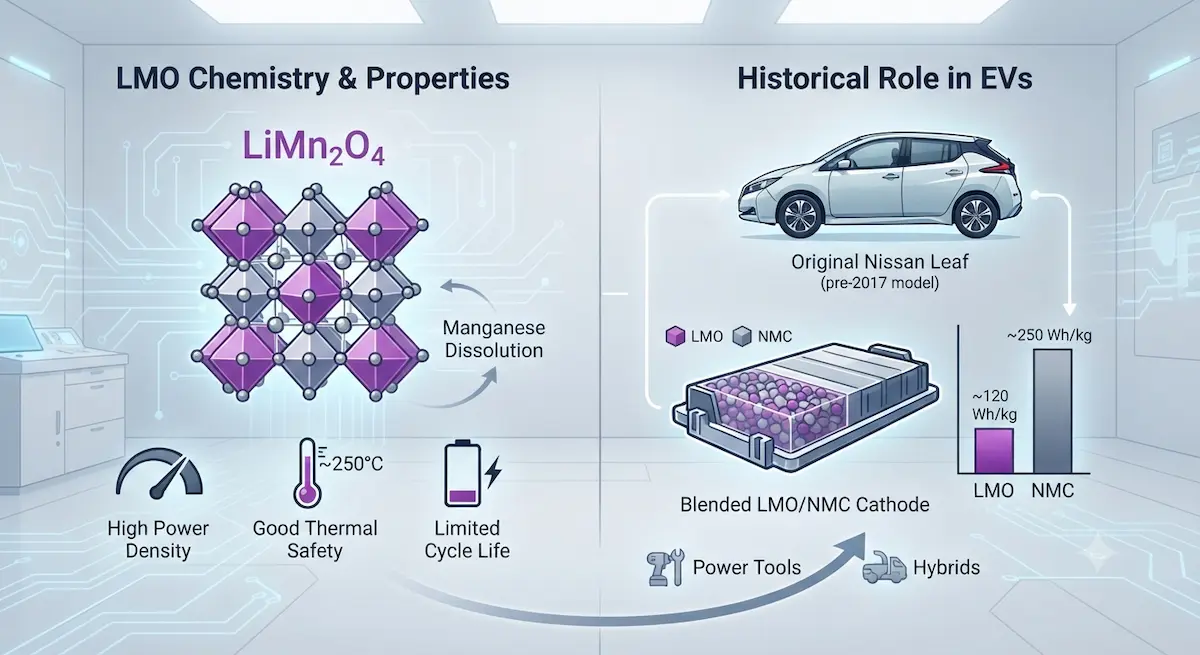
LMO (Lithium Manganese Oxide) uses a spinel crystal structure cathode with the formula LiMn₂O₄. It was one of the earliest EV battery chemistries — used in the original Nissan Leaf (in blend with NMC) and early Mitsubishi i-MiEV. LMO is cheap, thermally stable, and delivers high power — but its cycle life and energy density are significantly lower than NMC or LFP. Today, LMO is largely obsolete as a standalone EV chemistry, though it persists in blended cathode formulations and some specialized applications.
LMO Battery Key Properties
| Property | LMO Value |
|---|---|
| Cathode formula | LiMn₂O₄ (spinel structure) |
| Cell voltage | ~3.8–4.0V |
| Energy density | ~100–150 Wh/kg |
| Cycle life | ~300–700 cycles (to 80%) |
| Thermal runaway onset | ~250°C (good safety) |
| Power density | High — good for high-rate discharge |
| Manganese dissolution | Yes — accelerates at high temperatures |
| Primary use today | Blended cathodes, power tools, some hybrids |
Why LMO Was Used in Early EVs
LMO’s spinel structure allows lithium ions to move in three dimensions — enabling high power output (fast charge and discharge rates). Combined with manganese’s thermal stability (~250°C) and very low cost, LMO was attractive for early EVs where power delivery was important and cycle life requirements were not yet fully defined. The original Nissan Leaf used a blended LMO/NMC cathode in its 2011–2016 models — combining LMO’s power with NMC’s energy density.
Why LMO Lost to NMC and LFP
LMO has two fundamental weaknesses that limited its EV future:
- Manganese dissolution: Mn²⁺ ions dissolve from the spinel structure into the electrolyte at elevated temperatures — migrating to the anode and causing permanent capacity loss. This is why LMO EVs in hot climates degraded faster than in cool climates. Temperature above 50°C dramatically accelerates this dissolution.
- Low cycle life: 300–700 cycles to 80% capacity — far below NMC’s 1,000–2,500 or LFP’s 2,000–5,000+. Even at modest driving rates, LMO packs would show significant degradation within 5–8 years.
LMO Today: Blended Cathodes
While standalone LMO is obsolete for mainstream EVs, it persists in blended cathode formulations. Combining LMO with NMC or NCA cathode materials in the same cell creates a hybrid cathode that captures LMO’s high power capability while NMC/NCA provides energy density and cycle life. This blending approach was used by early Nissan Leaf and Mitsubishi EV models and is still used in some power tools, electric motorcycles, and hybrid vehicle applications where power density is prioritized over energy density.
Frequently Asked Questions
What is LMO battery chemistry?
LMO (Lithium Manganese Oxide) is a lithium-ion battery chemistry using a spinel-structure LiMn₂O₄ cathode. It offers high power density and good thermal safety (~250°C), but poor cycle life (300–700 cycles) and moderate energy density (~100–150 Wh/kg) due to manganese dissolution. It was used in early EVs like the original Nissan Leaf but has largely been replaced by NMC and LFP in modern vehicles.
Does any current EV use LMO batteries?
Mainstream new EVs do not use standalone LMO. Some older used EVs (pre-2017 Nissan Leaf, early Mitsubishi i-MiEV) used blended LMO/NMC cathodes. LMO continues in niche applications — some hybrid vehicle sub-packs, power tools, and electric motorcycles — where high power density and cost matter more than cycle life.
Conclusion
LMO battery chemistry played an important role in early EV development — its manganese-based spinel structure offered thermal safety and high power at low cost. But manganese dissolution at elevated temperatures and short cycle life (300–700 cycles) made it unsuitable for modern EVs requiring 150,000+ mile durability. Today, LMO exists primarily in blended cathode formulations and specialty applications. For mainstream EVs, NMC and LFP have fully replaced LMO as the chemistries of choice.
