
What Causes Electrolyte Breakdown in EV Batteries?

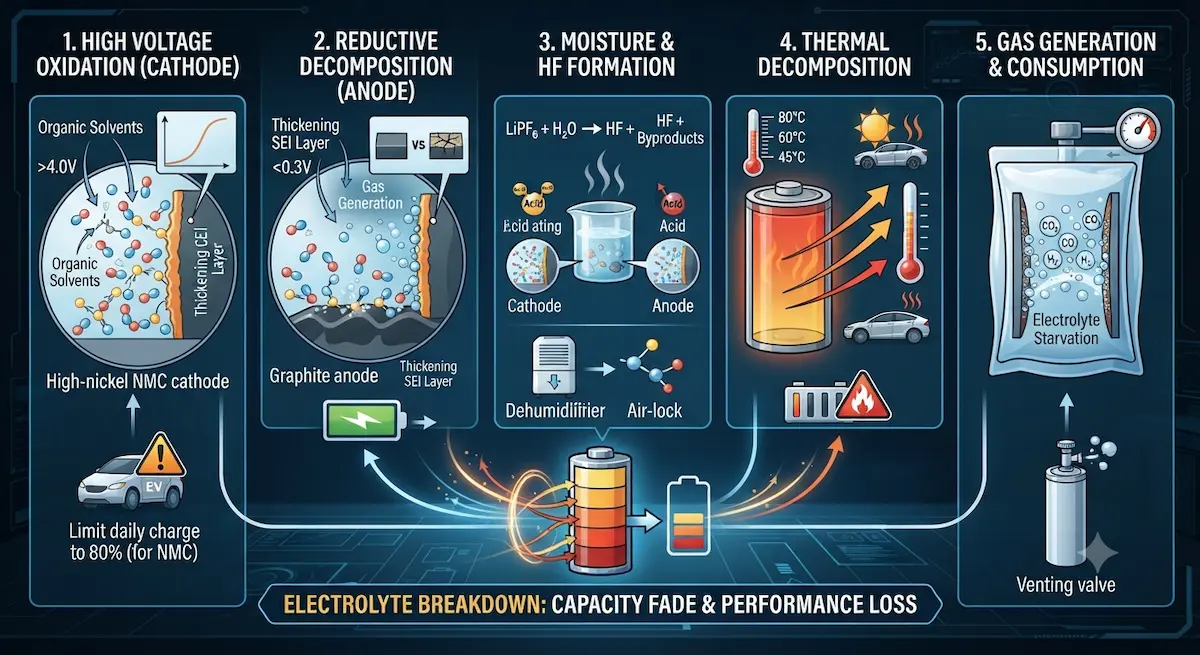
Electrolyte breakdown in EV batteries is one of the primary mechanisms of capacity fade and performance loss over time. The liquid electrolyte — a solution of LiPF₆ in organic carbonate solvents — is chemically unstable under the extreme electrochemical conditions inside a battery cell. It undergoes multiple degradation reactions simultaneously, consuming electrolyte, forming resistive films on electrodes, and generating gases that increase cell pressure. Understanding what causes electrolyte breakdown helps EV owners adopt charging and storage habits that dramatically slow these reactions— significantly extending battery life.
In its most severe form, this breakdown can create the conditions for a much more dangerous failure — see our explainer on what lithium dendrite growth is and why it’s dangerous.
The Five Main Causes of Electrolyte Breakdown
1. High Voltage Oxidation at the Cathode
At the cathode surface — particularly at high states of charge where cathode potential exceeds 4.0V vs Li/Li⁺ — the organic carbonate solvents are thermodynamically unstable and undergo oxidative decomposition. This reaction produces insoluble organic and inorganic compounds that deposit on the cathode surface, forming the Cathode-Electrolyte Interface (CEI) layer. A thin, stable CEI is actually beneficial — it protects the cathode surface from further electrolyte attack, similar to how the SEI protects the anode. But over hundreds to thousands of cycles, the CEI thickens progressively, increasing cell impedance and reducing how fast lithium ions can move in and out of the cathode. High-nickel NMC 811 cathodes are particularly susceptible — their higher operating potential and more reactive surface accelerate CEI growth compared to LFP or lower-nickel NMC formulations.
The practical implication for EV owners: limiting daily charging to 80–90% state of charge (for NMC batteries) keeps the cathode at a lower voltage, significantly slowing CEI oxidation and the associated electrolyte decomposition. Research published in 2023 found that NMC cells aged 20–30% faster when routinely held at 100% SoC vs 80% — primarily due to accelerated CEI growth from high-voltage electrolyte oxidation.
2. Reductive Decomposition at the Anode (SEI Formation and Growth)
The graphite anode operates at very low electrochemical potential (~0.05–0.3V vs Li/Li⁺) — below the thermodynamic stability window of most organic electrolyte solvents. The electrolyte is thermodynamically unstable at these low potentials and will spontaneously react. During the very first charge cycles, this reaction forms the Solid Electrolyte Interphase (SEI) — a thin, mixed organic/inorganic film on the anode surface. The SEI layer subsequently passivates the anode surface, preventing further bulk electrolyte decomposition. Once the SEI is established, lithium ions can still pass through it, but the flammable solvent cannot reach the graphite surface directly.
The problem is that the SEI is never perfectly stable. Small amounts of lithium and electrolyte are consumed in maintaining and gradually thickening the SEI with each charge cycle. This slow, continuous SEI growth is responsible for the gradual capacity fade all lithium-ion batteries exhibit over their lifetime — even under ideal conditions. Electrolyte additives like vinylene carbonate (VC) and fluoroethylene carbonate (FEC) improve SEI quality — forming thinner, more uniform, and more stable SEI layers that thicken more slowly, directly extending cycle life.
3. Moisture and HF Formation
LiPF₆ — the standard lithium salt — is extremely sensitive to trace moisture. Even at parts-per-million (ppm) water levels, LiPF₆ undergoes hydrolysis:
LiPF₆ + H₂O → LiF + POF₃ + HF
Hydrofluoric acid (HF) is highly corrosive — it attacks cathode active material surfaces, dissolves transition metals (particularly manganese from NMC), and degrades the SEI on the anode. Dissolved manganese then migrates to the anode and deposits there, further disrupting the SEI. This moisture-driven degradation cascade can rapidly accelerate cell aging. Battery manufacturers control moisture in their production environments to extremely low levels (often below 1 ppm water in air) — the reason EV battery gigafactories use enormous dehumidification systems and strict air quality control in all electrode and cell assembly areas. Despite these controls, trace moisture always finds its way in, making some level of HF-driven degradation inevitable over cell lifetime.
4. Thermal Decomposition at Elevated Temperature
Organic carbonate solvents become chemically reactive at elevated temperatures — with decomposition rates increasing exponentially with temperature following Arrhenius kinetics. Above approximately 45°C, the rate of all electrolyte decomposition reactions accelerates significantly. Above 60°C, decomposition is rapid and practically measurable within hours of exposure. At temperatures above 80°C, the electrolyte begins to vaporize, and above 90–120°C, the combination of electrolyte vapor and oxygen (from cathode decomposition in NMC cells) creates a thermal runaway fire risk.
For EV owners, the practical message is clear: parking in direct sun on a hot summer day (where the interior of a car can reach 70–80°C and the battery pack can reach 45–55°C even with passive cooling) meaningfully accelerates electrolyte decomposition and battery aging. Tesla’s data from hot climate regions (Arizona, Texas) shows meaningfully faster degradation than equivalent vehicles in temperate climates, primarily due to sustained elevated temperature electrolyte decomposition.
5. Gas Generation and Electrolyte Consumption
Electrolyte decomposition reactions generate gaseous byproducts — primarily CO₂, CO, H₂, CH₄, C₂H₄, and other organic fragments. In sealed cells, these gases accumulate in the cell’s headspace, increasing internal pressure. In cylindrical cells, a venting mechanism releases gas (and electrolyte vapor) at a defined pressure threshold — visible as “cell gassing” during end-of-life or overcharge events. In pouch cells, gas buildup causes the pouch to swell — a phenomenon EV owners sometimes report as the battery pack appearing puffy or losing its original profile. Gas generation also consumes electrolyte, reducing the liquid volume available for ion transport and further accelerating cell degradation as electrolyte starvation increases.
Cold-weather charging brings its own distinct anode-side risk — see our explainer on what causes lithium plating in EV batteries.
Summary: What Accelerates Electrolyte Breakdown
| Factor | Effect on Electrolyte | EV Owner Action |
|---|---|---|
| High SoC (90–100%) for NMC | Accelerates cathode-side oxidation (CEI growth) | Limit daily charging to 80–90% |
| High temperature (>40°C) | Exponentially increases all decomposition rates | Park in shade; avoid hot climates at high SoC |
| Frequent ultra-fast charging | Generates more heat; higher current → more SEI damage | Use fast charging occasionally, not daily |
| Moisture ingress | LiPF₆ hydrolysis → HF → cathode attack | Manufacturer controlled; not driver-controllable |
| Low temperature charging | Lithium plating damages SEI irreversibly | Precondition battery before cold-weather fast charging |
| Deep discharge (<5% SoC) | Copper current collector dissolution begins | Avoid regularly depleting below 10% |
Frequently Asked Questions
What causes electrolyte breakdown in EV batteries?
Five main causes: high-voltage oxidation at the cathode surface (accelerated by charging to 100% SoC in NMC), reductive decomposition at the anode forming and slowly thickening the SEI layer, LiPF₆ hydrolysis from trace moisture generating HF that attacks electrodes, thermal decomposition at elevated temperatures above 40–60°C, and gas generation from accumulated side reactions that consumes electrolyte and pressurizes cells.
Can electrolyte breakdown be prevented?
Not completely — it is a thermodynamic inevitability given the operating conditions inside a lithium-ion cell. But it can be dramatically slowed through: limiting NMC charging to 80% daily, avoiding sustained operation above 40°C, using DC fast charging occasionally rather than routinely, avoiding regular deep discharges below 10%, and enabling battery preconditioning before cold-weather fast charging. Good habits can reduce electrolyte decomposition rates by 50% or more compared to abusive usage.
Does LFP suffer less from electrolyte breakdown than NMC?
Yes — for two reasons. LFP’s lower operating voltage (~3.65V max at 100% SoC vs NMC’s ~4.2V) reduces the thermodynamic driving force for cathode-side electrolyte oxidation — the CEI grows more slowly in LFP cells. Also, LFP can be charged to 100% daily without significant additional electrolyte stress because the lower voltage keeps cathode oxidation below the threshold where decomposition accelerates. NMC’s higher voltage makes full-charge electrolyte oxidation substantially more aggressive — the primary reason NMC owners are advised to limit daily charging to 80%.
Conclusion
Electrolyte breakdown in EV batteries is driven by five simultaneous degradation mechanisms — cathode oxidation, anode SEI growth, moisture-driven HF formation, thermal decomposition, and gas generation. These processes are thermodynamically inevitable but highly sensitive to operating conditions. Temperature and state of charge are the two factors most within an EV owner’s control — and managing both thoughtfully can reduce electrolyte decomposition rates by 50% or more, meaningfully extending battery life. For battery engineers, electrolyte formulation improvements — better additives, more stable salts, flame-retardant co-solvents — continue to push cycle life and operating temperature limits, making each new generation of EV batteries more durable and safer than the last.
High-nickel cathodes face an especially aggressive mechanical version of this stress — see our explainer on what cathode cracking is in high-nickel EV batteries.
