
EV Charging Connectors: NACS, CCS, J1772 & More

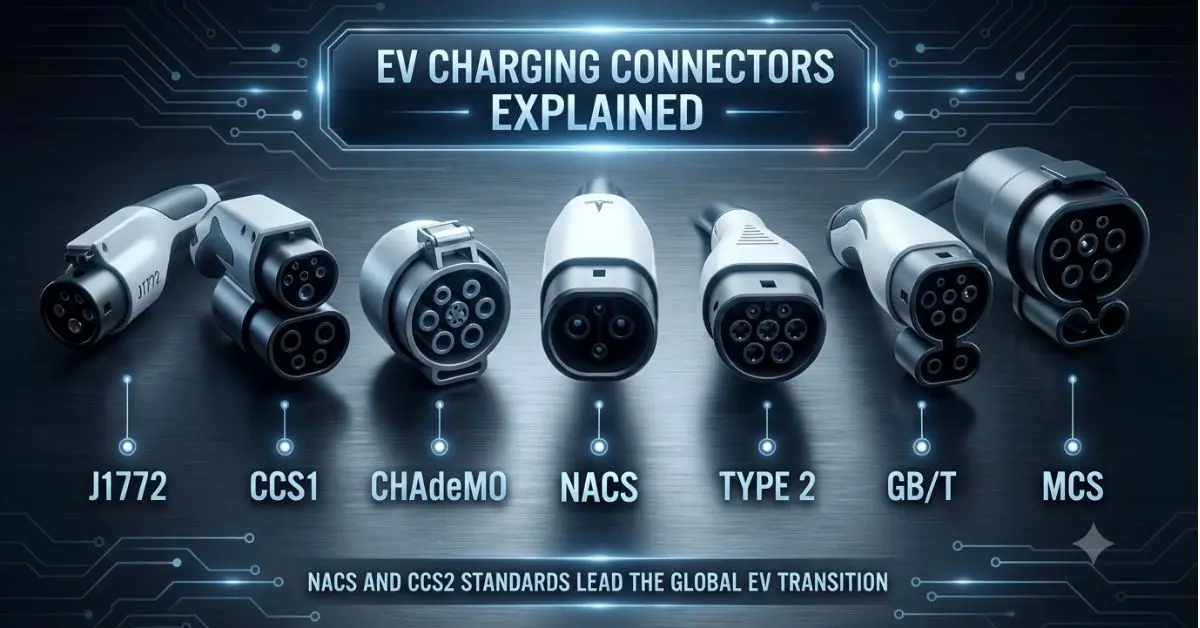
North America is mid-way through the biggest plug change since the EV went mainstream: the Tesla-style NACS plug is becoming the standard, while millions of cars on the road still use J1772 and CCS1. This guide lays out every connector you will actually meet — what it does, how fast it can charge, where it is used, and which one your car has.
In North America there are three plugs that matter: J1772 for AC charging (Level 1 and 2), CCS1 for DC fast charging, and NACS (SAE J3400) — the compact Tesla-designed plug that does both and is taking over from 2025. Europe uses Type 2 for AC and CCS2 for fast charging. Japan’s CHAdeMO is fading (one US model left), China uses its own GB/T plugs, and electric trucks are getting a megawatt plug called MCS.
Every EV charging connector at a glance
Seven connectors cover the whole world. This table is the whole guide in one screen — the sections below it explain each row.
| Connector | Type | Where | Max power | Found on |
|---|---|---|---|---|
| J1772 (Type 1) | AC, Level 1–2 | North America, Japan | 19.2 kW (80 A) | Almost every non-Tesla EV and PHEV (AC port) |
| NACS (SAE J3400) | AC + DC | North America | Up to 1 MW by design; adapters rated 500 A / 1,000 V | Tesla; most new EVs from 2025 |
| CCS1 | DC fast | North America, Korea | 350 kW class (500 A / 920 V); stations up to 500 kW | Most non-Tesla EVs built to ~2025 |
| Type 2 (Mennekes) | AC | Europe and most of the world | 43 kW max; 22 kW typical | European EVs (AC port) |
| CCS2 | DC fast | Europe and most of the world | Same 350 kW class as CCS1 | European-market EVs |
| CHAdeMO | DC fast | Japan; legacy worldwide | About 50 kW at US stations | Older Nissan Leaf; Mitsubishi Outlander PHEV |
| GB/T | AC + DC (two plugs) | China only | China’s own standard | Chinese-market EVs |
| MCS | DC, heavy-duty | Global (rolling out) | Up to 3.75 MW (1,250 V / 3,000 A) | Electric trucks and buses |
Two honest notes on the numbers. “Max power” is what the standard allows, not what your car will pull — most EVs charge well below their connector’s ceiling, and the car, not the plug, usually sets the speed. And for NACS, the 1 MW figure is Tesla’s design claim for the connector; the adapters and cars on sale today work at the 500-amp, 1,000-volt level.
The AC connectors: what you plug in at home and at work
AC charging is the everyday kind — slower, cheaper, and handled by the charger built into your car. Three plugs divide the world between them.
J1772 (Type 1): North America’s home plug
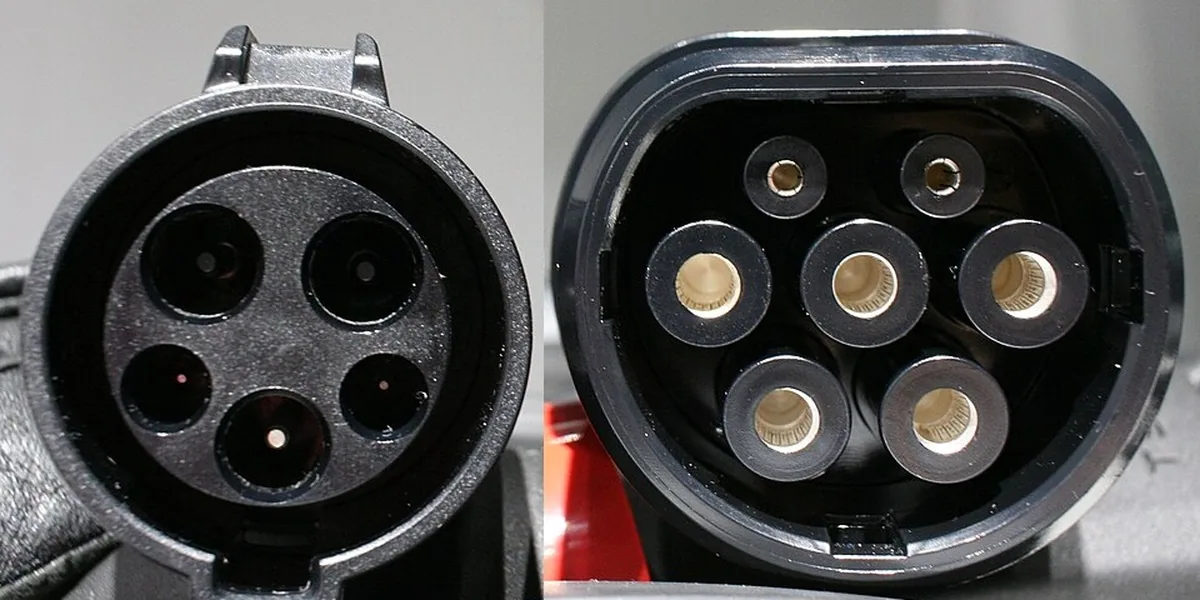
The five-pin J1772 is the AC standard for North America and Japan, covering Level 1 (120 V) and Level 2 (240 V). The standard allows up to 80 amps — 19.2 kW — though most home Level 2 charging runs at 30–48 amps (7.2–11.5 kW). If you drive any non-Tesla EV or plug-in hybrid in the US, this is the plug in your garage. It has one quirk owners notice: unlike Europe’s Type 2, it has no automatic lock, so the connector relies on the car’s own latch.
Type 2 (Mennekes): Europe’s seven-pin standard
Europe’s Type 2 carries seven pins and works on single-phase or three-phase power. Its ceiling is 43 kW at 63 amps three-phase, but the level you will actually meet at European public posts is 22 kW (32 amps three-phase), with home charging usually at 7.4 or 11 kW. Type 2 locks itself into the car while charging — a small thing you appreciate the first time you use it. Travelling the other way is covered in our guide to charging a US EV in Europe.
NACS on AC: one plug for everything
NACS uses the same two power pins for AC and DC, which is why the plug is so small next to a CCS1. At home it behaves like any Level 2 connector; the difference is that the same inlet also takes DC fast charging, so a NACS car needs one port where a CCS1 car effectively carries two plugs in one housing. Tesla cars have charged this way for years, and every Tesla ships with a J1772 adapter for public AC posts.
The DC fast-charging connectors
DC fast charging skips your car’s onboard charger and feeds the battery directly — which is why these plugs are bigger, heavier, and liquid-cooled at the top end.
CCS1 and CCS2: the combined plug
CCS takes the AC plug you already know and adds two large DC pins underneath it — CCS1 under a J1772 in North America, CCS2 under a Type 2 in Europe — so one inlet handles home and highway charging. Per CharIN, the standard’s classes top out at 500 amps and 920 volts (the “HPC 350” class); stations are installed at up to 500 kW, though most EVs today accept 200 kW or less. Above roughly 200 amps the cables are liquid-cooled, which is why the fastest chargers’ cables feel oddly stiff and heavy.
NACS (SAE J3400): the takeover, dated
Tesla opened its plug design to everyone in late 2022, and SAE turned it into a formal standard in two steps: a technical report (TIR) in December 2023, then the full J3400 Recommended Practice in September 2024. The cars followed: the 2025 Hyundai Ioniq 5 was the first non-Tesla vehicle sold with a factory-fitted NACS port, and even Nissan’s Leaf — the former CHAdeMO flagship — now ships with NACS built in. If you want the full head-to-head of how NACS compares with the plug it is replacing, our CCS vs NACS guide goes through it in depth; the short version is that the connector war in North America is over, and the transition will run on adapters for years.
CHAdeMO: the fading Japanese standard
CHAdeMO arrived before CCS and uses a completely separate round plug, so its cars carry two inlets — one for AC, one for DC. At US stations it delivers up to about 50 kW, well under what the modern versions of the specification allow on paper. Its installed base is ageing out: in the US the last vehicle still using it is the Mitsubishi Outlander PHEV, whose DC fast charging works only on CHAdeMO. Networks are not expanding it, and the plug’s own association has moved on to a next-generation design (ChaoJi) developed with China’s GB/T side.
GB/T: China’s own system
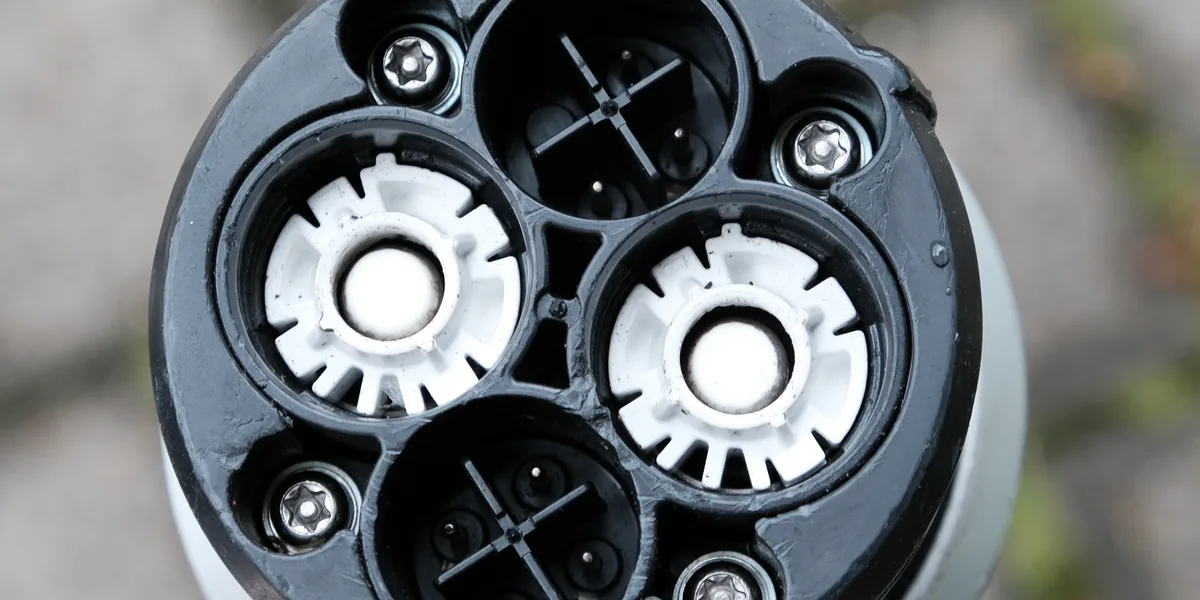
China uses neither CCS nor CHAdeMO. Its GB/T standard has separate AC and DC plugs that look deceptively like Type 2 but are wired in a different order and are not compatible with it. Unless you are importing a Chinese-market car, GB/T is the one connector on this page you will never meet — it is here because any honest world list has to include the largest EV market on Earth.
MCS: the megawatt plug for trucks
The Megawatt Charging System (SAE J3271) is a new, much larger connector built for electric trucks and buses, designed by the CharIN group. It starts around 440 kW and tops out at 3.75 MW with liquid cooling — power levels chosen so a long-haul truck can take on meaningful range inside a driver’s mandatory rest break. It will not fit a car, and no car will ever need it; its place in this guide is that it completes the map, from a 1.9 kW wall outlet to a plug that out-powers a small neighbourhood.
Which connector does your car use?
In North America the answer depends on the badge and the model year. Everywhere else, it depends on the region the car was built for.
- Tesla (North America): NACS, always. Europe: CCS2 (Model 3/Y) or a modified Type 2 (older S/X).
- Most US EVs from Ford, GM, Hyundai, Kia, Rivian and others built up to about 2024: J1772 for AC, CCS1 for DC.
- The same brands from 2025 onward: increasingly NACS from the factory, starting with the Hyundai Ioniq 5 and spreading model by model — check the specific car, because line-ups are mixed during the changeover.
- Nissan Leaf: CHAdeMO up to the old model; the new Leaf is NACS. Mitsubishi Outlander PHEV: CHAdeMO for DC.
- Europe: Type 2 + CCS2 on effectively everything. Japan: J1772-style AC with CHAdeMO DC on domestic models. China: GB/T only.
The networks behind these plugs matter as much as the plug itself — how the industry organises them is covered in our explainer on OCPP, and the countries that built charging out fastest are ranked in our charging-infrastructure guide.
Adapters: what exists, and what to avoid
Adapters are the bridge across the transition — but AC and DC adapters live by completely different rules.
AC adapters are simple and safe in both directions. J1772-to-NACS adapters (one comes with every Tesla) let a Tesla use public AC posts, and NACS-to-J1772 adapters let other cars use Tesla’s home and destination chargers; GM, for example, sells both kinds. These are low-power, pin-to-pin devices.
DC fast-charging adapters are a different animal, because they carry up to 500 amps. The rule the automakers themselves give is consistent: use your own maker’s approved adapter. Ford’s Fast Charging Adapter is rated at 500 amps and 1,000 volts and works only for DC (never AC); GM’s NACS DC Adapter costs $299; Rivian’s is $200 — and all three exist specifically so CCS1 cars can use NACS fast chargers, including Superchargers open to them.
CHAdeMO is the exception that proves the rule. There is no official CCS-to-CHAdeMO adapter: the two systems even talk different languages (CCS uses power-line communication, CHAdeMO uses a CAN bus). A bulky grey-market unit that translates between them does exist, but the CHAdeMO Association itself cautions against adapters it cannot certify, and Nissan offers none. Treat that as a no.
Frequently asked questions
Are CCS and J1772 the same?
They are two halves of one inlet. J1772 is the upper AC part; CCS1 adds the two big DC pins below it. A CCS1 car uses the J1772 section for home charging and the whole plug at a fast charger — same car, same port, two jobs.
Is J1772 going away?
Not for a long while. New cars are switching to NACS, but the J1772 fleet numbers in the millions and public AC posts are overwhelmingly J1772, so it will be served for many years. If you are buying a home charger today, either plug is a reasonable buy — adapters cover the gap in both directions at AC power.
Can I use a Tesla Supercharger with a CCS1 EV?
Yes, where Tesla has opened the station to other brands, and with your car maker’s approved NACS DC adapter (Ford, GM and Rivian all sell one). Stations with a built-in Magic Dock need no adapter. Not every Supercharger is open to non-Teslas, so check the Tesla app for your car before a trip.
Which EV charging connector is used in Europe?
Type 2 for AC charging and CCS2 for DC fast charging, on effectively every EV sold there. Tesla’s European cars use the same CCS2 inlet.
Conclusion
The connector map is simpler than it looks: one AC plug and one DC plug per region, a North American changeover under way, and a megawatt outlier for trucks.
Learn your own car’s two plugs and the adapter rule — maker’s own for DC, almost anything listed for AC — and you know everything this topic can demand of you until the NACS changeover finishes. The standards bodies have done their part; from here it is just fleet turnover.
