
Skip to content
EV Battery Guide
  • Home
  • EV Battery BlogExpand
    • Solid-State Batteries
    • Battery Basics
    • Brand Specific Batteries
    • Chemistry
    • EV Charging
    • Lithium-Ion Batteries
  • EV CalculatorsExpand
    • Home Charging Cost Calculator
    • EV Charging Time Calculator
    • EV vs Gas Cost Calculator
    • US EV Tax Credit Eligibility Checker
    • Best EV Finder Quiz
  • Car Calculators
  • EV News
EV Battery Guide

What to Do If You Run Out of Charge on the Road

Written bySherjeel Sajid 02/11/202609/09/2026
Home / EV Charging / What to Do If You Run Out of Charge on the Road
Can You Tow an EV to a Charging Station Written by Sherjeel Sajid 11072026 Home EV Charging Can You Tow an EV to a Charging Station Most EVs cannot be towed to a charging station with two wheels on the road — they must be transported on a flatbed with all four wheels off the ground. Towing an EV with the drive wheels rolling can damage the electric motor, regenerative braking system, and transmission components on many models. The correct procedure is a flatbed tow truck, not a tow dolly or traditional tow with a hook. Here is everything you need to know about towing an EV to a charging station safely. Why Most EVs Cannot Be Conventionally Towed Traditional gas cars can be towed with two wheels on the ground because their wheels spin freely in neutral. In most EVs, putting the car in “neutral” still keeps the drive motor physically connected to the wheels through the single-speed reduction gear. Rolling the drive wheels activates the motor as a generator — creating back-EMF that can cause electrical damage to the motor and inverter if sustained at speed or for long distances. Some EVs specifically warn in their owner’s manual that conventional towing causes irreversible damage. Which EVs Can Be Towed (Limited Distance) EV Towing Method Allowed Max Speed Distance Notes Tesla Model SX3Y Flatbed only (all 4 wheels off ground) NA for conventional tow Transport mode available in infotainment Hyundai Ioniq 56 Flatbed only (standard); conditional tow at very low speed Check owner’s manual Some models allow slow tow short distances Chevy Bolt EV Flatbed only NA No tow mode available Ford F-150 Lightning Flatbed strongly recommended Very short distances only in neutral Check owner’s manual — some models have transport mode Rivian R1TR1S Flatbed only NA Dual motor means no safe conventional tow The Correct Way to Tow an EV Flatbed A flatbed tow truck (also called a rollback) is the correct vehicle for transporting a depleted EV. The car’s wheels are completely off the road surface — no rolling occurs and no motor damage risk exists. Request a flatbed specifically when calling roadside assistance for an EV. Standard tow hooks (“hook and chain” or “wheel lift”) that drag or roll any EV wheels are inappropriate for most EVs and should be refused. Tell the dispatcher you have an EV and need a flatbed — most roadside providers now have this in their dispatch protocols. How to Put an EV in Transport Mode Many EVs include a Transport Mode (sometimes called Tow Mode) that configures the vehicle for flatbed loading. In Transport Mode, the electric parking brake releases, steering is unlocked, and the car rolls freely for loading onto the flatbed. Access Transport Mode through the car’s touchscreen — typically under Settings → Safety or Settings → Service. Tesla’s Transport Mode is activated through the touchscreen and requires the car to have sufficient 12V auxiliary battery power. If the 12V battery is also depleted (which can happen if the main battery runs to true 0%), contact the manufacturer’s roadside team for special procedures. What If Only a Tow Dolly Is Available If only a tow dolly is available (lifts front two wheels only, rear wheels roll on ground), this is safe for front-wheel-drive EVs where the rear wheels are undriven — the rear wheels rolling do not spin the motor. For rear-wheel-drive or AWD EVs, even a tow dolly can cause motor damage. Check your owner’s manual specifically — it will state which wheel combination (if any) can safely roll during towing. When in doubt, insist on a flatbed and wait for the correct vehicle rather than risk motor damage from improper towing. Roadside Assistance Coverage for EV Towing AAA Now includes flatbed EV towing in most regions — specify “electric vehicle” and “need a flatbed” when calling; mileage limits apply based on your membership tier Manufacturer roadside assistance Tesla, Hyundai, Kia, Ford, and most brands include complimentary roadside assistance for new vehicles — covers flatbed towing to the nearest dealer or charger for battery-related breakdowns Auto insurance roadside Many comprehensive auto insurance policies include roadside assistance with towing — check your policy’s mileage limits for towing coverage Credit card benefits Some premium credit cards (Chase Sapphire, American Express Platinum) include roadside assistance that covers towing — check your card’s benefits guide Conclusion Yes, you can tow an EV to a charging station — but only on a flatbed with all four wheels off the ground for most models. Conventional towing with wheels rolling risks motor and drivetrain damage on most EVs. Always request a flatbed specifically when calling roadside assistance, activate Transport Mode if available, and confirm your owner’s manual’s specific towing instructions for your model. Preventing the need for towing entirely through careful range planning is always the better outcome — but if it happens, a flatbed to the nearest DC fast charger is the safe, standard, and correct solution.

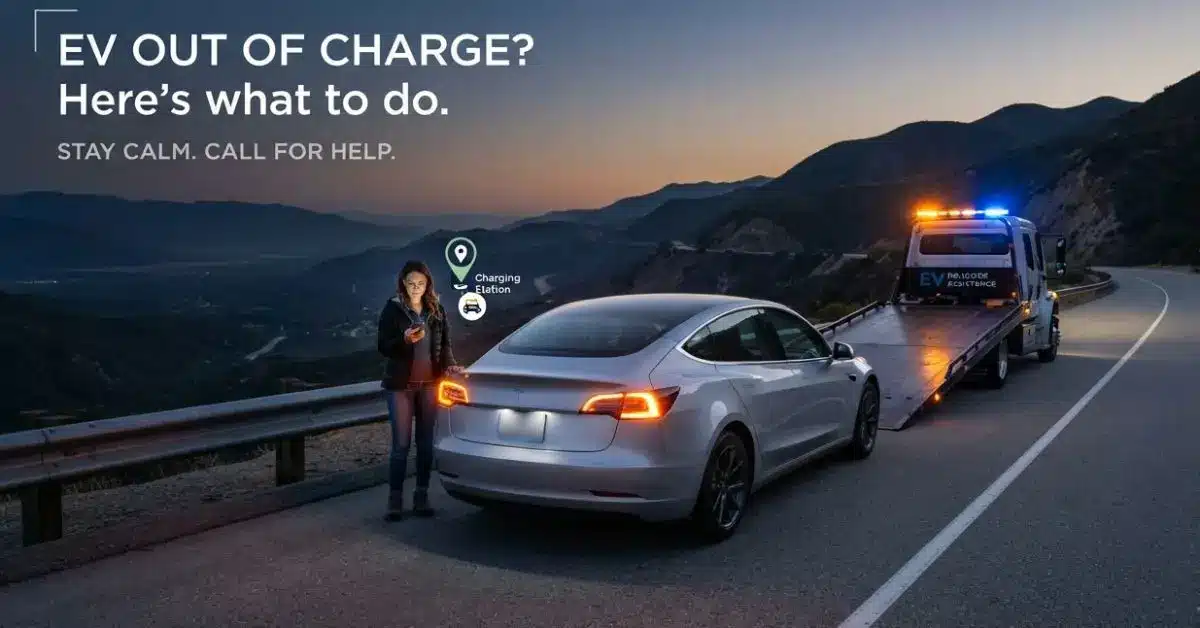
If you run out of charge in an EV, your first step is to safely pull off the road, turn on hazard lights, and call roadside assistance. Unlike running out of gas, an EV that reaches 0% cannot be quickly topped up from a portable container — you need either a mobile charging unit, a flatbed tow to a nearby charger, or in some cases a Level 1 connection to add enough range to reach a charging station. Running completely out of charge is rare with proper planning — but here is exactly what to do if it happens.

Table of Contents
  • Immediate Steps When Your EV Runs Out of Charge
  • What Roadside Assistance Can Do
  • The EV "Reserve" Battery: Not Truly Zero
  • Can You Push an EV or Put It in Neutral?
  • How to Prevent Running Out of Charge
  • Conclusion
  • Related Guides

Immediate Steps When Your EV Runs Out of Charge

  • Step 1 — Stay calm and pull over safely: EVs give multiple range warnings before reaching 0% — you will have time to safely exit traffic. Activate hazard lights immediately when pulling over
  • Step 2 — Call roadside assistance: Your car manufacturer’s roadside assistance number is in the owner’s manual and usually accessible through the car’s infotainment touchscreen. AAA, your car insurance roadside programme, and most EV brands include mobile charging or flatbed towing as standard coverage
  • Step 3 — Identify the nearest charger: Open PlugShare or Google Maps while waiting — knowing the nearest charger’s location helps the roadside assistance team plan the fastest solution
  • Step 4 — Unlock the charging port: Make the car accessible for the roadside assistance team before they arrive — confirm the charging port cover can be opened (some open via the touchscreen or key fob even with a depleted battery through the 12V auxiliary system)

What Roadside Assistance Can Do

OptionWhat It ProvidesTime to HelpAvailability
Mobile Level 2 charging unitAdds 10–20 miles in 30–60 min from a mobile generator30–90 min arrivalSome AAA regions, some manufacturer roadside teams
Flatbed tow to chargerTransports car to nearest charger30–90 min arrivalMost roadside assistance providers
Tesla Roadside AssistanceRange Assistance service provides mobile charge in some areasVaries by locationTesla owners only; not universal
Police / highway patrolCan help keep you safe while waiting; cannot charge your EVMinutesAlways available

The EV “Reserve” Battery: Not Truly Zero

Most EVs maintain a small hidden reserve below the displayed 0% — typically 3–8% of actual battery capacity. When the display shows 0% range remaining, you may have 5–20 miles of actual remaining range depending on your EV model and conditions. Tesla keeps approximately 3–5 miles in reserve below 0 miles displayed. Hyundai Ioniq 5 keeps approximately 5–8% reserve. This buffer is specifically to help you limp to a charger rather than stopping immediately at the “0 miles” warning. Drive slowly, avoid hills, turn off climate control, and use this reserve to reach safety or a charging point.

Can You Push an EV or Put It in Neutral?

Most EVs cannot be safely pushed or rolled in neutral with a fully depleted battery — the electric parking brake and steering may not function without 12V power. Some EVs allow a neutral mode for towing, but this varies by model and requires specific procedures in the owner’s manual. Never attempt to push an EV onto a flatbed without first confirming the correct procedure with your roadside assistance provider and owner’s manual. Most EVs specify they must be transported on a flatbed with all four wheels off the ground — not tow-dolly or towing with two wheels on the road.

How to Prevent Running Out of Charge

  • Never plan to arrive at a charger with less than 10–15% SoC: Always leave a comfortable buffer — range estimates become less predictable at very low SoC, especially in cold weather or at highway speeds
  • Use ABRP for road trips: A Better Routeplanner accounts for real-world efficiency at your specific speed, weather, and elevation — far more accurate than the car’s built-in range estimate for long journeys
  • Set a personal low-SoC alert: Most EV apps allow alerts at specific battery levels — set an alert at 20% SoC to prompt you to start looking for a charger
  • Slow down when range gets low: Aerodynamic drag drops dramatically at lower speeds — slowing from 75 mph to 60 mph typically increases remaining range by 20–25%

Conclusion

Running out of charge in an EV is rare — every EV provides extensive low-battery warnings well before reaching 0%. If it does happen, pull over safely, activate hazards, call roadside assistance (flatbed to a charger is the most reliable solution), and use PlugShare to identify the nearest charging station for the tow destination. The most important prevention is planning: use ABRP for road trips, never plan to arrive at a charger with less than 10% buffer, and treat the 15% SoC warning as your cue to find the next charger — not a suggestion to push on.

Related Guides

  • Explore more guides in this category
  • Ccs Vs Nacs
  • Best Ev Charging Habits To Extend Battery Life
  • Maximum Ev Charging Speed
  • Which Evs Support Bidirectional Charging
Sherjeel Sajid

Written by Sherjeel Sajid — working in supervision at a battery manufacturing company, with 15 years of hands-on experience, holding a D.A.E. in Chemical Engineering, and still working in the same role.

Facebook

Post navigation

Previous Previous
How to Charge an EV If You Live in an Apartment
NextContinue
What Is a Hybrid Car

Latest Posts

  • BMW Opens US Battery Plant in Woodruff to Power the American-Built iX5
  • QuantumScape’s Osprey Cell Is Fully Solid-State — and It Ran 1,000 Cycles at Just 1 Atmosphere
  • Lithium-Ion Battery Chemistry: How It Works in EVs
  • What Are Cathode and Anode Materials in EV Batteries?
  • Is NMC Battery Safe? Risks and Thermal Stability

Table of Contents
  • Immediate Steps When Your EV Runs Out of Charge
  • What Roadside Assistance Can Do
  • The EV "Reserve" Battery: Not Truly Zero
  • Can You Push an EV or Put It in Neutral?
  • How to Prevent Running Out of Charge
  • Conclusion
  • Related Guides

About Us

I've spent 15 years working in EV battery manufacturing and servicing. This site covers everything US EV owners need to know — how batteries work, degrade, charge, and what replacement actually costs.

Quick Links

  • About Us
  • Contact Us
  • Privacy Policy
  • Disclaimer

Visit Our Pages

Facebook Linkedin Pinterest Instagram X YouTube

© 2026 EV Battery Guide

  • Home
  • EV Battery Blog
    • Solid-State Batteries
    • Battery Basics
    • Brand Specific Batteries
    • Chemistry
    • EV Charging
    • Lithium-Ion Batteries
  • EV Calculators
    • Home Charging Cost Calculator
    • EV Charging Time Calculator
    • EV vs Gas Cost Calculator
    • US EV Tax Credit Eligibility Checker
    • Best EV Finder Quiz
  • Car Calculators
  • EV News