
What Is a Distributed BMS Architecture?

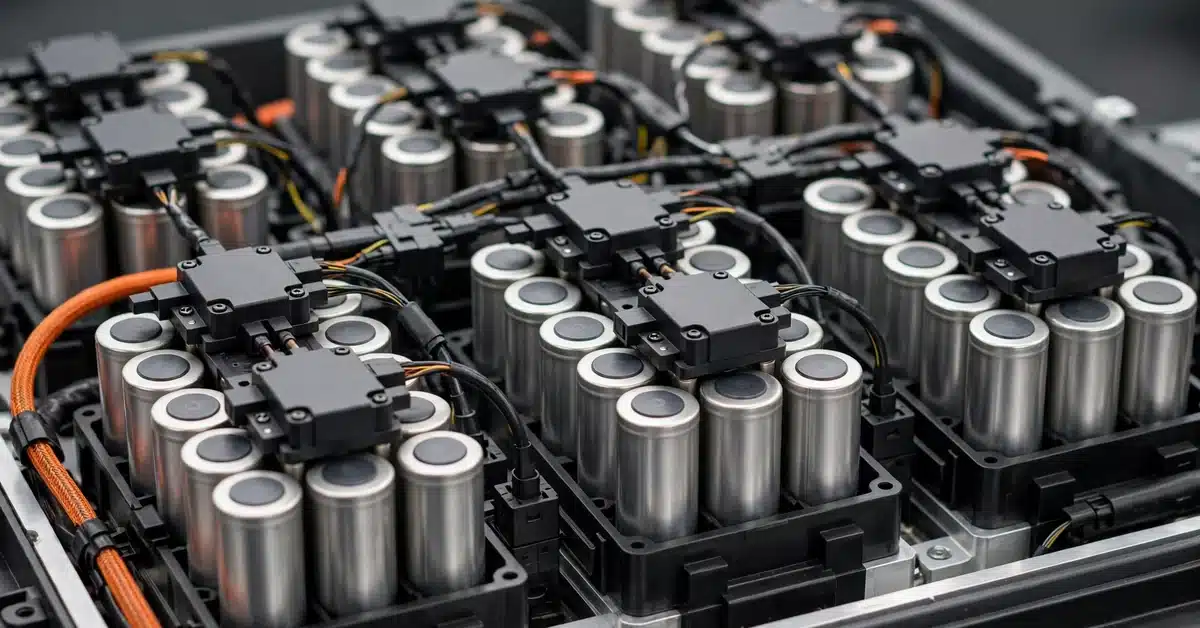
A distributed BMS architecture uses multiple controllers positioned across specific modules or cell groups, each handling local monitoring, while coordinating with the rest of the pack, rather than routing every measurement back to one central board. It trades some simplicity for meaningfully better scalability and fault tolerance in large EV packs.
How a Distributed BMS Is Physically Built
Rather than one central control board wired to every cell, a distributed system places smaller controllers, often called battery monitoring units, directly on or near each module. These local units handle voltage and temperature sensing for their specific section, then communicate that data to the rest of the system over a shared communication bus.
Why Large EV Packs Favor Distributed Design
Reduced Wiring Complexity
Since each local controller only needs short wiring to its own nearby cells, the long, bulky wiring harnesses required by centralized designs are largely eliminated, a significant advantage as pack size and cell count grow.
Better Scalability
Adding more cells or modules to a distributed system generally means adding more local monitoring nodes, rather than redesigning a single central controller’s wiring and processing capacity to handle the increased load.
Improved Fault Tolerance and Redundancy
If one local controller fails, it doesn’t necessarily compromise monitoring across the entire pack, since other modules continue operating with their own local units. This built-in redundancy is a meaningful safety advantage in large, high-voltage EV applications.
More Precise Local Thermal and Balancing Control
Because each module has its own dedicated monitoring, distributed architecture can achieve more precise, localized temperature regulation and balancing response than a single centralized controller managing the whole pack at once.
The Tradeoffs of Distributed Design
Higher Cost
More individual controllers and more sophisticated communication infrastructure between them increase the overall bill of materials compared to a simple centralized design.
Communication Protocol Complexity
Coordinating multiple independent controllers requires a well-defined, reliable communication protocol between them, adding design and validation complexity that a single-controller centralized system doesn’t face.
Real-World Example
Distributed BMS topology is used in production EVs, including designs where individual controllers manage each battery module independently, improving both efficiency and safety through precise module-level management rather than a single point of centralized control.
| Strength | Tradeoff |
|---|---|
| Reduced wiring complexity | Higher overall component cost |
| Better scalability for large packs | More complex communication protocol needed |
| Improved fault tolerance/redundancy | More design and validation effort |
Conclusion
A distributed BMS architecture spreads monitoring and control across multiple local controllers rather than a single central unit, offering better scalability, reduced wiring complexity, and improved fault tolerance for large EV battery packs. The added cost and communication complexity are the tradeoff for a design that handles the scale and safety demands of modern EV battery packs more effectively than centralized architecture.
FAQs
Is distributed BMS more expensive than centralized?
Yes, generally, due to the additional controllers and communication infrastructure required.
Why do most large EVs use distributed rather than centralized BMS?
Scalability, reduced wiring complexity, and fault tolerance make distributed architecture better suited to large, high-voltage packs.
Can a single module failure in a distributed BMS affect the whole pack?
It’s less likely than in centralized designs, since other modules’ local controllers continue operating independently.
