
What Is a Master-Slave BMS Configuration?

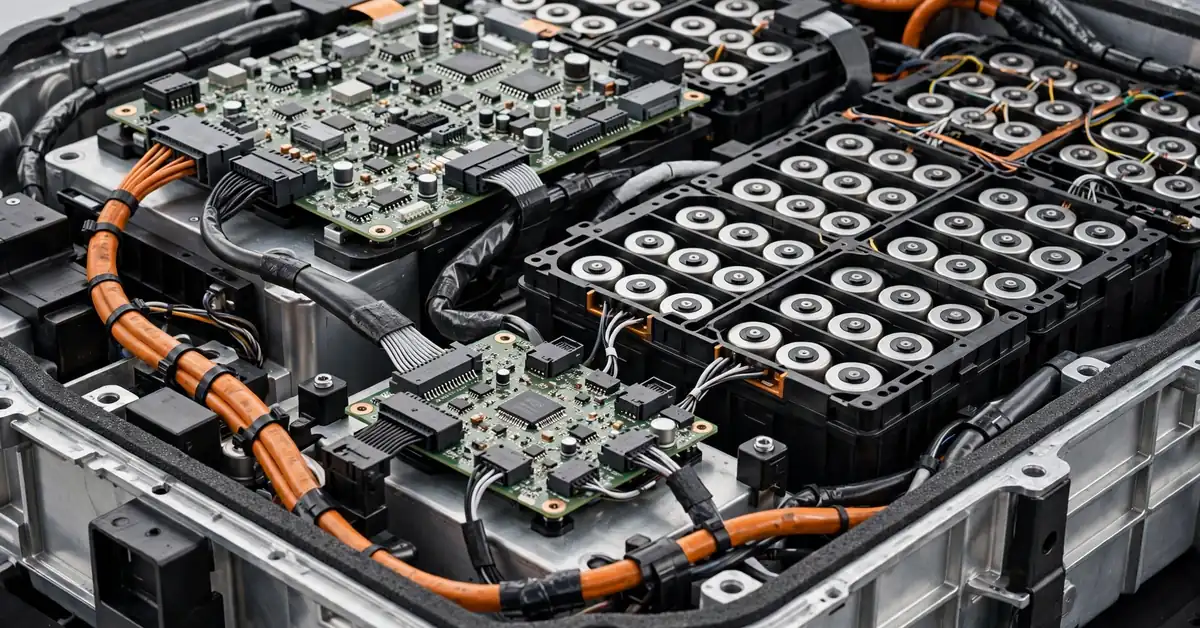
A master-slave BMS configuration splits responsibilities between one master controller that handles core calculations and decision-making, and multiple slave modules that simply collect and report local voltage and temperature data. It’s a deliberate middle ground, combining the cost benefits of centralized logic with some of the scalability of distributed hardware.
How Master-Slave Splits the Work
Rather than every module having its own fully independent, decision-making BMS, or one central controller wired directly to every cell, master-slave architecture divides the job cleanly: slave modules gather raw data, and the master controller does the thinking.
What the Slave Modules Actually Do
Slave modules are kept intentionally simple. Their job is limited to collecting voltage and temperature readings from their local cells and transmitting that data up to the master controller, without performing complex calculations or making protection decisions themselves. This simplicity keeps slave module hardware inexpensive.
What the Master Controller Actually Does
The master controller receives data from every slave module and handles the heavier computational work: state-of-charge and state-of-health estimation, balancing decisions, fault detection, and communication with the rest of the vehicle. Centralizing this decision-making logic in one place, rather than duplicating it across every module, keeps overall system complexity more manageable.
Why This Split Makes Practical Sense
Cost Efficiency
Because slave modules don’t need to handle complex decision-making, their hardware and software requirements are minimal, keeping per-module cost low even as the number of modules scales up.
Concentrated, Manageable Complexity
Rather than spreading sophisticated logic across many independent modules, master-slave design lets the master controller focus on complex calculations in one place, simplifying development, testing, and validation of that critical logic.
Reasonable Scalability
Adding more cells or modules to a master-slave system generally means adding more low-cost slave units reporting to the same master, offering better scalability than a fully centralized design without the full cost and complexity of a fully distributed one.
Where Master-Slave Fits Best
This architecture suits applications that are cost-sensitive but still need meaningful scalability, a middle ground between small centralized systems and large, fully distributed EV battery packs. It’s a natural fit where budget matters but the pack is too large or complex for a purely centralized design to handle comfortably.
The Tradeoff Worth Knowing
Because slave modules don’t make decisions independently, a communication failure between a slave and the master can leave that section of the pack without active management until communication is restored, a different kind of vulnerability than the redundancy offered by fully distributed architecture where each module can operate more independently.
| Component | Role |
|---|---|
| Master controller | SOC/SOH calculations, balancing decisions, external communication |
| Slave modules | Collect and report local voltage/temperature data only |
Conclusion
A master-slave BMS configuration divides responsibilities between a single decision-making master controller and multiple simple, low-cost slave modules that handle local data collection. This split delivers a practical middle ground between centralized simplicity and distributed scalability, making it a common choice for applications that need to scale reasonably without taking on the full cost and complexity of a fully distributed system.
FAQs
Is master-slave the same as distributed BMS?
They’re related but distinct — distributed architecture typically gives each module more independent decision-making capability, while master-slave keeps decision-making centralized in the master.
What happens if a slave module loses communication with the master?
That section of the pack may lack active management until communication is restored, since slave modules don’t make protection decisions independently.
Is master-slave architecture cost-effective for large battery packs?
Yes, it’s often chosen specifically for cost-sensitive applications that still need to scale beyond what a purely centralized design handles well.
