
What Is High Voltage Interlock (HVIL) in EV BMS?

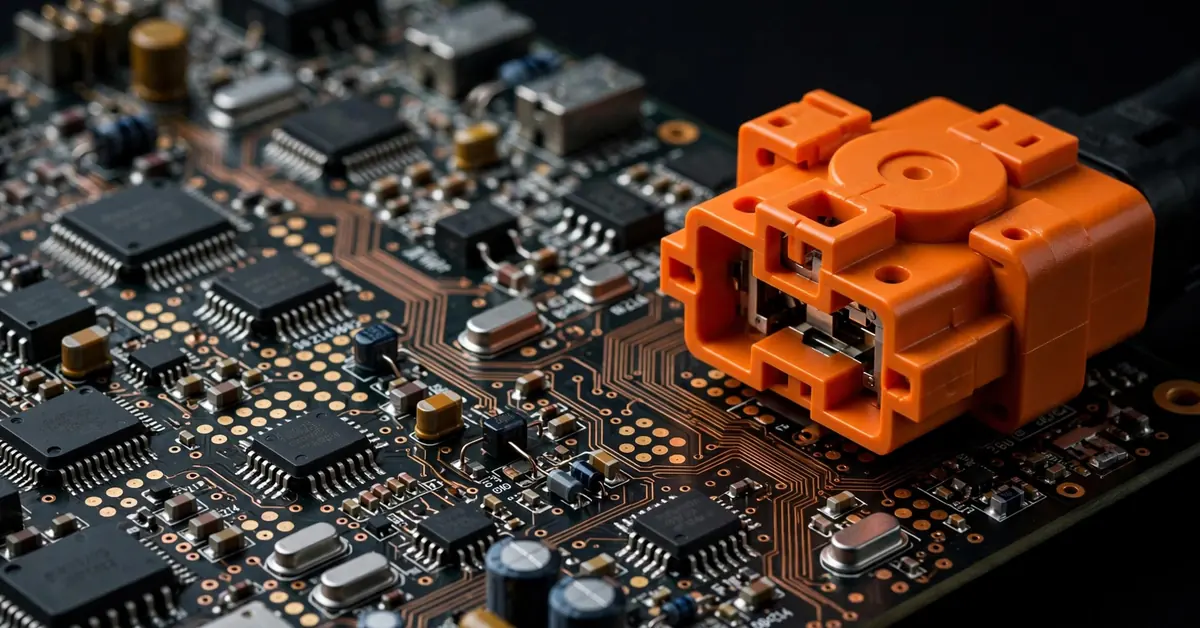
High Voltage Interlock (HVIL) in an EV BMS is a low-voltage safety loop, typically around 12V, that runs in series through every high-voltage connector and component in the vehicle, verifying everything is properly connected before the BMS will allow high-voltage contactors to close. If any connector loosens or a protective cover is removed, HVIL opens the loop and the BMS immediately cuts high-voltage power.
Why HVIL Exists as a Dedicated Safety System
Automotive high-voltage systems, typically anything above 60V, carry genuine risk of injury if a technician or occupant makes contact with an exposed live connection. HVIL exists specifically to guarantee the high-voltage system can never energize unless every connector and protective cover is verified to be properly and completely secured.
The Clever Physical Design Behind HVIL
Every high-voltage connector on the vehicle contains two types of contacts: large, main power pins that carry propulsion current, and smaller, physically shorter HVIL auxiliary pins. This height difference is deliberate. When a connector is plugged in, the long power pins make contact first, and the shorter HVIL pins connect last, only after the power connection is fully seated. When a connector is unplugged, the sequence reverses, the HVIL pins disconnect first, immediately signaling an open loop before the power pins ever separate.
How the Loop Is Actually Monitored
The BMS (or in some designs, the vehicle control unit) applies a small, constant low-voltage signal, often around 12V at roughly 20mA, through the entire loop, which runs in series through the battery pack, motor controller, onboard charger, DC-DC converter, and every major high-voltage connector. Some implementations use a PWM waveform specifically because it can more effectively identify short circuits to ground or power compared to simple voltage detection.
What Happens When the Loop Opens
If any connector loosens, a protective cover is removed, or a cable is damaged anywhere along the loop, the circuit opens, and the BMS or VCU immediately commands the main contactors to open, cutting high-voltage power. The fault typically must be physically resolved, the connector properly reseated or the damage repaired, before the system will allow contactors to close again.
Why This Sequencing Prevents Arcing and Injury
By ensuring contactors only close after HVIL confirms every connector is fully seated, and open the instant any connector begins to separate, the system prevents arcing across partially connected contacts and ensures technicians or occupants can never contact a live high-voltage connection during normal connection or disconnection.
Single-Loop vs Multi-Loop HVIL Designs
Some vehicles use a single interlock circuit running through all high-voltage components in series, while others use multiple parallel loops, which can improve fault location accuracy by identifying which specific section of the system has a problem rather than just knowing the overall loop is open somewhere.
| HVIL Element | Function |
|---|---|
| Low-voltage monitoring signal | Continuously verifies loop integrity |
| Long HV power pins / short HVIL pins | Ensures proper connection sequencing |
| Contactor control | Prevents energizing until loop confirms all connections secure |
Conclusion
High Voltage Interlock is a dedicated low-voltage safety loop running through every high-voltage connector in an EV, verifying complete, secure connections before the BMS allows contactors to close, and cutting power immediately if any connection is compromised. This physically clever design, using sequenced pin contact and continuous loop monitoring, is a fundamental safety barrier protecting anyone who might otherwise contact a live high-voltage connection.
FAQs
What happens if I get an HVIL fault warning on my EV?
It typically means a high-voltage connector or protective cover isn’t fully secured; the vehicle likely needs inspection before the high-voltage system will re-energize.
Is HVIL itself a high-voltage circuit?
No, it’s a low-voltage monitoring circuit, typically around 12V, that runs alongside the high-voltage system specifically to monitor its integrity.
Can an HVIL fault occur while driving?
Yes, though the vehicle’s response may differ depending on whether it’s actively in drive versus at rest, sometimes issuing a warning rather than an immediate shutdown while moving.
